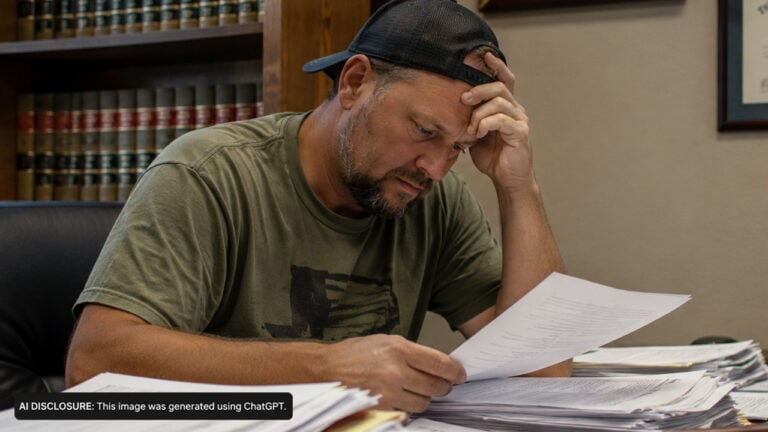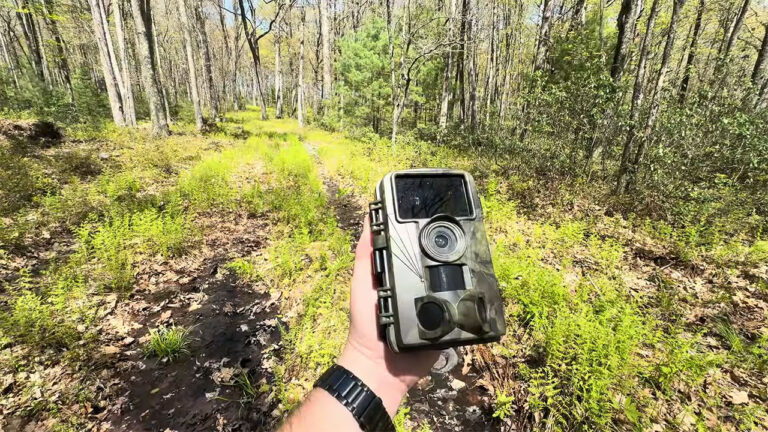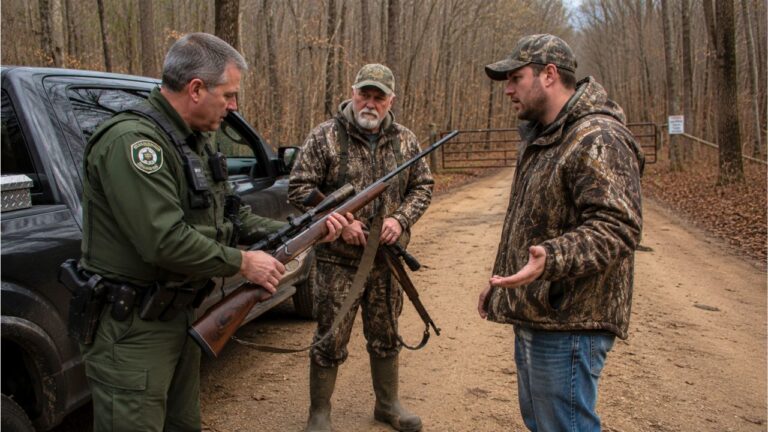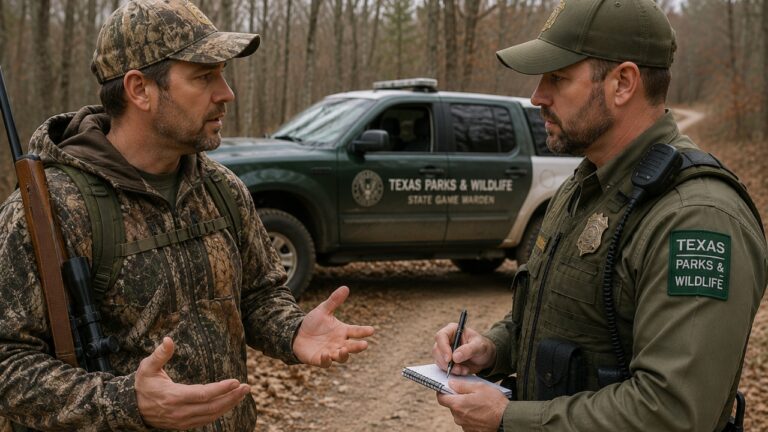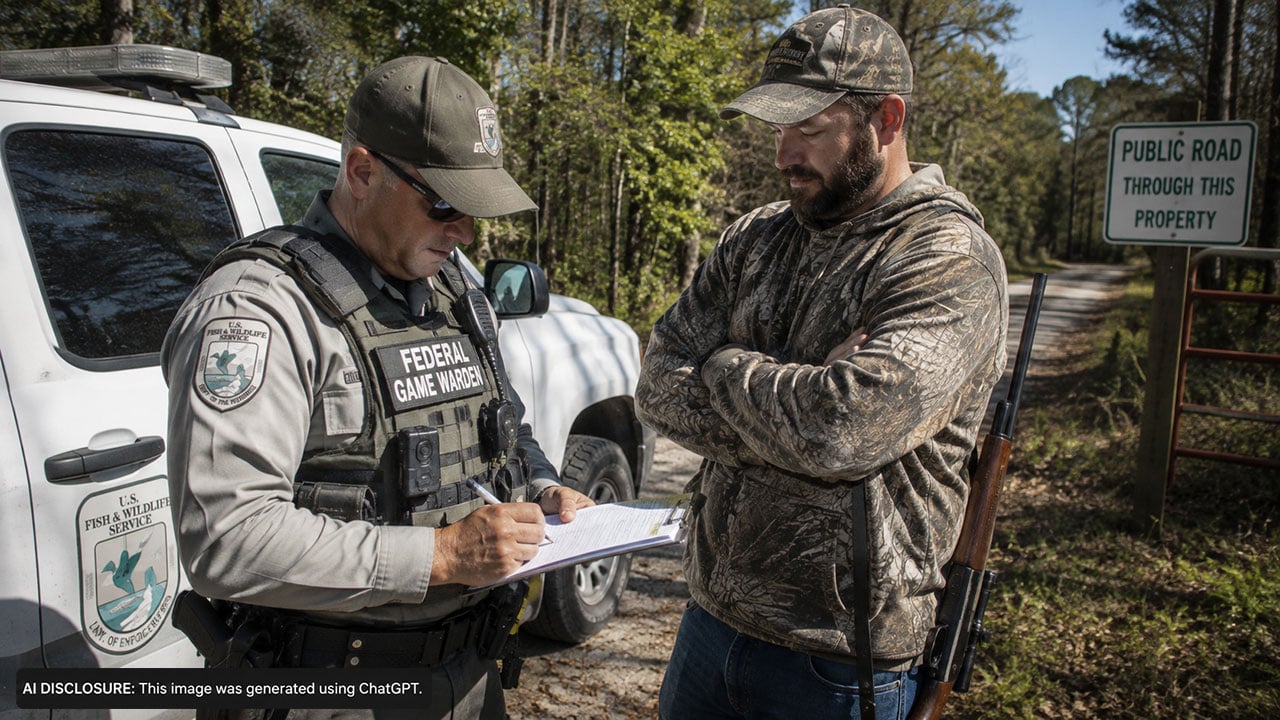
Photo credit: AI-generated image created using ChatGPT. Illustrative only
A trespassing ticket can feel pretty simple on paper: you were somewhere you weren’t supposed to be, and now you’ve got to answer for it. But when the “somewhere” is federal game management land, and the whole thing hinges on whether a road is public or not, it can get complicated in a hurry.
That’s exactly what a Louisiana family described in the source post, where a stepson was cited for trespassing on a federal game management area. According to the post, he decided to fight it because he believed the route he was on was a public road. About a month later, the situation reportedly escalated when the federal game warden started saying there was a gun in the vehicle—something the family says wasn’t mentioned the night of the stop.
How a “simple” trespass ticket turns into a bigger problem
Most hunters have been around enough check stations, WMA gates, and “Area Closed” signs to know that property boundaries can be messy. A gravel road might look like it’s been used forever, and it might even be used forever—but that doesn’t automatically make it public.
In the post, the stepson’s defense idea was straightforward: if it was a public road, then the trespass ticket shouldn’t stick. The catch is that on federal ground, the government may treat access rules, closures, and travel corridors differently than what locals assume. Even if a road is “public” in the sense that folks drive it, the legal status can be a different animal.
The charge shift that changed the tone
The part that makes outdoorsmen sit up and take notice is the timing. The family’s question was whether a federal game warden can change a charge a month later. In their telling, the stepson was initially charged with trespassing, and the driver also received a ticket for drug paraphernalia. Nothing was said about a gun at the time, according to the post.
Then later, as the trespass ticket was being fought, the warden reportedly brought up that there was a gun in the vehicle. Whether that turns into a separate citation, an added charge, or just a pressure point depends on details we don’t have here—but anyone who hunts knows how quickly “there was a firearm involved” can raise the stakes, especially on federally managed land.
Why the “public road” argument can be harder than it sounds
Hunters like clear lines: fence means fence, posted sign means posted sign. Roads don’t always work that way. A road can be maintained by a parish or county, it can cross federal property, or it can be an easement. It can also be closed to vehicle traffic even if it exists on a map.
If you’re going to fight a trespass allegation on the idea that a road is public, you better be ready to prove it with more than local knowledge. Maps, plats, right-of-way documentation, closure orders, and the specific regulations for that management area are what matter. Otherwise, it becomes one person’s understanding versus the officer’s interpretation, and that’s a rough spot to live in.
Firearms in vehicles: where hunters get tripped up
To a hunter, “a gun in the truck” can be the most normal thing in the world—especially if you’re scouting, checking cameras, running traps, or just driving home after a morning sit. But legality can depend on how the firearm is stored, whether it’s loaded, what season it is, and what the area’s regulations say.
On some public lands, you can legally possess a firearm but still violate rules if you’re in a closed area, traveling off designated roads, spotlighting, or otherwise breaking the management area’s rules. And when other tickets are in the mix—as the post notes with drug paraphernalia on the driver—it can make the whole stop feel more suspicious in the eyes of law enforcement, fair or not.
The blunt advice both attorneys agreed on
The responses in the thread didn’t mince words. Two attorneys answered, and both pointed in the same direction: get an experienced criminal defense attorney, and specifically one who’s comfortable dealing with federal charges and federal land enforcement.
One attorney called it “quite a jump” from trespass to the gun issue. Another advised it was “definitely time” to sit down with an experienced federal attorney. No one in the responses tried to coach the family through a DIY defense, and that’s telling. When a case starts changing shape after the fact, it’s usually not the time to keep winging it.
What this should remind hunters and landowners to do
If there’s a practical lesson for outdoorsmen, it’s that access assumptions can cost you—especially on WMAs and federal management areas. Before you roll down a road that “everybody uses,” confirm it’s legal access for the use you’re making of it (driving, parking, hunting, retrieving game, etc.). If it’s a place you hunt a lot, keep the map app updated and pay attention to seasonal closures and motor-vehicle restrictions.
And if you do get cited, treat it like it matters from day one. Write down what was said, what was checked, what was seized (if anything), who was driving, and what you observed. If an allegation shows up later—like the gun issue mentioned in the post—you’ll want your own timeline to match up against the paperwork, not just your memory.
In the outdoors, most of us want the same thing: clear rules, safe behavior, and fair enforcement. But when you’re dealing with federal ground and charges that can evolve, common sense isn’t always enough. Sometimes the smartest move is the unromantic one—get competent legal help and make sure the facts, maps, and paperwork are all nailed down before you bet your future on a handshake understanding of a “public” road.
Like The Avid Outdoorsman’s content? Subscribe to our newsletter so you never miss an article.
Here’s more from us: