Photo credit: Theavidoutdoorsman.com
It’s one thing to hear a couple pops off in the distance on a summer night. It’s another thing when it becomes a routine—late, close, and just irregular enough that you can’t chalk it up to a normal range day. In this case, a homeowner did what a lot of folks are told to do: stay calm, don’t confront anyone in the dark, and use the non-emergency line to document what’s happening.
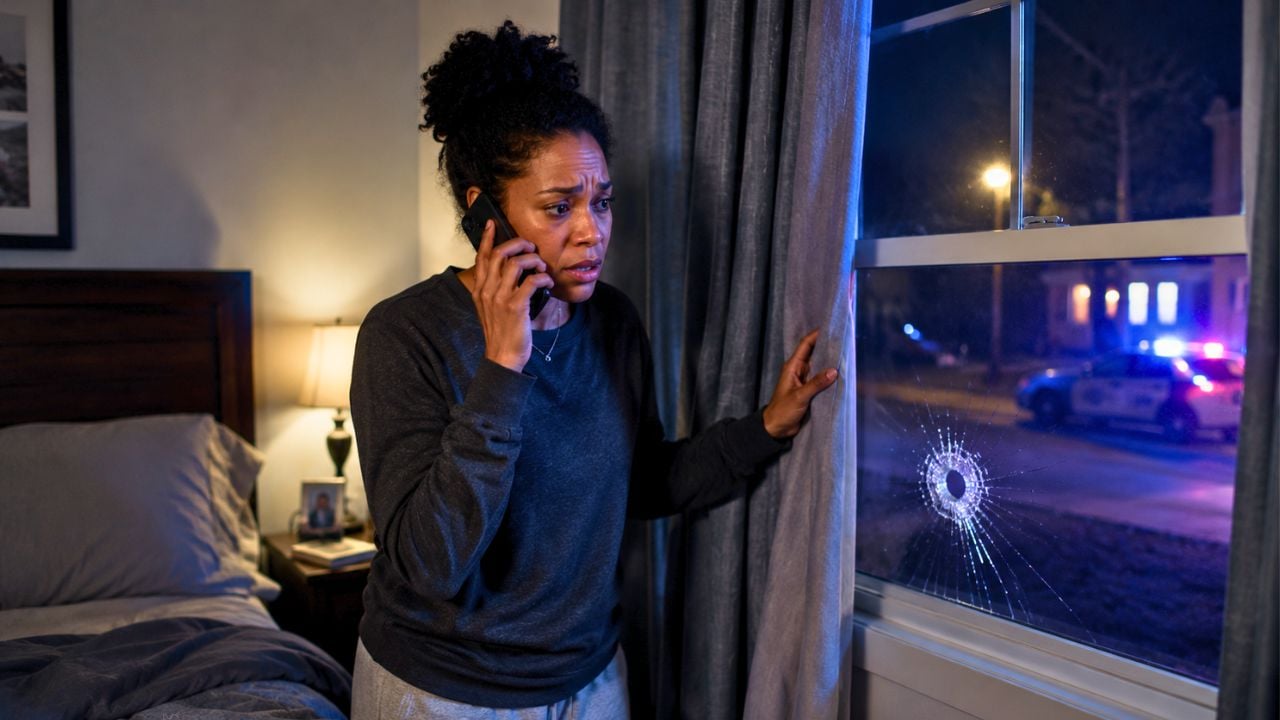
Seven calls later, the situation stopped being “probably kids” or “somebody sighting in after work.” A single round came through a bedroom window.
The nighttime gunfire became a pattern, not a one-off
The first few nights sounded like typical rural noise—two or three shots, then quiet. But the shots kept happening, always after dark, and always from the same direction. The homeowner could hear the difference between a shotgun report and a rifle crack, and this sounded like a rifle most of the time, the kind of sharp snap that carries.
What made it hard was distance and terrain. If you’ve ever tried to pinpoint gunfire with trees, hills, and a little wind, you know it plays tricks on you. One night it sounds like it’s a mile away, the next it sounds like it’s behind your barn.
Calling the non-emergency line felt like the right move—until it wasn’t
Instead of stepping outside with a flashlight and a temper, the homeowner started calling the non-emergency number. That matters, because those calls create a record—time, date, general location, and the fact that it’s ongoing. Dispatch can also compare notes if other neighbors are calling in the same complaint.
But non-emergency responses are often slow by design, especially at night when patrol units are stretched thin. By the time a deputy rolls through, the shots are over and whoever was pulling the trigger has had plenty of time to pack up and move along. That doesn’t mean the calls were wasted. It just means the problem had more momentum than a quick drive-by could fix.
The moment a bullet entered the house, everything changed
The round that came through the bedroom window turned the whole thing from “nuisance” into “somebody could die.” It punched through glass, carried into the room, and ended up lodged where it didn’t belong. Whether anyone was in that room at the moment is almost beside the point. That’s a near-miss that’ll keep you awake for weeks.
Folks who don’t shoot much might not realize how far a rifle round can travel—especially if it’s fired at an upward angle or across a shallow valley. If someone is plinking at night without a backstop, or shooting toward a ridgeline thinking “nothing’s over there,” that bullet doesn’t just disappear. It keeps going until physics and terrain stop it.
And when a projectile crosses into an occupied dwelling, it’s no longer a debate about property lines, noise, or “being too sensitive.” It’s a hard safety issue. The kind that demands an emergency response and a real investigation.
What the likely causes looked like on the ground
In rural areas, repeated nighttime shots usually fall into a few buckets. Sometimes it’s a private backyard range being used at bad hours. Sometimes it’s trespassers cutting loose on someone else’s land because it’s “quiet back there.” And sometimes it’s illegal hunting—folks trying to spotlight or shoot from a road, figuring darkness is cover.
There’s also the possibility of someone shooting at pests or predators. The problem is that “I saw a coyote” isn’t an excuse to ignore a safe backstop, and it sure isn’t a reason to send rounds into a direction you haven’t checked. If you can’t positively identify what’s beyond your target, you don’t press the trigger. That’s not a slogan. That’s how you keep bullets out of bedrooms.
Once the round hit the house, investigators would have a much better chance of narrowing down the direction of fire. Even a rough trajectory—combined with sound reports, neighbors’ accounts, and any cameras in the area—can shorten the map fast.
Commenters zeroed in on cameras, backstops, and not playing hero
When stories like this make the rounds, outdoorsmen tend to split into two camps. One group focuses on self-defense and immediate protection: move the family to a safer room, stage a flashlight, keep a phone handy, and take the threat seriously. The other group focuses on long-term fixes: cameras, signage, boundary marking, and getting law enforcement enough information to act.
Both are right, up to a point. You do need to protect your household in the moment—especially after a round enters the home. But you also don’t want to go prowling your back forty at midnight trying to catch somebody with a rifle. That’s how good people get hurt, mistaken for a threat, or end up in a confrontation that turns ugly fast.
The most practical suggestions usually sound boring: install motion lights, run exterior cameras that can actually capture plates, and make sure your address is clearly visible from the road for responders. A few folks also mention looping in a game warden if there’s any hint of illegal hunting, since wardens are used to working odd hours and dealing with firearm violations in the field.
What landowners can do before and after the shots start
If you’re dealing with recurring gunfire nearby, documentation is your friend. Keep a simple log: dates, times, how many shots, and what direction it sounded like. If you can safely do it from inside, a short phone video that captures the sound and timestamp can help establish that it’s not imaginary and not a one-time thing.
Cameras do a lot of heavy lifting, but placement matters. A camera pointed at your driveway won’t help if the shooting is coming from the back boundary, and a cheap unit that blows out at night won’t catch usable detail. The goal isn’t to play detective—it’s to provide enough credible information for authorities to connect the dots without guessing.
After a round enters a home, treat it like the serious incident it is. Preserve the evidence. Don’t start pulling projectiles out of walls with pliers. Don’t toss broken glass. Call it in as an emergency, get everyone to a safe spot, and let professionals handle the scene. That bullet’s path can tell a story, and you don’t want to accidentally erase it.
Gun owners who care about the community already know the bottom line: shooting is a responsibility, not just a hobby. If you’re sending rounds at night, you’d better have a safe backstop, a controlled direction of fire, and a real reason to be doing it. Because sooner or later, one careless shot can find the one window that’s lit up—and the damage doesn’t stop at broken glass.
Like The Avid Outdoorsman’s content? Be sure to follow us.
Here’s more from us: