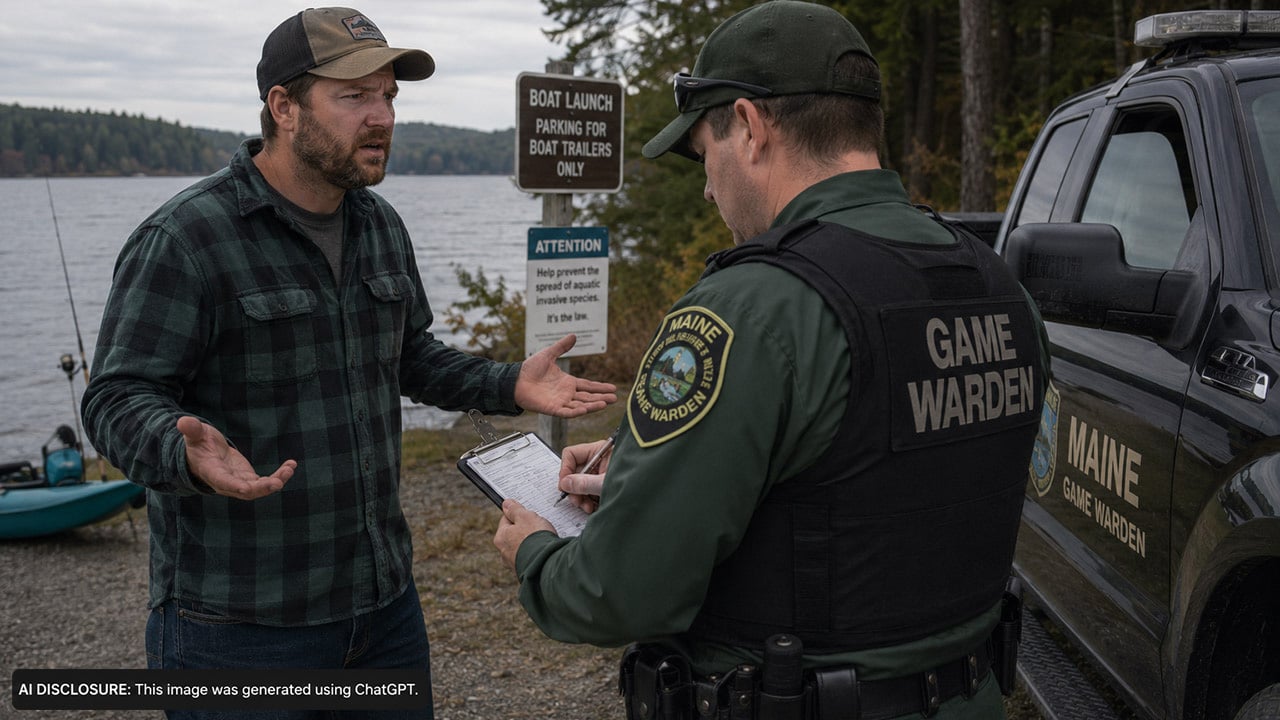
Photo credit: AI-generated image created using ChatGPT. Illustrative only
Most of us have had that moment on the water where you pat your pockets and do a quick mental checklist: keys, phone, knife, pliers… license. In a lot of states, being short on paperwork can turn a relaxing day into an expensive lesson.
But one angler’s situation was a whole different kind of headache. In the original post, a non-resident said he was arrested in Maine over a fishing-without-a-license citation that dated back to when he was 17—about 10 years earlier. He also noted the officer who issued the citation is now retired, and he asked what his next move should be.
A routine stop turns into something bigger
If you’ve spent enough time outdoors, you know how quick a simple contact with law enforcement can go sideways when there’s an old issue tied to your name. The poster described being arrested “yesterday” in Maine, not for something that happened that day, but because of an old ticket for fishing without a license when he was a teenager.
That’s the part that’ll make any hunter or angler sit up straight: you can think you left a small mistake in the rearview mirror, only to find out the system never forgot. When a citation doesn’t get resolved—paid, dismissed, or otherwise cleared—it can hang around like a hook buried under the skin.
How a decade-old citation can still bite
In the outdoors world, a lot of folks think in terms of “statute of limitations” like it’s a hard reset. The poster’s first question was exactly that: what’s the statute of limitations for fishing without a license?
Here’s the practical reality: “limitations” usually deal with how long the state has to bring a case in the first place. But once a ticket is written and a court date is missed—or a fine isn’t paid—many states can issue a warrant or some kind of failure-to-appear consequence that doesn’t just evaporate with time. That’s not a fishing thing; that’s a paperwork thing, and it can follow you across years and state lines.
And it’s worth saying plainly: a wildlife citation might feel minor in the moment, but once it moves into the court system as an unresolved matter, it can stop being “just a ticket.”
Non-resident mistakes cost more than money
The poster emphasized he isn’t a Maine resident. That matters, because non-resident hunting and fishing rules are often stricter and more expensive, and the logistics of fixing problems are tougher. If you live down the road, you can show up at the clerk’s office, get a copy of paperwork, and sort it out. If you’re from out of state, every step takes longer and costs more—time off work, travel, and sometimes hiring an attorney who knows the local court.
It also matters because a lot of folks travel for fishing. Maine draws people for salmon, brook trout, smallmouth, and everything in between. When you cross borders to chase fish, you’re automatically dealing with a new rulebook and a new set of enforcement practices.
The best habit is boring but effective: before you even gas up the truck, buy the license, screenshot the receipt, and keep a printed copy in the glove box. Phones die. Apps glitch. Service disappears the second you hit those backroads.
“The officer is retired” doesn’t erase the paper trail
The poster also pointed out that the officer who issued the original citation is retired. A lot of outdoorsmen hear that and think it’s a silver bullet—like the case falls apart if the original warden isn’t around to testify.
In most real-world situations, that’s not how it plays out. Citations are documentation. They’re logged, filed, and tied to court records. Even if the issuing officer is long gone, the paperwork—and whatever happened after the ticket was written—can still be very much alive.
And if the arrest was triggered by a warrant or a missed court obligation, it’s not really about the retired officer anyway. It’s about the court record showing something wasn’t completed when it should’ve been.
The smart next steps when an old outdoor ticket resurfaces
The poster asked, “What should my plan of actions be?” He didn’t lay out what happened back when he was 17—whether he paid, whether he went to court, whether he moved and never got notice—so the best advice stays practical and general.
First, get the exact information in writing. That means finding out what the arrest was based on: an unpaid fine, a failure to appear, a warrant, or something else attached to that old citation. You can’t fix what you can’t name, and “fishing without a license” might be the original issue while the current problem is the unresolved follow-up.
Second, treat it like a real legal problem, not a campfire story. If there’s a court involved, contact the court clerk in the jurisdiction tied to the citation and ask what the case status is and what’s needed to close it. If it’s complicated—or if you’re out of state—this is where talking to a Maine attorney can save you from making it worse with a well-meaning phone call.
Third, don’t ignore it and hope it cools off. Outdoorsmen are independent by nature, but old tickets don’t usually “wear out.” They tend to resurface at the worst time—during a traffic stop, a license application, a background check for a job, or right when you’re trying to buy tags for a trip you’ve planned for months.
What this should remind every angler before the next trip
This is one of those stories that makes you double-check your own house. Not because everyone’s walking around with decade-old warrants—most aren’t—but because it highlights how fast outdoor fun turns into legal trouble when paperwork gets neglected.
If you ever get cited in the field, handle it immediately. Save the citation. Confirm the court date. Pay the fine or show up and fight it, but don’t let it drift into “I’ll deal with that later.” Later has a way of turning into years, and years can turn into an arrest when you least expect it.
And if you’re traveling to fish out of state, make your license situation bulletproof. Buy it ahead of time, keep proof on you, and know the local rules. It’s cheaper than a lawyer, and it sure beats explaining to your buddies why the fishing weekend ended in a holding cell.
Like The Avid Outdoorsman’s content? Subscribe to our newsletter so you never miss an article.
Here’s more from us: