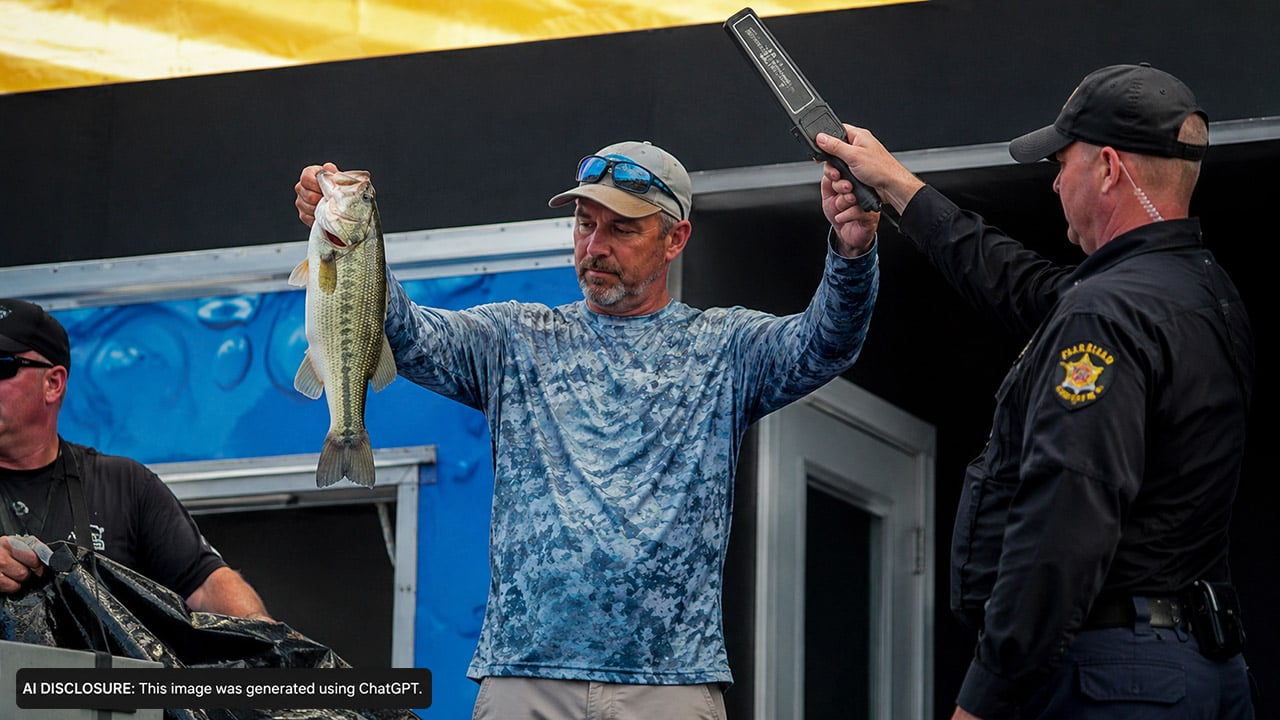
Photo credit: AI-generated image created using ChatGPT. Illustrative only
Most bass tournaments run on trust, a good scale, and a line of tired anglers waiting their turn at weigh-in. At Lake Fork in East Texas, that routine got interrupted when a handheld metal-detecting wand lit up on a fish that didn’t seem like it should’ve been setting off alarms.
Texas Parks and Wildlife officials say that simple scan led to a necropsy and a criminal case against a competitor. Details were first reported in the original post, and the story has a few hard lessons for anyone who fishes for money, pride, or both.
A quick wand check changed the whole weigh-in
According to TPWD spokesperson Maggie Berger, tournament staff used a metal-detecting wand and it alerted to the possible presence of a foreign object inside a largemouth bass entered in the inaugural Lake Fork Lures Fishing Tournament.
That’s the kind of moment that flips a weigh-in from “who’s leading?” to “what exactly are we looking at here?” Organizers contacted Texas game wardens, and the process moved from tournament rules to state enforcement.
Game wardens opened the fish up and found the problem
Wardens performed a necropsy on the bass, and TPWD says they discovered three fishing weights in the fish’s stomach. The weights were described as three three-quarter-ounce weights.
It’s hard to overstate how much that matters in a tournament setting. On a tight leaderboard, a couple ounces can shuffle places and payouts. Even if a fish looks healthy and swims strong, extra weight where it doesn’t belong turns the whole event into something else.
The arrest and the charge are tied to a specific tournament law
TPWD said Curtis Lee Daniels, 45, of Willow Park, was arrested Sunday in connection with the incident. He was booked into the Wood County Jail and released Monday on a $20,000 bond.
The charge listed is violating a fishing tournament law, and it’s not a slap-on-the-wrist ticket. TPWD says it’s a third-degree felony, which can carry serious time and serious consequences beyond any single event on the calendar.
The details that made it harder to explain away
In the affidavit obtained by KLTV, the same type of weights allegedly found in the bass were also found in Daniels’s boat. That’s a small detail on paper, but in the real world it’s the kind of thing that makes a situation go from “we need to sort this out” to “this is going to be a case.”
For tournament anglers who do things the right way, this is also the part that stings. A legitimate fish caught fair and square can still get questioned when cheating shows up in an event, and that suspicion can hang around long after the trailers leave the ramp.
When the prize is real money, the penalties get real, too
The overall prize for the tournament was listed at $11,500. That’s enough cash to tempt the wrong kind of decision, but it’s also enough to bring real scrutiny when something doesn’t add up.
TPWD notes that, beyond prison time and fines of up to $10,000 for a third-degree felony, other penalties can include license revocation and civil restitution. For an angler who lives for tournaments—or even just likes to fish on weekends—losing your license isn’t a side issue. It changes your whole outdoor life.
Why tournament organizers are leaning on simple tools
The metal-detecting wand is the unsung piece of this story. It’s not fancy, and it doesn’t care who you are, who you know, or how good your “fish story” sounds at the table afterward. It just alerts or it doesn’t.
There’s a practical takeaway here for anyone who runs events: prevention and deterrence beat drama at the scale. A visible check—whether it’s a wand, camera coverage at weigh-in, or tight fish-handling protocols—doesn’t accuse honest folks. It protects them by making it harder for a bad actor to steal money and reputation from the rest of the field.
For the average weekend angler watching this play out, it’s also a reminder that game wardens aren’t just there for license checks. When tournament integrity crosses into criminal behavior, they’ve got the authority and the tools to treat it like what it is.
Lake Fork has built a reputation as a place where big bass are always possible. Stories like this don’t change the fishery, but they do put a spotlight on what’s at stake when competition and cash get mixed in. If you’re fishing tournaments, the straight path is still the only path worth taking—because once a weigh-in turns into an investigation, it’s not about bragging rights anymore.
Like The Avid Outdoorsman’s content? Subscribe to our newsletter so you never miss an article.
Here’s more from us: