Photo credit: AI-generated image created using ChatGPT. Illustrative only
Most gun owners understand that a stolen firearm isn’t just about replacing a piece of property—it’s about the sick feeling that something with your name tied to it is out there in the wild. For one Wisconsin gun owner, that uneasy chapter from 2017 suddenly reopened years later when local police called with news: his stolen pistol had been recovered in Chicago.
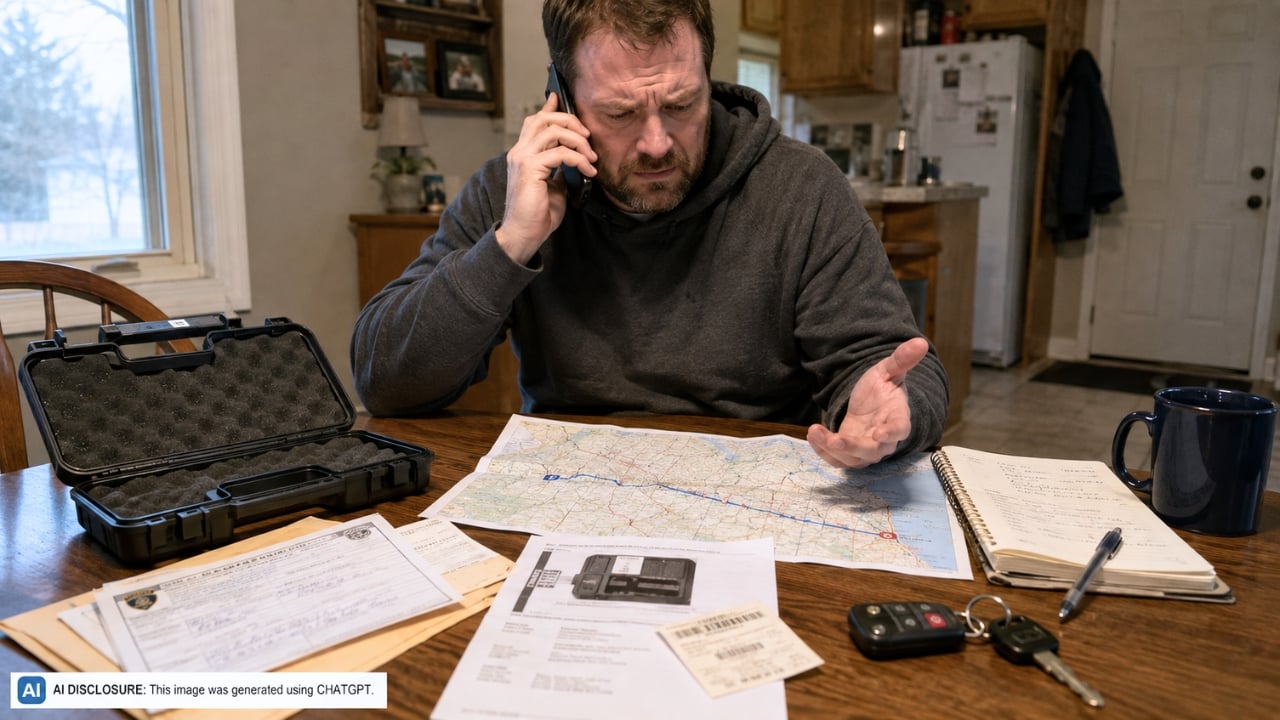
The catch is the part that’ll make any working person grit their teeth. To even learn where the gun is and how to get it back, he was told he’d need to show up in person and pull the case file—an eight-hour drive each way. The situation was laid out in the original post, and it reads like the kind of bureaucracy that makes folks throw their hands up.
A phone call that should’ve been good news
On paper, “your stolen gun has been recovered” sounds like a win. The owner said a pistol of his was stolen back in 2017, and only recently did his local police department contact him to say it turned up in Chicago.
The local officer gave him a phone number and a case number—exactly what you’d expect in a situation like this. At that point, most people assume the rest is paperwork and a little patience.
The eight-hour drive that turns recovery into a burden
Here’s where it went sideways: when he called the number he was provided, the person who answered “was not helpful at all,” in his words. Instead of giving him clear next steps over the phone, he was told he’d have to come in to get the case file and find out where the gun is to retrieve it.
That’s a big ask when you live in Wisconsin and the recovery happened in Chicago—an eight-hour drive for him. And it’s not just the mileage. It’s taking time off work, fuel money, maybe a hotel if hours don’t line up, and the nagging uncertainty of whether the trip even guarantees he’ll leave with the firearm.
Why “just come in” hits different for rural gun owners
In a lot of rural towns, dealing with the sheriff’s office or local PD is straightforward. You show up, talk to a deputy, sign the form, and handle business. But once you cross into big-city systems—especially when you’re not a local—simple things can turn into a maze of desk windows, phone extensions, and “that’s not my department.”
That’s what makes this story so relatable for outdoorsmen. An eight-hour drive isn’t a quick errand—it’s a full-on trip. If you’ve got a job that doesn’t offer flexible time, livestock to tend, kids to pick up, or a fall weekend you’d rather spend in a stand, the “come in and we’ll tell you” approach feels like punishment for being the victim in the first place.
The paperwork side people don’t think about until it’s their gun
Stolen guns carry a long paper trail, and it doesn’t always move fast. A firearm recovered in another jurisdiction can be tied up for a lot of reasons—evidence holds, administrative processing, verification steps, property room procedures, and the plain reality that big departments are busy.
From the owner’s perspective, though, the frustrating part is the lack of clear information. He has a case number and a phone number, but he still can’t get a straight answer on where the gun physically is or what exact process would let him recover it without burning a day (or two) behind the wheel.
And for any gun owner, there’s also the quiet worry in the background: if the firearm was used in a crime, or simply passed around enough, how long will it sit before anyone will release it—if it can be released at all?
The practical reality: time, money, and the risk of a wasted trip
An eight-hour drive to “get the case file” isn’t like driving to buy a used boat off Facebook Marketplace where at least you know what you’re walking into. This is showing up to navigate someone else’s system, on someone else’s timeline, with no guarantee the right person will be available when you arrive.
If you’ve ever dealt with government offices, you know how it can go: you take a day off, drive across state lines, find parking, wait your turn, and then learn you need one more form, one more ID requirement, one more signature—something you could’ve handled at home if you’d been told ahead of time. That’s the real weight of the burden here. The distance isn’t just inconvenient; it multiplies every small hitch into a major ordeal.
Even if everything goes right, there’s still the question of logistics. Is the firearm at a property facility? A police evidence unit? A different location than the office where he’s told to get the case file? If the case file is step one, does that mean step two requires another stop? None of that was made clear to him in the exchange he described.
What this story teaches: treat documentation like gear you might need later
There’s a hard-earned outdoorsman lesson buried in this: keep your important info squared away before you ever need it. Just like you don’t wait until opening morning to sight in a rifle, you don’t want to be digging for serial numbers, receipts, or old reports when the phone finally rings years later.
The owner did the right thing by having enough information on record for the gun to be identified and tied back to him. But this situation also highlights how recovery can hinge on documentation and procedure, not just “it’s mine.” When a firearm crosses jurisdiction lines, the owner can end up at the mercy of whatever process that agency uses, whether it’s efficient or not.
It also reinforces the importance of safe storage and theft prevention. Nobody plans on being the guy whose pistol disappears in a burglary or theft, but once it’s gone, you’re in a long game. And even when it’s found, getting it back can be its own uphill climb.
For this Wisconsin owner, the toughest part isn’t learning the gun was recovered—it’s learning that the first real step toward getting it back may require an eight-hour drive just to figure out where to go next. That’s a rough deal, and it’s the kind of headache that makes you appreciate any system that keeps victims from having to chase their own property across state lines.
Like The Avid Outdoorsman’s content? Subscribe to our newsletter so you never miss an article.
Here’s more from us: