
Photo credit: Benchmade
Benchmade could’ve left the Mini Bugout alone and still sold piles of them. It’s already one of the default picks for guys who want a light, compact folder that actually cuts. So when they tweaked it again, a lot of people assumed it was going to be another limited-edition colorway built for collectors more than users. Instead, the newest Woodland Green Mini Bugout quietly addresses two real-world complaints: handle durability and edge performance over the long haul. The result is a knife that feels more grown-up than the original ultralight version without losing the pocketable, “forget it’s there until you need it” character that made it a hit in the first place.
Aluminum scales that change how the knife behaves, not just how it looks
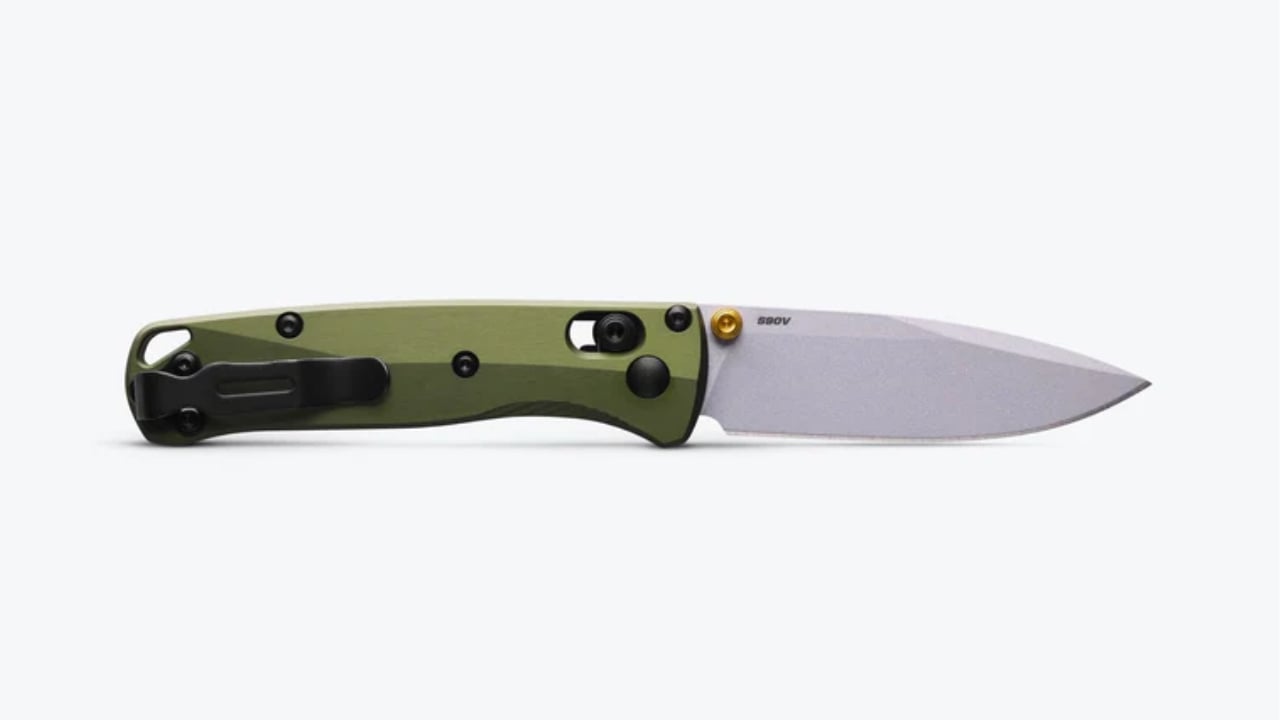
The biggest shift is the move to aluminum handle scales on the Mini Bugout 533SL-10. Earlier models leaned hard into ultralight, with polymer scales that kept weight down but could feel flexy in a hard pinch. The new Woodland Green version brings full aluminum handles into the mix, which stiffens the knife up under torque and gives you a more confidence-inspiring feel when you’re twisting through cuts or bearing down on the spine. Benchmade kept the overall profile slim and contoured, so it still carries like a featherweight, but in use it feels more like a shrunken hard-use folder than a dainty gentleman’s knife. The color choice nods to old camp gear, but the meaningful change is in how the knife resists flex and hot spots when you’re doing actual work.
A serious steel upgrade for people who actually cut things
Benchmade also leaned into performance by spec’ing premium S90V on the new Mini Bugout variants. Older runs were already decent cutters, but S90V changes how often you have to think about sharpening if you’re the guy who actually breaks down cardboard, processes kindling, or runs a knife hard on hunts and trips. S90V isn’t the easiest steel to bring back on a cheap stone, but in return you get excellent wear resistance and corrosion resistance in a truly compact package. That matters more in the field than one more layer of fancy Cerakote. On a knife this small and light, being able to trust the edge through a whole weekend without babying it is exactly the kind of “quiet” upgrade that serious users care about and spec sheets can’t fully capture.
Still tuned for real carry, not sock-drawer collecting
One of the easy ways Benchmade could’ve screwed this up was by letting the upgrades turn the Mini Bugout into a chunky showpiece. They didn’t. The Woodland Green model keeps the slim profile, deep carry clip, and pocket-friendly weight that made the original so popular as an everyday piece. The aluminum adds durability but doesn’t turn it into a brick, and the hardware choices—Gold anodized accents on the limited Woodland run, for example—stay tasteful enough that you don’t feel silly pulling it out at a jobsite or deer camp. It still rides easily in a front pocket, disappears on a pack strap, and feels familiar in hand if you’ve run any of the previous Bugout family, which is exactly what long-time users wanted.
What this tells us about where Benchmade is headed
Stepping back, the way Benchmade updated the Mini Bugout says more than another wild color combo ever could. Across their 2025 lineup, they’ve been revisiting proven models with better materials—Richlite, upgraded steels, more aluminum variants—instead of flooding the catalog with untested designs. The Mini Bugout refresh fits that pattern. It respects the original use case—lightweight cutting tool for people who actually carry knives every day—while tightening up the spots real owners have complained about over the years. That’s the kind of incremental, user-driven evolution serious knife guys pay attention to. If you already own a Mini Bugout, this version doesn’t make your old one useless, but it does give you a clearer “working” option: stronger in hand, longer-lasting at the edge, and still compact enough that it actually gets carried instead of left sitting in a case.
Like The Avid Outdoorsman’s content? Subscribe to our newsletter so you never miss an article.
Here’s more from us:


