Photo credit: Dmitri T/Shutterstock.com
The Avid Outdoorsman is reader-supported. If you buy through links in this article, we may earn a small commission at no extra cost to you.
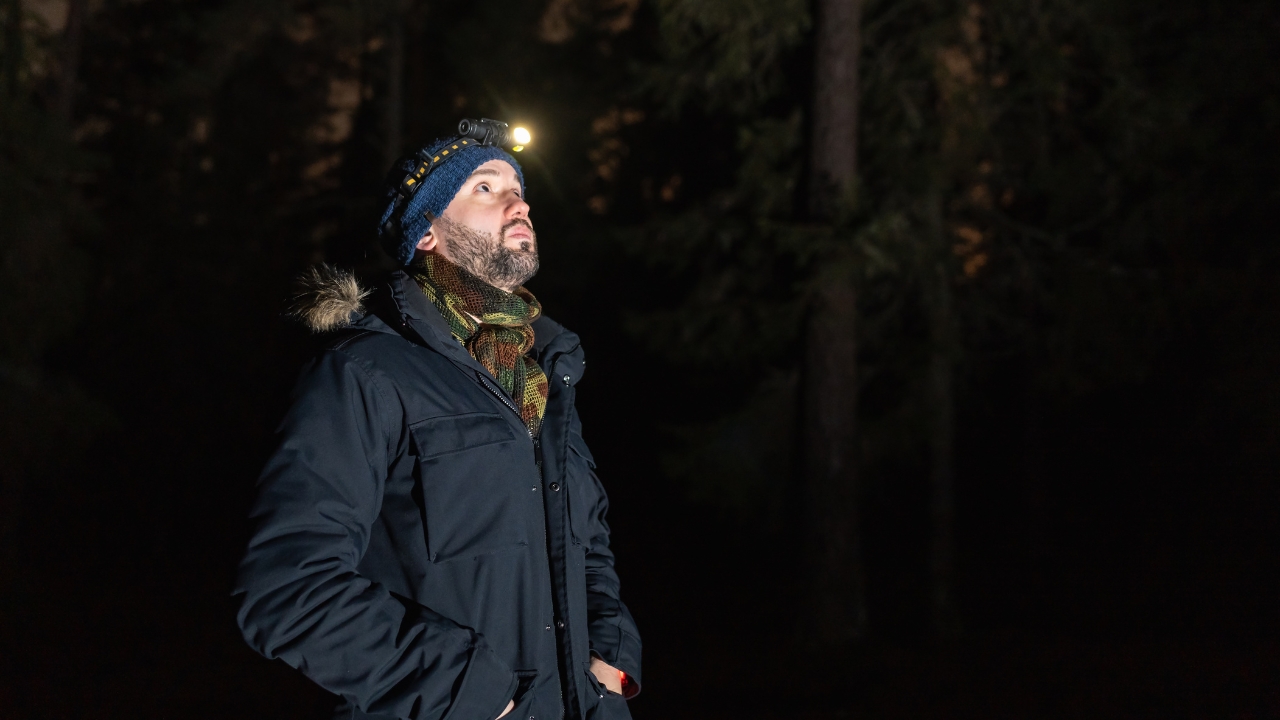
The best headlamp for hunting has to do two opposite jobs. At 5:15 in the morning you want dim, wide and red, so you don’t wreck your own night vision or announce yourself to every deer in the county. At 9:40 at night, over a speck of blood on wet oak leaves, you want something else. Then there’s the third job nobody plans for: dragging a deer out in the dark with both hands full.
These picks come from manufacturer specs, retailer spec sheets and owner feedback, not hands-on testing. Prices are what merchants showed today, 21 October 2026.
Quick Picks
| Headlamp | Best at | Approx. Price |
|---|---|---|
| Petzl Aria 2 | Walking in with color control | About $60 |
| Black Diamond Spot 400 | The one-light compromise | About $55 |
| Fenix HM50R V2.0 | Doubling as a handheld | About $60 |
| Liteband Sportsman PRO 1000 | Dragging and field dressing | About $70 |
| NEBO IllumaTrace Blood Tracker | Dedicated blood trailing | About $58 |
| Pursuit 200-Lumen | The $7 pack backup | About $7 |
| Wicked Lights ScanPro iC GEN4 | Premium, three colors in one head | About $200 |
Read next: Deer Hunting Gear Checklist
Red, Green and White: What Each Color Actually Does
Start with your own eyes. Rod cells, the ones doing your night vision, are relatively insensitive to long-wavelength red, so a dim red beam lets you find a screw-in step without wrecking twenty minutes of dark adaptation. White undoes it in a second.
Now the deer. Whitetails are dichromatic, two cone types to our three. Work from the University of Georgia’s Deer Lab, where Dr. Karl Miller and Dr. Gino D’Angelo study deer vision, describes cones tuned to short blue and middle green-yellow wavelengths, with very few responding to the long wavelengths we see as red and orange. Deer also lack the pigment that filters ultraviolet in our eyes, so blue stands out to them.
So red is less conspicuous, not invisible. A deer sees a dim colorless glow instead of a red one, and a rod-heavy eye still catches moving light. Green sits near the peak of both human sensitivity and the deer’s middle cone: brighter and more useful to you, probably more visible to the deer. Run red for stealth, green when you need to see. Blue is worst for sneaking in, and white is for after the shot.
Blood Trailing: What the Evidence Supports
Fresh blood on brown leaves is a contrast problem, not a brightness problem. Dump 1,000 lumens of white on wet leaf litter and you get glare off the water and red-brown that all looks the same.
There’s a real physical reason blue and violet help. Forensic examiners rely on it: blood absorbs strongly around 412 nm, so crime labs illuminate at roughly 410 to 415 nm to make a stain go dark against its background. But we could find no controlled field trial of blood trailing in leaf litter, so treat the physics as sound and the hunting marketing as unproven. Dedicated blood-tracking lights are a real category, working off violet or blue, a wide white flood to kill glare, or NEBO’s IllumaTrace, which alternates strobe rates on the theory that flicker makes a stain pop.
What isn’t preference: a wide beam beats a narrow one, and a second light raked low across the ground finds blood an overhead headlamp walks right past. Cabela’s own Blood-Tracking Light, 112 LEDs behind a wide 900-lumen flood for about $30, is the cheap way to get that second angle.
Check the current price of the Cabela’s Blood-Tracking Light at Bass Pro Shops
Lumens Versus Beam Pattern
A 1,000-lumen spot is worse than a 200-lumen flood for nearly everything in dark woods. The spot gives you a bright dinner plate and pitch black everywhere else, so your pupils clamp down. Shop beam pattern first, output second. High earns its place in three situations: reading a creek bottom for a crossing, picking up eye shine at distance, and signaling if something goes wrong. Four hundred lumens covers it.
Batteries in the Cold, and Why Runtime Numbers Mislead
Alkaline AA and AAA cells lose capacity fast below freezing, and the drop can look like a dead light when it’s only a cold one. Primary lithium is the opposite: Energizer rates its Ultimate Lithium AA for operation from -40°F to 140°F. Lithium-ion packs run cold but deliver less, and cold hurts them most on the charger, so never charge a frozen pack.
Which is why a sealed rechargeable with no backup is a bad plan on a cold morning. At twenty percent and 20°F you may not get the two hours the box promised, and you can’t drop in a fresh cell. Dual fuel, like the Spot 400, or a CR123A fallback, like the IllumaTrace, earns its keep.
Runtime is published to the ANSI/PLATO FL 1 standard, which stops the clock when output falls to ten percent of starting brightness. A 300-lumen light rated for 40 hours is making something above 30 lumens for most of them.
Fit, Weight and Water
Anything under about 4 ounces disappears on your forehead. Over 8, usually a rear battery pack, needs the top strap and slides when you sweat. Test it over the hat you actually wear: a bulky housing on wide elastic rides up over a beanie, while a slim head like the Aria 2 or Spot 400 sits down on it and stays.
IPX4 is splash-resistant: drizzle and sweat. IPX7 survives immersion in a meter of water for thirty minutes, which is what you want for a light that may end up in a creek. IP67 adds dust-tight; treat IPX7 as the floor.
Read next: 10 Essential Pieces Of Gear For A Successful Deer Hunt 2
Controls: Lockout, Memory and One-Handed Use
Lockout. A headlamp that switches itself on inside your pack will be dead when you need it. Insist on hold-to-lock; the Spot 400 and Aria 2 both have it.
Memory that remembers the right thing. A light that boots to full white every time it wakes is actively bad for hunting: you thumb the button at your tree and blow out your night vision plus everyone else’s within 300 yards. A circuit that returns to the dim setting you last used is a safety feature. The Fenix HM50R V2.0 recalls the last level used and keeps red on its own press sequence.
One-handed use. You’ll change settings holding a rifle or a drag rope, so one big button you can find through a glove beats a cluster of small ones. And a light you can stand on the ground facing the trail beats another 500 lumens.
A Word on Safety and the Law
A headlamp makes you visible to other hunters, which is good. Wear it walking in and out, especially on public land in a firearms season. But never use a light to scan an area you have not already identified by other means. A light does not identify a target, and eyes in the beam are not information you can shoot on.
Rules on artificial light while in possession of a firearm differ sharply by state and they catch careful people out. Some restrict spotlighting, some restrict hours, some treat a light and a loaded gun in one vehicle as an offense. Read your own state’s current regulations before you hunt.
The Picks
Petzl Aria 2: Best for Walking In
Petzl lists 450 lumens of white on a wide or mixed beam, plus red, green and blue at 4 lumens, on three AAA cells. IP67, 106 grams, one button, lock function. That 4-lumen color mode is the point: deliberately dim, exactly right for the last 300 yards.
Who it’s for: Hunters who keep blowing out their night vision on the walk in. Pros: Four colors, a truly dim low, AAAs anywhere, slim on a beanie. Cons: The colors are far too dim to track with. White stops at 450.
Check the current price of the Petzl Aria 2 Headlamp at Bass Pro Shops
Black Diamond Spot 400: The One-Light Compromise
400 lumens, 75 meters of throw, 2.5 hours on high and up to 200 on low. Dual-fuel: three AAA alkalines included, or Black Diamond’s rechargeable 1500 pack sold separately. 3.3 ounces, IPX8, digital lockout, red night vision only.
Who it’s for: One light for deer season, chores and the truck. Pros: The best cold-weather insurance here. Real lockout. Slim under a cap. Cons: Red only. 2.5 hours on high is short. The pack costs extra.
Check the current price of the Black Diamond Spot 400 Headlamp at Bass Pro Shops
Fenix HM50R V2.0: Best Headlamp That’s Also a Handheld
700 lumens on turbo with 115 meters of throw, four white levels down to 30, red at 5 lumens on two settings. One 16340 cell, USB-C, 2.75 ounces, IP68, lockout. The body pops out as a right-angle flashlight, and the light you rake low across the leaves is the one that finds blood.
Who it’s for: Hunters who want a headlamp for the walk and a handheld for the trail. Pros: Detaches to handheld. IP68. Tiny. Remembers your setting. Cons: One small cell, so carry a spare. One hour on turbo. No green.
Check the current price of the Fenix HM50R V 2.0 Rechargeable Headlamp at Bass Pro Shops
Liteband Sportsman PRO 1000: Best for Dragging and Field Dressing
Liteband’s idea is a 210-degree band of light across your head instead of a beam out of a housing. The Sportsman PRO 1000 lists 1,000 lumens, a 3400 mAh USB-C pack, up to 28 hours on low and IPX5, with green in place of the standard PRO’s red LED.
Who it’s for: Anyone who has field dressed a deer by a dinner-plate beam. Pros: Widest spread here. Long low-mode runtime. No front-heavy nod. Cons: IPX5 is the weakest rating here. No throw. Sealed pack, so no cold swap.
Good light only helps if the knife in your pocket is up to the job.
Read next: Best Deer Skinning Knife
NEBO IllumaTrace Blood Tracker: The Dedicated Tracker
Three white levels at 800, 400 and 200 lumens, plus three blood-tracking strobe settings at 100 lumens each, which NEBO says alternate flashes to make blood stand out. A 2200 mAh pack charges over USB-C, or it runs two CR123A primaries. IPX6, 5.12 ounces. That primary-battery fallback is the best feature here.
Who it’s for: Bowhunters and anyone who tracks after dark often. Pros: Purpose-built tracking modes. Runs on primaries when the pack dies. Cons: The strobe approach is a maker’s theory, not a result. No red or green. IPX6 only.
Check the current price of the NEBO Illumatrace Blood Tracker Headlamp at Bass Pro Shops
Pursuit 200-Lumen: The Backup That Has No Excuse
Bass Pro’s house brand runs a white LED on high, low and strobe, plus two green LEDs for keeping your night vision. That’s it, for seven dollars. A backup is not optional: lights get dropped and soaked, and 600 yards into a cutover with a dead headlamp is how people get hurt.
Who it’s for: Everybody, as a spare. First light for a kid. Pros: Costs less than a box of slugs. Has green, which most cheap lights don’t. Cons: No tracking light. No published water rating or weight.
Check the current price of the Pursuit 200-Lumen Headlamp at Bass Pro Shops
Wicked Lights ScanPro iC 3-Color-In-1 GEN4: The Premium Pick
One head, three center-axis LEDs in white, red and green, selected by rotating the module. Full brightness control instead of fixed steps, two 21700 cells at 5000 mAh each, a two-bay charger and a hard case. The dimmer is the real feature: rolling red up from nothing beats another fixed high mode.
Who it’s for: Hog and predator hunters, and deer hunters who track a lot. Pros: Three real colors with a true dimmer. Two big swappable cells. Cons: About $200. Nobody publishes its lumens or beam distance. Heaviest here.
Frequently Asked Questions
Can deer see red light?
Yes, but not as red. Based on the University of Georgia Deer Lab’s work, whitetails have very few cones sensitive to long wavelengths, so red reads as a dim gray or brown rather than a color. A red beam is less conspicuous than white, not invisible, and a moving light still gets noticed.
Is green or red light better for deer hunting?
Red for stealth, green for seeing. Green sits near the peak of both the deer’s middle-wavelength cone and human sensitivity, so it looks brighter to you and is probably more visible to the deer.
How many lumens do I need in a hunting headlamp?
Far fewer than the packaging suggests. A 10- to 20-lumen low handles anything within arm’s reach, 100 to 200 lumens of flood covers walking, field dressing and dragging, and 400 reaches across a creek bottom.
What color light is best for tracking blood at night?
Forensic practice points to violet-blue, around 410 to 415 nm, because blood absorbs strongly there and goes dark against its background. We found no controlled field test of blood trailing in leaf litter, so treat hunting-specific claims as unproven. A wide beam swept low across the ground reliably helps.
Do I really need two lights?
Yes. One on your head and one in your pack, and on a blood trail the second does real work from a low angle a headlamp can’t match. It’s also a safety item: lights die and get dropped in creeks.
What to Set Up Before Tomorrow Morning
Buying one light? Make it the Black Diamond Spot 400: dual fuel means a cold morning can’t strand you. If your problem is getting spotted on the walk in, the Petzl Aria 2 and its dim colored modes. If you track after dark often, the Fenix HM50R V2.0 plus a cheap handheld flood beats any single light.
Then do the unglamorous part tonight. Charge the cells, confirm the lockout locks, put lithium spares in the pack, drop the backup light in the bottom and leave it there, and read your state’s current rules on artificial light. Then try the rig on over the hat you’ll actually wear.