Photo credit: SARCRAFT
When most knives “fail,” it’s usually not a clean snap in half. It’s the stuff that ruins a tool when you’re relying on it: edge chipping, tip damage, handle loosening, warped grinds that bind, or a blade that won’t hold up once you lean on it hard. The knives that survive ugly work tend to share the same traits: real full tangs, thick-enough stock, good heat treat, sensible edge geometry, and handles that don’t punish your hands.
This list is about blades that are known for staying together when the job gets rough—splitting kindling, digging into stubborn material, scraping, prying within reason, and taking repeated impacts without turning into a pile of parts.
ESEE-5

The ESEE-5 is built like a pry bar that happens to have an edge. It’s thick, heavy, and not trying to be a slicey little bushcraft knife. That extra mass and thickness is why it survives the kind of abuse that breaks lighter knives—batonning through knots, splitting larger kindling, scraping, digging, and general “I need this to work” situations. The full tang construction and robust handle setup give it a lot of margin.
The tradeoff is it’s not a graceful cutter for fine work. You’re not buying an ESEE-5 to carve delicate notches all day. You’re buying it because it keeps its shape and keeps functioning when you do dumb-but-necessary things in camp. If you want a blade that survives ugly work, this is one of the first names that comes up for a reason.
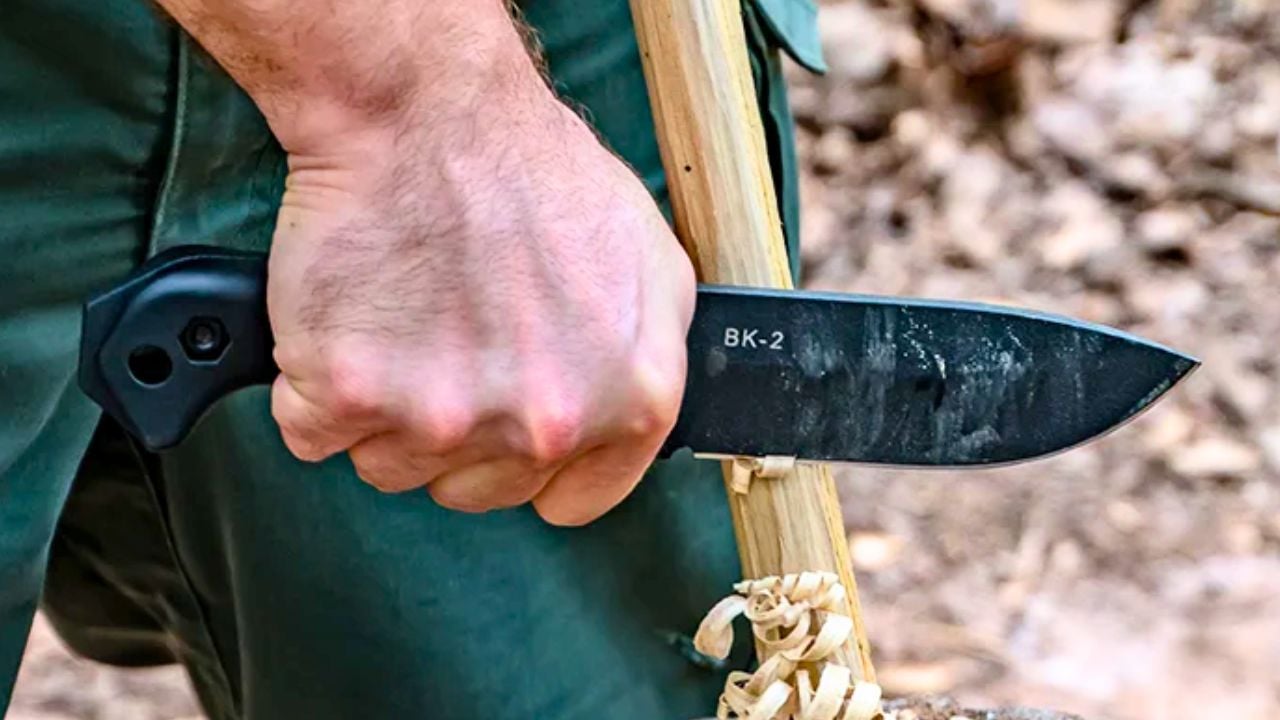
Becker BK2 (Ka-Bar Becker Campanion)

The BK2 is famous because it’s simple and hard to kill. Thick blade stock, full tang, and a design that’s basically made for camp abuse—splitting wood, pounding, and general rough handling. It’s not a lightweight backpacking knife. It’s a “truck knife” that survives being treated like a tool instead of a collectible.
Where the BK2 shines is its balance of toughness and real usability. The edge geometry can be set up to be more efficient, but even stock it holds up well under impact and side loads that make thinner knives twist and bind. It also has a handle setup that’s comfortable enough to actually use for longer sessions, which matters when the work is repetitive and messy.
TOPS B.O.B. Fieldcraft

The B.O.B. Fieldcraft has a strong reputation for field durability, and a lot of that comes down to smart design choices: full tang, durable handle construction, and a profile that works across wood, food, and general camp use without being fragile. It’s not a pure “splitter,” but it can handle batonning and hard use better than most knives in its size class.
What keeps it from being a “fail” knife is the combination of thickness, grind, and steel/heat treat philosophy—more geared toward durability than chasing a razor-thin edge that chips the first time you hit a knot. It’s also one of those knives that feels like a tool in the hand, not like an EDC toy. If you want a blade that survives real camp work, it belongs in the conversation.
Fallkniven A1

The Fallkniven A1 is built around the idea of survival durability, and it’s known for handling heavy tasks without coming apart. The thicker blade, strong tang construction, and durable edge geometry give it margin. It’s the type of knife people pick when they expect hard use—batonning, rough carving, and general “I need one blade that can take it” situations.
The A1 also gets talked about because it tends to avoid the brittle failure mode you see in some harder, thinner blades. It’s built to survive impact and twisting better than a lot of knives that look similar on paper. It’s not cheap, but the whole point is that it’s not built like a bargain blade. When the job is ugly, knives like this are the ones that keep functioning.
Cold Steel SRK (fixed blade)

The SRK has earned its place as a hard-use beater because it’s designed to survive abuse at a price most guys can justify. Full tang, durable construction, and a no-nonsense shape that works for chopping light material, batonning, and rough camp chores. It’s a simple design that doesn’t pretend to be fancy—and that’s a good thing when you’re talking about survival durability.
Cold Steel also tends to build knives with the idea that users will do stupid things with them. That means you usually get stronger tips, stronger spines, and a handle setup that can take impacts without loosening. If you want a blade you can throw in a truck, take on a hunt, and not baby, the SRK is one of the better “it survives” options in the mainstream market.
Ontario RAT-5

The RAT-5 hits a size range that’s very practical: big enough to baton and do heavier chores, not so big that it becomes awkward on the belt. It’s known for being a work knife—full tang, robust construction, and a design that tolerates rough handling. It doesn’t need to be trendy to be useful. It just needs to keep working.
Where the RAT-5 survives is in repeatability. It’s the kind of knife you can take out, do the same rough chores week after week, and not have it turn into a loose-handled mess. It’s also easier to sharpen and maintain than some “super steel” options, which matters because a blade that survives is also a blade you can keep running.
Mora Garberg

The Garberg is what guys wanted the Companion to be when it comes to abuse tolerance: a full-tang Mora built to survive harder field use. It keeps the Mora “cutting efficiency” vibe, but adds the structure that helps it survive batonning, rough carving, and impacts without risking the same tang/handle stress that partial tang designs can run into.
It’s a strong example of why design matters more than price. The Garberg isn’t the thickest wedge on earth, but it’s durable and practical, and it tends to hold up to real camp work without developing the “loose handle” feeling some lighter knives can get over time. If you like Mora ergonomics but want a blade that survives harder use, this is the one.
Terävä Jääkäripuukko 140

Terävä knives are known for being built like tools. The Jääkäripuukko 140 is a great example: sturdy construction, practical geometry, and an approach that prioritizes durability over flash. It’s the kind of blade that survives because it doesn’t have fragile design choices. It’s meant to be used in ugly conditions—wet, cold, gritty—and still keep doing the job.
The real win is the balance between toughness and cutting performance. Some “tough” knives are so thick they’re miserable cutters. The Jääkäripuukko tends to keep enough cutting efficiency to be useful while still handling batonning and rough chores without feeling delicate. If you want a blade that survives hard field work and still cuts well, this is a smart direction.
Bradford Guardian 5

Bradford Guardians are known for quality builds that can take real use, and the Guardian 5 sits in a size range that’s hard to beat for camp and field chores. Full tang, strong handle construction, and enough blade to baton and do rough work without pushing the design past its limits. It’s not built as a “one and done” disposable knife—it’s built to keep running.
Where it survives is consistency. You don’t get the “it worked until it didn’t” feeling as often because the construction and finish tend to be solid. It also gives you a handle that’s actually comfortable under hard use, which matters when you’re doing repetitive work like splitting kindling or carving stakes. Comfort keeps you from forcing bad technique that breaks knives.
Bark River Bravo 1

The Bravo 1 is famous in the camp knife world for a reason: it’s built to handle heavy use without falling apart. Thick enough to survive impacts, full tang construction, and an ergonomic handle that encourages controlled work. It’s the kind of knife that people pick when they want one blade that can do most chores and not feel fragile doing it.
The other reason it survives is that it’s generally set up with edge geometry that doesn’t act brittle under stress. It’s not a thin laser edge that chips the first time you hit something hard. It’s a working edge. If you want to baton, carve, and do “camp real life” without babying your knife, the Bravo 1 has a long track record in that lane.
Condor Terrasaur

The Terrasaur is a practical, affordable fixed blade that’s built to take abuse without being precious. It’s a full-tang design that’s sized well for camp chores and batonning small to medium wood, and it’s easy to maintain. That matters because a knife that survives is not always the knife with the fanciest steel—it’s often the knife that can take impacts and then be sharpened back into service easily.
Condor’s strength in knives like this is simple durability. You get a tool that can be used hard without constant worry. If you’re building a kit for someone who’s actually going to use it—and maybe isn’t going to obsess over maintenance—the Terrasaur is a good “it’ll survive the learning curve” option.
LionSteel M5

The M5 is one of those knives that can handle real field work because it’s designed with durability and ergonomics in mind. Solid construction, comfortable handle, and a blade profile that can take impacts and rough chores without feeling fragile. It’s a knife that tends to survive because it’s built like a serious tool, not a thin slicer pretending to be a camp knife.
It also survives because it doesn’t force you into bad technique. When a handle is too small or too slick, guys grip harder, twist more, and do dumber things. A good handle reduces that. The M5 gives you control, and control keeps knives alive. When you’re tired and you need wood processed, that matters more than branding.
Fallkniven S1

The S1 sits in a “just right” size class for a lot of camp work. Big enough to do real tasks, not so huge that it becomes awkward. It’s built to survive impacts and rough use while still being a practical cutter. It’s one of those knives that people trust when they don’t want a blade that chips or loosens after a couple of hard weekends.
Where it shines is in doing repeated real chores—splitting kindling, carving, scraping—without developing the small failures that kill cheaper or thinner knives. It’s not hype. It’s design margin. If you want a blade that survives because it’s built for survival work, the S1 is right in that lane.
Becker BK9

The BK9 is a larger blade that survives because it has the mass and thickness to handle heavier chores that smaller knives struggle with. When guys start doing “knife as machete” work—clearing brush, chopping, splitting larger pieces—the BK9 has more margin than compact camp knives. That extra length and weight can prevent the bind-and-pry behavior that snaps smaller blades.
It’s not a scalpel, and it’s not meant to be. It’s a big tool blade you can lean on. The survival advantage is that it can replace some hatchet-style work while still being a knife. If your “most knives fail at” tasks involve heavier chopping and splitting, bigger knives like this tend to survive because they’re not being forced past their size class.
Helle Temagami (for controlled hard use, not prying)

This one is about smart durability, not brute strength. The Temagami is built for real outdoor work and tends to hold up because it’s designed with practical geometry and quality construction. It’s not a knife you should use as a pry bar, but it will handle serious cutting chores, wood processing within reason, and repeated use without turning into a damaged edge mess.
The survival point here is that a lot of knives “fail” because they chip or roll under normal outdoor work, not because they snap in half. A knife like the Temagami survives by staying usable—keeping an edge, resisting ugly damage, and feeling controlled in the hand. If your work is realistic camp chores and not stupid prying, this class of knife survives better than most people think.
Like The Avid Outdoorsman’s content? Be sure to follow us.
Here’s more from us: