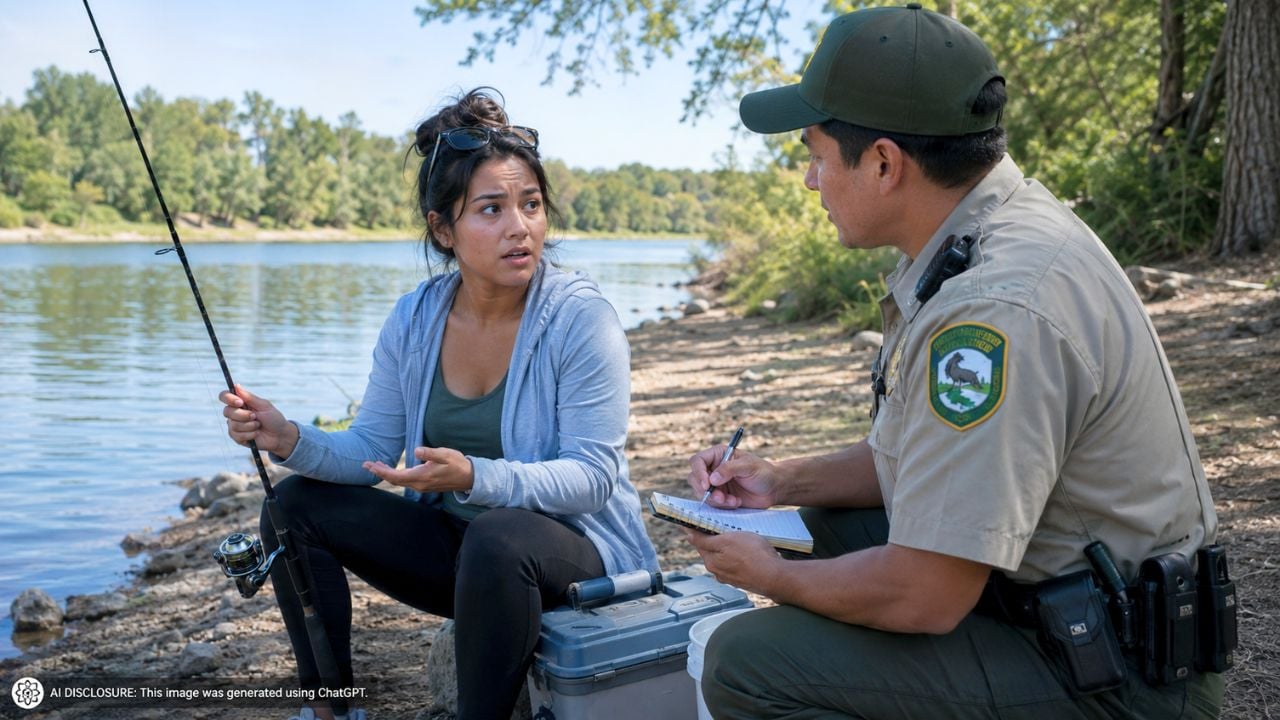
Photo credit: AI-generated image created using ChatGPT. Illustrative only.
She wasn’t out there chasing a limit or running a slick operation on the water. She was killing a couple hours with borrowed gear, waiting on her brother to get off work so they could go catch a movie. And then a game warden walked up and changed the whole day.
In the original post, the brand-new angler said she’d basically never fished before, but decided to try it on July 13, 2021. She didn’t catch anything, and she said her line wasn’t even in the water when she was contacted. What she did have, though, was no North Dakota fishing license—and in that state, she learned the hard way, that can turn into a criminal citation.
A casual “kill some time” outing turned into a citation
Most folks start fishing the way she did: borrow a rod, find a spot that looks fishy, and see what happens. No complicated plan. No deep knowledge of seasons and regulations. Just a quiet way to burn an evening.
But she said a game warden approached her and cited her for fishing without a license. The surprise wasn’t just the stop—it was the seriousness. She wrote that in North Dakota it’s a Class B misdemeanor, and she couldn’t believe she might be staring at that on what had been a spotless record.
Not catching fish doesn’t mean you aren’t “fishing” in the eyes of the law
One detail that jumps out is her statement that she hadn’t caught a fish and didn’t even have her line in the water when she was approached. That’s the kind of thing beginners assume will matter, because in normal life we judge actions by results: no fish, no harm, no foul.
But fishing regulations usually don’t work that way. In many places, it’s not about whether you caught something—it’s about participating or attempting to participate. Even being geared up at the water can be enough for an officer to investigate. Wardens aren’t mind readers, and they’re trained to enforce what the rule says, not what a person meant to do.
The part that hits hardest: misdemeanor language and a “spotless record”
If you’ve never had so much as a speeding ticket, the word “misdemeanor” lands heavy. Outdoorsmen tend to be practical about consequences: fines happen, mistakes happen. But when you start talking about a criminal charge, people get real serious real fast.
That’s where she was. She wrote that she couldn’t believe she might have a Class B misdemeanor on her record over a first-time fishing mistake. She asked if there was anything she could do to avoid it and whether anyone else had been in the same situation.
How it played out in court: a deal, a big fine, and a year of looking over your shoulder
About a month later, she updated her post with what happened at her first court appearance on August 11, 2021. She showed up early and spoke with the state’s prosecuting attorney, and she was offered a deal: the Class B misdemeanor would be dismissed if she didn’t commit any more crimes in North Dakota for a year.
That didn’t mean it was free. She said she had to pay a $500 fine, and the court allowed her to pay it over the course of a year. She also said she had to plead guilty and was placed on unsupervised probation. Since she doesn’t live in North Dakota, she noted she could live in any other state, but she needed to keep the court updated with her current address.
Her takeaway was blunt. Even if a fishing license costs $50 like hers did, she said the ordeal wasn’t worth it—and if you know you need a license, go get one.
Practical lessons for new anglers (and the folks who bring them along)
This is one of those situations that can happen to anybody, especially a beginner who doesn’t know what questions to ask. A lot of us grew up in fishing families where “get your license” was as normal as “bring sunscreen.” When you’re new, it might not even cross your mind that you need paperwork to stand on the bank with a rod.
If you’re the experienced one inviting someone along—brother, buddy, boyfriend, girlfriend, whoever—do them a favor and make the license part of the plan. Don’t assume they’re covered. Don’t assume “I’m not really fishing” is a safe gray area. Before you leave the driveway, take two minutes and confirm what the state requires for residents, nonresidents, short-term licenses, age exemptions, and whether a license is needed just to fish from shore.
And for the new folks: if you’re traveling, don’t assume rules follow you across state lines. Some states are more forgiving, some are stricter, and the penalties can be a lot steeper than people expect. The license fee feels annoying until you compare it to court, probation, and a $500 fine.
One last point that outdoorsmen understand: game wardens aren’t just out there for paperwork. Licenses fund management, stocking, access, enforcement, and habitat work. Getting legal isn’t just “avoiding trouble.” It’s part of paying into the system that keeps fishing worth doing.
In the end, this wasn’t a story about someone trying to skirt the rules. It was a brand-new angler learning—fast—that “I didn’t know” doesn’t carry much weight once you’re on the water. The cheapest part of most fishing trips is the license, and it’s the one thing that keeps an easy evening from turning into a year-long headache.