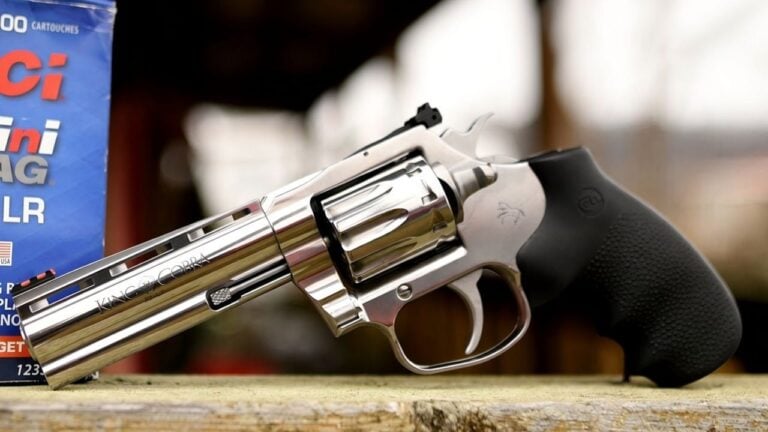
Photo credit: By Falcon® CC BY-SA 2.0, /Wikimedia Commons
Every hunter has been there—you spot an animal on the far side of a meadow or just beyond the treeline, and the shot looks tempting. But not every caliber is built to carry that kind of distance. Some lose energy too quickly, some drop like a rock after 150 yards, and others were never meant for anything beyond close-range woods hunting. Knowing which calibers fall flat outside the treeline keeps you from wasting ammo and risking wounded game. These rounds might work fine inside thick timber, but once the distance stretches, they run out of steam. Here are the calibers that can’t be trusted to carry past the treeline.
.30-30 Winchester

The .30-30 Winchester is the king of short-range woods hunting, but once you step past the treeline, it shows its limits. With flat-nosed bullets and modest velocity, it drops quickly after 150–200 yards. That’s fine for close-in deer, but beyond that, you’re pushing it.
Hunters love it for its reliability and history, but it was never designed to be a long-range round. Even with modern ammo, it can’t hold energy or trajectory against open-country calibers. A .30-30 hit inside 100 yards is deadly, but when you try stretching across a meadow, you’re working against physics. Many hunters have learned this the hard way, watching bullets fall short or impact with little authority. Inside timber, the .30-30 shines. Beyond the trees, it simply doesn’t carry enough to anchor game reliably. If you want performance past the treeline, you need something built with reach in mind.
.35 Remington

The .35 Remington has anchored deer and bear for over a century, but it’s not a cartridge that carries well once you’re outside of the woods. Its slow, heavy bullets hit hard up close, but they lose velocity quickly, dropping energy and trajectory in dramatic fashion past 200 yards.
In thick brush, the .35 Remington excels. It handles tough angles and delivers reliable penetration at short distances. But when you try stretching it across a clearing, it falls behind. Even with handloads, it simply wasn’t designed to compete at range. Many hunters who brought it out west discovered it was a poor match for open country. It remains a favorite in the Northeast and South where shots are short, but once you step past the treeline, it’s out of its league. It’s a woods rifle through and through, not something you carry when long shots are on the menu.
.45-70 Government

The .45-70 Government is a powerhouse inside 200 yards, but that’s where it stops. Heavy bullets moving at moderate speeds make it devastating up close, yet they arc steeply once distance increases. Past the treeline, you’re dealing with rainbow trajectories and quick loss of energy.
Hunters who carry .45-70s know this round isn’t about reach—it’s about impact in thick country. In brush, timber, or short-range elk hunts, it delivers like few others. But once you stretch into open meadows or across ridgelines, the limitations become obvious. Even with modern “hot” loads, you’re not extending its true effective range much. It’s a caliber that thrives inside the trees, not beyond them. That’s why it remains beloved in Alaska’s alder thickets and Montana’s dark timber, but not in wide-open country. The .45-70 is one of those cartridges that commands respect up close but simply can’t carry once the distance grows.
.44 Magnum

The .44 Magnum is often chambered in carbines and rifles, and while it’s deadly in thick woods, it doesn’t carry past the treeline. Its bullets are heavy and slow, which makes for devastating performance up close but poor trajectories once the distance stretches. Beyond 100–150 yards, it falls off fast.
Hunters carrying .44 Magnum rifles usually do so knowing they’ll be in brush or timber where shots are close. The round was never designed for open-country hunting, and trying to make it reach only highlights its limits. Even handloaded or with modern ammo, it doesn’t have the velocity or ballistic coefficient to perform at distance. It’s a great cartridge in its lane, but step outside that, and it’s a liability. If you take a .44 into the woods, it will serve you well. If you try to use it past the trees, it’s the wrong tool for the job.
.357 Magnum (Carbine)

The .357 Magnum out of a rifle-length barrel makes a handy woods gun, but once you’re outside of timber, it quickly loses credibility. It’s accurate and effective under 100 yards, but past that, bullet drop and energy loss become impossible to ignore. It was never designed as a long-range caliber.
Hunters who use .357 carbines like the lightweight handling and fast follow-ups. In thick brush, it’s more than enough for deer and hogs. But when the shot stretches, it lacks both reach and authority. Compared to rifle cartridges, the .357 is simply out of its element. Even the hottest loads can’t compete with cartridges built for distance. That’s why it’s loved as a close-range hunting or ranch rifle but dismissed once you move beyond the treeline. It’s not a question of whether it works—it does, in its range. Beyond that, it’s a round that hunters know won’t carry.
.32 Winchester Special

The .32 Winchester Special was meant to offer a step up from the .30-30, but it suffers from the same limitations. It shoots heavier bullets at modest speeds, which makes it deadly up close but unreliable at longer distances. Once you push past 200 yards, it drops hard and sheds energy fast.
Hunters who grew up with lever guns know the .32 Special shines in the timber. It puts animals down cleanly inside the woods. But once you’re outside, you’re handicapping yourself. Compared to modern calibers, it can’t stretch its legs. Even with pointed bullets from handloads, the trajectory isn’t competitive. It’s the kind of caliber that’s tied to nostalgia and tradition more than practicality in open country. If you stick to the timber, it’s great. If you plan to shoot across a meadow or treeline, it’s not the caliber you want to bet on.
.300 Blackout

The .300 Blackout is versatile and popular, but as a hunting round, it doesn’t carry much beyond the treeline. With subsonic loads, range is laughable, and even supersonic options top out quickly. By 200 yards, it’s losing energy and accuracy compared to nearly every mid-size rifle caliber.
Hunters who use .300 Blackout like it for hogs and deer inside 100 yards, and it performs well in that lane. But once you start talking about longer shots, it falls apart. The round was designed for suppressed performance, not long-range reach. Out of the trees, it becomes obvious you’re handicapping yourself. Compared to .308, 6.5 Creedmoor, or even .243, the .300 Blackout can’t compete. It’s a great short-range cartridge, but if you take it outside the woods, you’ll be disappointed. Hunters respect it for what it is, but no one pretends it’s a long-range round.
.219 Zipper

The .219 Zipper was an interesting experiment in its day, but it never carried well, and that’s why it faded out. Its light bullets and modest velocity made it effective on varmints at close ranges, but beyond 200 yards, it couldn’t maintain accuracy or energy. For hunting past the treeline, it simply doesn’t measure up.
Hunters who’ve tried the .219 often found themselves limited by bullet selection and poor ballistic performance. Compared to .22-250 or .220 Swift, it was always the weaker option. That’s why it remains more of a collector’s curiosity than a practical tool today. It represents the kind of cartridge that works fine inside the timber but falls flat in open country. If you find one, it’s a neat rifle to own, but not something you’d rely on past the trees. The .219 Zipper is a reminder that not every old idea could stand up to real field conditions.
.351 Winchester Self-Loading

The .351 Winchester Self-Loading was designed for early semi-automatic rifles, and it served its purpose in short-range hunting. But once you step outside the trees, its limits become obvious. The bullet choices are limited, and the round simply doesn’t hold energy at distance. By 200 yards, it drops and loses authority fast.
Hunters who’ve used it know it can be effective on deer inside 100 yards, but past that, it’s not reliable. Compared to other calibers available even in its heyday, it was never a standout for range. Today, it’s more of a collector’s caliber than anything else. If you’re thinking about carrying it beyond timber country, you’ll quickly see why it never gained wide popularity. The .351 shows exactly why some rounds are confined to brush hunting and don’t belong in open-country situations. It was built for a specific purpose, and carrying past the treeline was never part of it.
.25-20 Winchester

The .25-20 Winchester is another old woods round that doesn’t carry outside the timber. Its light bullets lack the velocity and energy to perform at distance, and even when new, it was considered a short-range cartridge. At best, it’s effective on varmints and small game. On larger animals, its limits show quickly.
Hunters sometimes tried it on deer inside the woods, but even then, it was marginal. Past the treeline, it becomes a non-starter. The trajectory is steep, the retained energy is poor, and the round simply wasn’t designed for open country. Today, it survives mostly in older rifles and among handloaders who enjoy its history. But as a practical hunting round outside the trees, it has no role. If you carry one, keep your expectations realistic—it’s a relic of a time when close-range woods hunting was the norm, not a cartridge meant for reaching across fields.
.22 Hornet

The .22 Hornet was once a popular varmint cartridge, but it doesn’t carry well outside the timber. With light bullets and modest velocity, it drops quickly and loses accuracy after 150–200 yards. For small game and varmints inside the trees, it’s fine. Beyond that, it’s not dependable.
Hunters often compared it to the .223 Remington, which quickly overshadowed it. The Hornet simply can’t keep up in trajectory, energy, or bullet performance. Even with modern loads, it remains a short-range tool. If you take it outside the treeline, you’ll see immediately why it faded from serious hunting use. It’s still fun for plinking and nostalgic shooting, but it’s not a caliber that belongs in open-country hunting. The Hornet is a cartridge defined by its limitations. It thrives in the timber where shots are short, but it can’t carry when distance becomes part of the equation.
7.62×39mm

The 7.62×39mm is a workhorse round for military rifles, but as a hunting cartridge, it doesn’t stretch beyond the treeline. Its trajectory is steep, and energy falls off fast after 200 yards. That makes it fine for hogs or deer inside timber but unreliable once the shot stretches across a clearing.
Hunters who use it appreciate its availability and effectiveness at short range, but they know it’s not built for long shots. Compared to .308 or 6.5 Creedmoor, it’s simply outclassed. The bullets lack the BC to fly straight and retain energy. For brush hunts, it’s fine. For open-country elk or mule deer, it’s a liability. If you’re serious about performance outside the trees, the 7.62×39 isn’t the tool for the job. It remains popular because of the rifles chambered for it, but when judged strictly as a hunting caliber, its limitations are clear. Past the treeline, it’s not a contender.
*This article was developed with AI-powered tools and has been carefully reviewed by our editors.