Photo credit: The Avid Outdoorsman
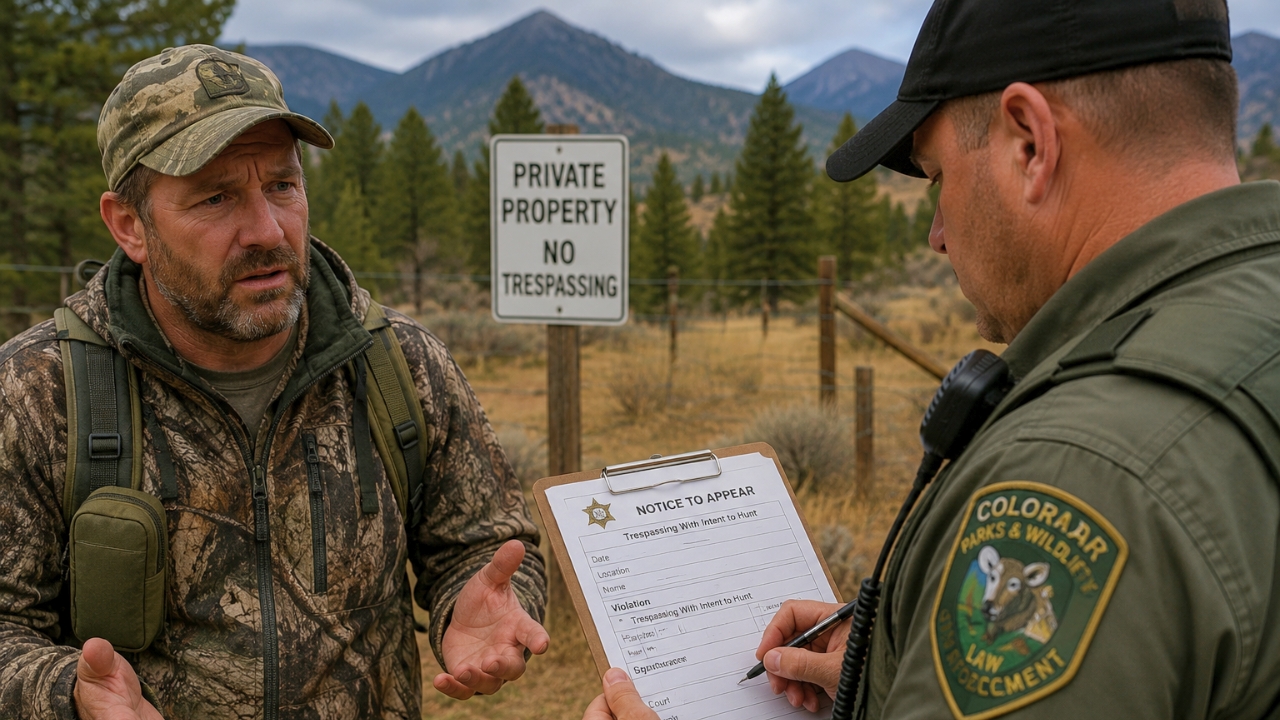
A Colorado hunting trip turned into a legal headache after hunters said they were cited for trespassing with intent to hunt.
According to the Reddit post, the hunters were facing tickets tied to being on property where they allegedly did not have permission while hunting. That is a different kind of problem than a normal trespassing warning, because the hunting angle can bring wildlife consequences on top of the ordinary legal ones.
The poster was not just worried about paying a fine. They were worried about what the charge could mean for their ability to keep hunting.
They explained the situation in a Reddit thread and asked what could happen after getting a trespassing-with-intent-to-hunt ticket in Colorado: https://www.reddit.com/r/legaladvice/comments/e6tqf1/co_trespassing_charge_with_intent_to_hunt/
The hunting part made it more serious
Trespassing is already a problem.
Trespassing while hunting can be worse. If someone crosses onto private land while carrying a rifle, bow, tag, or other hunting gear, the state may treat it differently than someone who simply stepped over a fence while hiking.
That was the part that worried the poster.
Hunters know that wildlife violations can follow them longer than a normal ticket. A citation can potentially affect licenses, preference points, future draws, or the ability to hunt in other states depending on what the violation is and how it is resolved.
That is why commenters did not treat it like a simple “just pay the fine” situation.
Commenters warned them not to ignore the ticket
One of the biggest practical points was that the hunters needed to take the citation seriously.
A lot of people are tempted to pay a ticket just to make it go away. But with hunting-related charges, paying can sometimes function like admitting guilt or accepting the violation. That can have consequences beyond the fine.
Commenters warned that if the hunters cared about their licenses, they needed to understand exactly what the charge meant before resolving it.
That meant reading the citation, checking Colorado wildlife rules, and likely talking to an attorney familiar with hunting or wildlife law.
The cheapest path in the moment may not be the safest long-term move.
Property boundaries were the center of the dispute
Hunting trespass cases often turn on the boundary.
Where exactly were the hunters standing? Was the land posted? Was there a fence? Was the property line clear? Did they rely on a map, GPS app, old information, or someone else’s permission?
Those details matter because a boundary mistake can happen, especially in western hunting country where public and private parcels can be mixed together in confusing ways.
But hunters are still responsible for knowing where they are.
That is why mapping apps, paper maps, landowner permission, and careful route planning matter so much. A mistaken property line can still lead to a ticket if a hunter ends up where they are not allowed to be.
GPS proof may help, but it may not solve everything
Hunters often rely on GPS apps to prove where they were.
That can help, but it is not always perfect. Phone GPS can drift. Property layers can be outdated. Parcel lines may not match fences or physical features. A screenshot after the fact may not answer every question.
Still, if the hunters had tracks, pins, timestamps, or screenshots showing they believed they were on legal ground, that evidence could matter.
Commenters generally encourage saving everything immediately. GPS tracks, photos, messages, landowner contacts, maps, and the exact location where the citation was issued could all become important.
If the hunters waited too long, some of that evidence might disappear.
A wildlife attorney could be worth it
Several commenters in cases like this usually point toward getting legal help.
That is because the stakes can be bigger than the fine. If a conviction or guilty plea affects hunting privileges, the hunter may regret handling it alone.
An attorney could look at the citation, the specific statute, the facts, the location, and the possible license consequences. They could also speak with the prosecutor or court about reducing or dismissing the charge if the facts support it.
For someone who hunts every season, that may be money well spent.
The question is not whether the fine is expensive. The question is whether the outcome could follow the hunter into future seasons.
The license issue was the real fear
The poster’s biggest concern was not just court.
It was whether Colorado Parks and Wildlife could suspend or revoke hunting privileges. That fear is understandable because states take trespass-related hunting violations seriously.
A hunter who loses license privileges does not just lose one day in the field. They may lose seasons, tags, draws, and opportunities they have been planning for years.
That is especially painful in states where big-game tags can be hard to draw.
That is why commenters urged caution. The hunters needed to know whether the charge carried points, suspension risk, or any reporting consequences before deciding what to do.
Other states could also matter
One issue many hunters miss is reciprocity.
Some wildlife violations can affect hunting privileges beyond the state where the ticket happened, especially if the state participates in a compact or shares revocation information.
That means a Colorado hunting citation could potentially become a problem for a hunter who also applies in other states.
The exact consequences depend on the violation and the outcome, but the possibility is enough to make the ticket worth taking seriously.
A person who hunts only once may see a citation differently than someone who applies across several western states every year.
Commenters asked whether they had permission
Permission is everything in private-land hunting.
If the hunters believed they had permission, they needed to prove it. Texts, written notes, names, maps, lease documents, outfitter information, or messages from a landowner could all matter.
If they relied on verbal permission from someone who did not actually control the property, that could be a problem.
If they were following an outfitter, guide, friend, or local who told them the land was public or accessible, that person’s information might explain the mistake, but it may not fully protect them.
Hunters are expected to verify access before they hunt.
Paying quickly could be a mistake
The thread worked as a warning because the easy option might be the wrong option.
A hunter who sees a ticket may think, “I’ll just pay it and move on.” But if paying creates a conviction or confirms a wildlife violation, the long-term cost could be much higher than the amount on the ticket.
That is why commenters advised slowing down.
Before paying, the hunters needed to know whether the citation required a court appearance, whether it was a criminal charge, whether it affected hunting points or licenses, and whether there was any way to contest or reduce it.
Fast does not always mean finished.
The incident showed how thin the margin can be
Western hunting often happens in places where public land, private ranches, leased parcels, state land, and access roads are tangled together.
A hunter can be legal on one side of a line and in trouble a few steps later. That does not make every citation fair, but it shows why land access is one of the most important parts of planning a hunt.
Scouting is not only about animals. It is about boundaries.
The hunters in the Reddit thread were learning that the hard way.
The best move was to protect the hunting future
The practical advice was clear.
Do not ignore the ticket. Do not casually pay it without understanding the consequences. Save GPS tracks, maps, photos, permission records, and anything showing where you were. Contact Colorado Parks and Wildlife if needed to understand the license side. Consider a lawyer who understands wildlife violations.
A trespassing-with-intent-to-hunt ticket is not just a bad end to a hunt. It can become a problem for future seasons if handled poorly.
For hunters, the lesson is simple: know the land, document permission, save your tracks, and treat any hunting-related citation like it could matter long after the fine is paid.
Like The Avid Outdoorsman’s content? Subscribe to our newsletter so you never miss an article.
Here’s more from us: