Photo credit: AI-generated image created using ChatGPT. Illustrative only
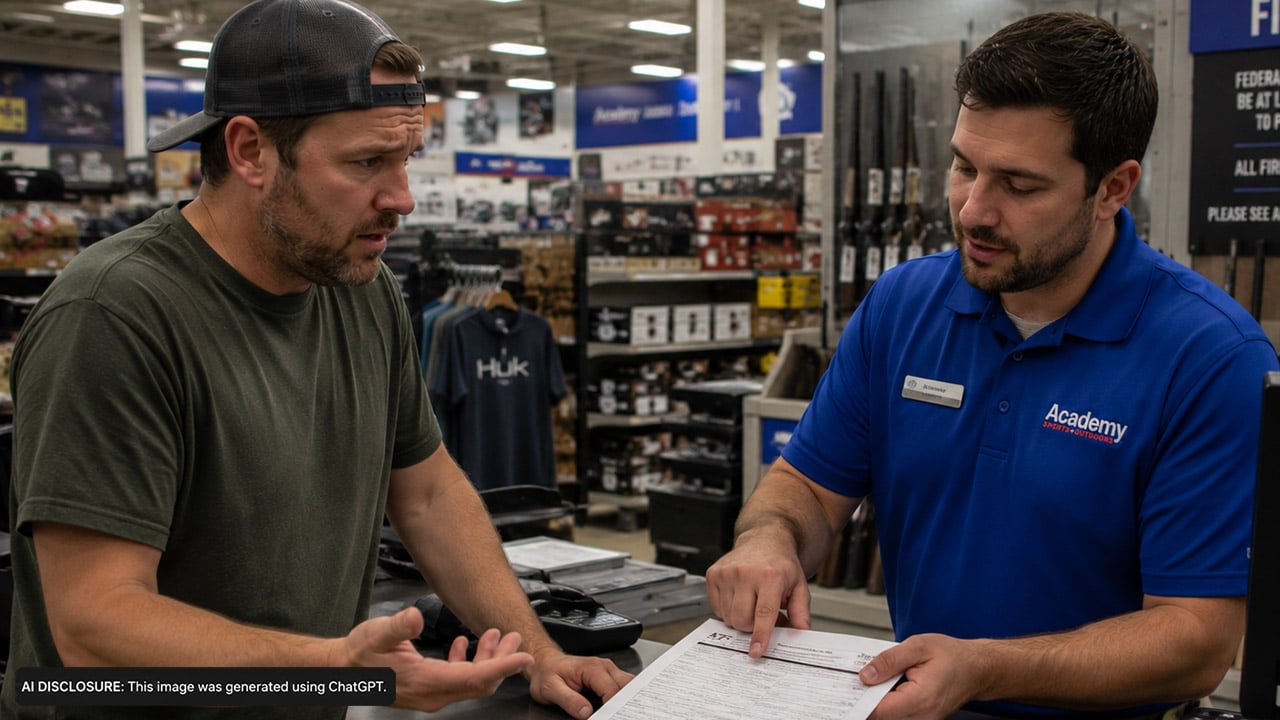
Anybody who’s bought a firearm from a big-box store knows the routine: wait your turn, show your ID, then work through the federal paperwork that feels like it was written by a committee that hates plain English. One buyer found that out the hard way after making a wrong click on the ATF’s yes/no section while trying to buy a gun at Academy Sports.
In the original post, the buyer said he asked the counter clerk for clarification on a confusing question, but was told it was against store policy to help interpret it. He submitted the form anyway, then was told he couldn’t buy the firearm. The clerk reportedly explained he wasn’t “denied,” but “delayed,” and would have to wait 30 days to retake the questionnaire—while the store would even reserve the firearm until then.
The mistake happened on one of the most confusing questions on the form
The buyer said the question he tripped over was the one asking whether he intended to purchase a firearm or ammunition “for sale or other disposition” to someone described in a list of prohibited categories, including a reference to certain nonimmigrant aliens who don’t fall within an exception.
That question is a mouthful, and the buyer admitted he read it two different ways in his head. One interpretation—what he later recognized as the correct one—was essentially: “Are you buying this gun to turn around and hand it to someone who’s prohibited (including certain nonimmigrant alien situations)?” The other interpretation he wrestled with was whether the question was asking about his own immigration status.
Academy’s policy, not a federal “30-day delay,” appears to be what stopped the sale
From the buyer’s description, the show-stopper wasn’t a background check coming back as a hard “denied.” It sounded like a store-level stop after an incorrect response on the yes/no portion—followed by a store-imposed waiting period to redo the paperwork.
The buyer asked the practical question most folks would ask: is that 30-day wait a company policy, and can he simply go buy the same firearm somewhere else—Bass Pro or Cabela’s—without being “flagged?” In other words, is he stuck in time-out with one retailer, or is he effectively blocked from buying a gun anywhere for a month?
When stores won’t “help,” the iPad format can make things worse
One detail that matters here is how the form was presented. The buyer said Academy uses iPads for the questionnaire. That sounds modern and efficient—until you realize a touchscreen doesn’t slow anybody down, doesn’t give you a margin to scribble notes, and doesn’t always provide the extra context a printed packet can.
When the buyer asked for clarification, he says the clerk wouldn’t explain it due to store policy. Whether that policy is meant to keep employees from giving sloppy legal advice or to keep the process uniform, the real-world result is simple: a customer stares at a confusing sentence, guesses, taps “submit,” and now the whole purchase is jammed up.
The buyer’s biggest worry: “If I go somewhere else, will I be flagged?”
This is the kind of question that makes honest gun buyers nervous, especially newer buyers. Nobody wants to accidentally create a paper trail that looks suspicious when all they did was misunderstand one badly written question.
From what the buyer wrote, his intent was not to do anything illegal. He was trying to understand what the form meant, couldn’t get help at the counter, and ended up answering in a way that stopped the transaction. That’s not the same thing as someone attempting a straw purchase. But it’s easy to see why a person would worry that a wrong answer could follow them from store to store.
Another big-box store reportedly prints an explanation for that exact question
Here’s the part that should make retailers—and buyers—pause. The buyer later added that Bass Pro “actually has a printed sheet explanation for THIS SPECIFIC QUESTION because of how many people misinterpret this question.” That one sentence tells you everything: the confusion isn’t rare, and it isn’t just this buyer.
If one chain has found it necessary to hand customers an explanation sheet for a specific question, that’s a pretty strong sign the wording is routinely misunderstood. It also shows there are ways to help customers understand what they’re answering without an employee getting into a back-and-forth legal debate at the counter.
What outdoorsmen can learn before they walk up to the gun counter
If you buy guns for hunting season, predator control, ranch work, or just to protect the homestead, the paperwork is part of the deal—same as checking your zero and keeping your mags clean. The best move is to slow down and read every line like it matters, because it does.
This story is also a reminder to pick your store wisely. Some places rely on rigid “we can’t explain anything” policies and a tablet screen that pushes you to hurry. Others at least acknowledge the reality that certain questions are confusing and provide printed explanations. When you’re spending serious money on a firearm, it’s fair to want a process that’s clear, consistent, and doesn’t punish honest mistakes.
Most of all, don’t let the pressure of a line behind you turn a federal form into a speed drill. Take your time, ask for whatever store-approved guidance exists, and if something doesn’t make sense, it may be better to pause the transaction than to guess. A hunting rifle or home-defense handgun is supposed to give you confidence—getting tripped up at the counter over a poorly worded question is the opposite of that.
Like The Avid Outdoorsman’s content? Subscribe to our newsletter so you never miss an article.
Here’s more from us: