Photo credit: Serhii Zavalnyi/Shutterstock.com
A concealed carrier on Reddit said he and his girlfriend were driving to go hiking on a Sunday when they passed an intersection near their apartment and saw something that made him stop thinking like a bystander. A man was dragging a woman by the hair into the road. The woman was being hit in the head and face with what looked like a metal rod, and it was happening right there in public, close enough that the driver could not tell himself he had imagined it. They were not watching a couple argue from a distance. They were watching a woman being violently attacked in the street.
The driver had a gun on him. He also had his girlfriend in the vehicle, traffic around him, and a situation unfolding fast enough that every option carried risk. If he kept driving, he would leave the woman with a man who appeared to be beating her with a weapon. If he stopped, he would be stepping into a violent scene where he did not know the attacker, did not know the woman, did not know whether anyone else was involved, and did not know if the man had more weapons. That is the kind of moment people argue about online all day, but in real life, you get seconds.
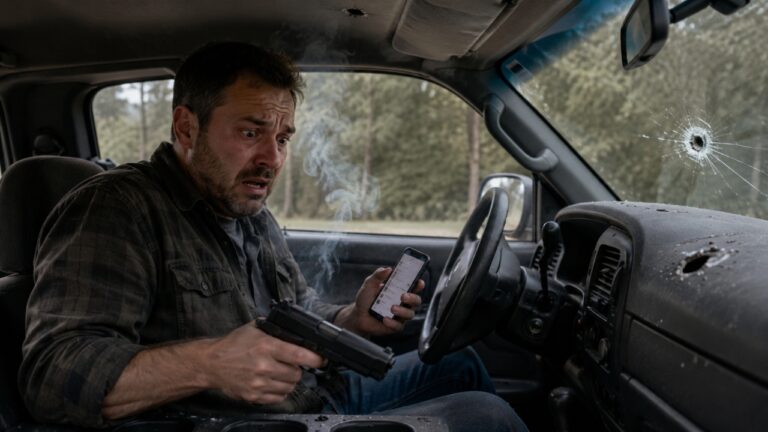
He stopped and got out with his gun. According to his post, he drew on the attacker and gave loud commands. That changed the scene immediately. The attacker stopped what he was doing long enough for the woman to get away from him. The driver’s girlfriend called 911. The whole thing became one of those rare defensive-gun moments where the gun did not have to fire to change the outcome, but it still carried every bit of seriousness that comes with pointing a firearm at another person.
That is the part a lot of people miss when they talk about carrying. Drawing is not some neat little “problem solved” button. The second the gun comes out, the carrier owns a stack of decisions. Where is the muzzle? What is behind the person? Is the woman still close to him? Are there cars moving? Are there pedestrians? Is the attacker still holding the weapon? Is he closing distance? Is he complying? Is the carrier about to be mistaken for the aggressor when police arrive? All of that is happening while adrenaline is trying to take over.
The Redditor said police eventually arrived, and the situation moved into the legal and emotional aftermath. That may be the least glamorous part of carrying, but it is one of the most important. Even when you believe you did the right thing, you may still have to explain every second of it to officers who only know that someone called 911 about a person with a gun and a violent assault. The woman was injured. The attacker had allegedly been beating her. The carrier had drawn his firearm. There is nothing casual about that scene.
The comments went back and forth on whether he made the right call. Some people believed he stopped a serious assault and may have saved the woman from worse injuries. Others warned him about the danger of intervening in domestic violence situations, where the victim may not cooperate, the attacker may redirect violence toward the helper, and the legal picture can get muddy fast. That is not armchair nonsense. Domestic violence calls are dangerous for police for a reason, and an armed citizen stepping into one has to understand that the situation may not unfold the way it looks from the first few seconds.
Still, the facts as he described them were hard to ignore. A woman was being dragged by the hair into the road and beaten with what looked like a metal rod. That is not somebody yelling in a parking lot. That is a violent attack with an apparent weapon. The carrier did not describe chasing the man down, firing a shot, or trying to hold court on the roadside. He stopped the immediate assault, gave commands, and let police take over.
For anyone who carries outdoors, on the road, at trailheads, or while traveling to hike, hunt, fish, or camp, this is the kind of scenario worth thinking through before it happens. Not because anyone should go looking to play hero, but because public violence does not wait until you feel prepared. If you carry, you need to know your state’s laws on defense of others. You need to know when deadly force may be justified and when it is not. You need to know how to communicate with 911 and responding officers. And you need to understand that drawing a gun can solve one problem while creating several more you still have to survive legally and morally.
The driver left that day with a lot to process. He had started out heading to a hike with his girlfriend and ended up standing at an intersection with a gun out, trying to stop a woman from being beaten in the road. No shots were fired. The attack stopped. Police arrived. That is about as clean as an ugly situation like that can end, but it is still the kind of moment that follows a person long after the gun goes back in the holster.