Photo credit: Freeograph/Shutterstock.com
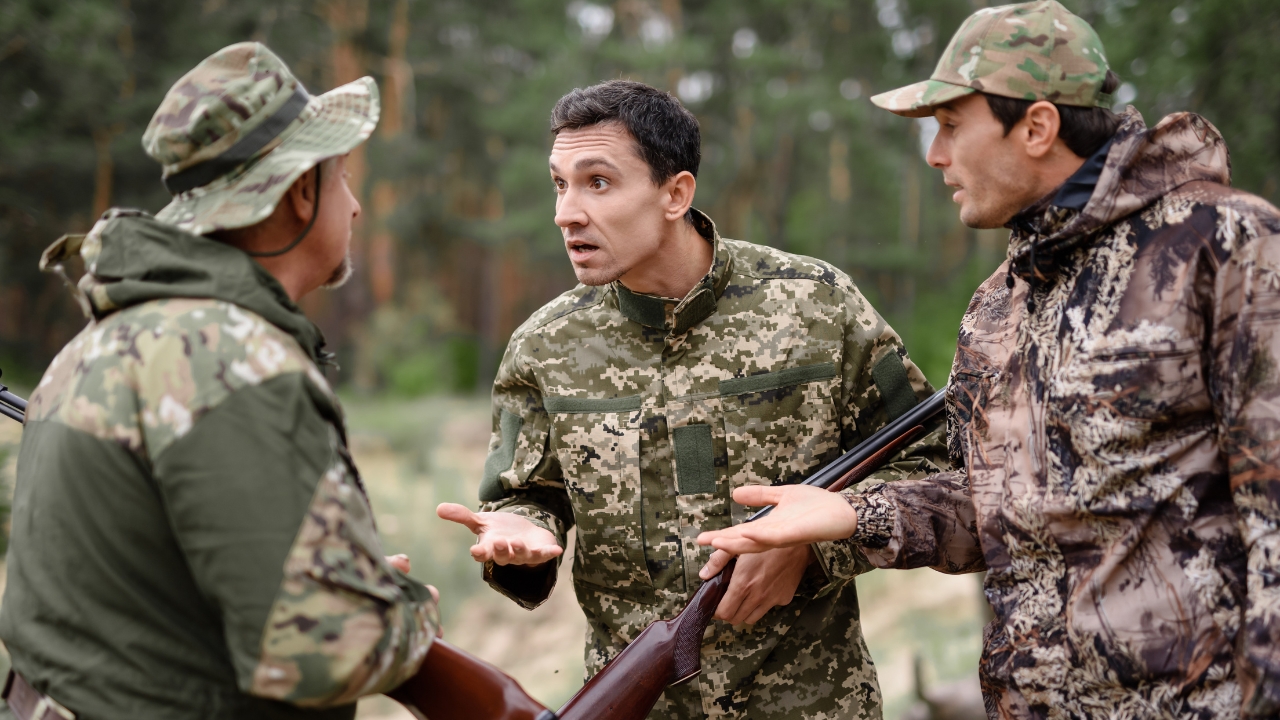
Public land has a funny way of making people act like they’ve got a deed in their pocket. A hunter finds a good ridge, kills a deer there once, hangs a camera for a few weeks, or parks at the same gate every opening weekend, and suddenly he starts talking like the place belongs to him. Then another hunter walks in, sets up legally, and hears the line that starts more public-land arguments than almost anything else: “You’re in my spot.”
That kind of confrontation can get tense fast because both sides usually feel like they’re right. One guy thinks history gives him claim to the area. The other guy knows public land is open to everyone. The truth is simple, but the situation still needs to be handled carefully. You can be legally right and still make a bad choice if you let pride take over in the dark, in the woods, with armed strangers around.
Stay calm and don’t argue ownership
The first thing to remember is that public land is public land. Unless there is a specific draw, reservation, posted closure, leased section, or special rule in place, nobody owns a spot because they hunted it last year. But saying that with too much attitude can make things worse quick.
You don’t need to give a speech about rights, taxes, access, or how the land belongs to everybody. Keep it plain. “I didn’t know anyone else was hunting here. I’m set up legally.” That says enough. If the other hunter is reasonable, he may grumble and move on. If he’s not reasonable, a longer argument won’t make him better. It just gives him more to push against.
Don’t let his confidence rattle you
Some hunters say “my spot” with so much confidence that it makes newer hunters second-guess themselves. They’ll talk about how long they’ve hunted there, how many deer they’ve killed there, where their camera is, where their buddy is sitting, or how everyone around there knows not to mess with that ridge. That can sound official when you’re standing there in the dark.
But confidence is not authority. A hunter’s history with a place does not give him legal control over it. If you accessed the land properly, followed the rules, and set up safely, you do not have to leave simply because someone else wanted the area. The decision becomes less about who is “allowed” and more about whether staying is smart.
Keep your hands and muzzle under control
Any confrontation in the woods comes with one rule that matters more than the argument: stay safe with your firearm. Keep the muzzle pointed in a safe direction. Don’t gesture with the barrel. Don’t adjust your gun in a way that could be misunderstood. Don’t step toward the other hunter aggressively.
A lot of public-land confrontations start as words, but the presence of firearms raises the stakes. Even if nobody intends harm, nervous movement can look threatening. Move slowly. Speak calmly. Keep your hands visible if you’re not holding your gun. The other hunter may be irritated, but he still needs to see you acting like a safe, controlled person.
Ask one practical question
Instead of arguing about who has the better claim, ask something practical: “Where are you set up?” or “Which direction are you hunting?” That moves the conversation from ego to safety. If he’s already in a stand 100 yards away, you need to know that. If his buddy is watching the same draw, that matters. If you’re both aiming into the same funnel, neither of you has a good setup anymore.
This question can also reveal whether he’s being reasonable. A decent hunter may explain the situation and help both of you avoid crowding each other. A hothead may just repeat that it’s “his spot.” Either way, you learn something. And you keep the conversation focused on hunting safely instead of arguing over imaginary property lines.
Don’t touch his stand, camera, or gear
If someone has a stand, blind, or trail camera nearby, leave it alone. Even if it’s on public land and even if he’s acting like a jerk, his gear is not yours to move, inspect, turn, open, borrow, or mess with. Touching another hunter’s equipment is one of the fastest ways to turn a territorial argument into a serious problem.
If the gear appears illegal, abandoned, or placed against local rules, document it safely and report it to the proper agency or land manager. Don’t handle it yourself unless the rules specifically allow that, and even then, be careful. You do not want to be standing there with someone else’s camera or stand in your hands when the owner walks up mad.
Decide if staying is worth it
There are times when you may have every right to stay, but the hunt is already damaged. If the other hunter is angry, loud, and determined to sit close anyway, you may spend the whole morning listening for him instead of watching deer. If he has buddies nearby or keeps trying to intimidate you, staying may not be worth the risk.
That’s not the same as letting someone bully you off public land. It’s making a practical call. Is the spot worth a long, tense morning? Do you have another setup ready? Is the other guy unstable enough that you don’t want to be around him with firearms involved? Sometimes the smartest move is to leave, note what happened, and report anything threatening or illegal later.
If you stay, create as much separation as possible
If both of you decide to hunt the general area, distance matters. Don’t sit close enough that your shooting lanes overlap. Don’t walk through his setup on purpose. Don’t set up where your presence creates a clear safety problem. Even when nobody owns the spot, both hunters still have a responsibility to hunt safely.
Be honest about whether the setup still makes sense. Public land can be big on a map and small in real life. A ridge, saddle, creek crossing, or food source may not safely handle two hunters sitting close together. If you can shift without ruining your own hunt, do it. If you can’t, one of you needs to move, and that decision may come down to who values peace more than pride.
Don’t escalate over parking-lot history
A lot of these disputes begin at the truck. Someone sees you parked at “his” gate and starts the conversation before you even hit the trail. He might tell you he’s hunted there for years or that his group always uses that access. That still does not make the access his.
At the same time, parking-lot arguments are rarely worth feeding. If someone confronts you before daylight, stay polite and brief. “I’m heading in that direction, so I’ll give you space if I see you.” That shows you’re not looking to crowd him, but you’re also not handing over public access because he got there with an attitude. Keep moving, avoid insults, and don’t turn the lot into a show.
Document threats, not ordinary grumbling
There’s a difference between a hunter being irritated and a hunter crossing the line. Someone saying, “I usually hunt here,” or “Man, that was my plan,” is not worth reporting by itself. Someone threatening you, blocking access, harassing you, firing dangerously, damaging gear, or trying to force you out of legal public land is different.
If things cross that line, document what you can without escalating. Note the time, location, description, vehicle, plate if safely visible, and exactly what was said or done. Then contact the wildlife agency, land manager, or local law enforcement as appropriate. Don’t try to win the whole fight in the woods. Get out safely and handle the serious part through the right channel.
Build backup spots so you aren’t trapped by one plan
The best way to handle someone claiming a spot is to avoid being emotionally locked into that one spot yourself. Public land is unpredictable. If your whole hunt depends on one tree, one crossing, or one ridge, another hunter can ruin your morning before daylight. That makes you more likely to argue because you feel like you have nowhere else to go.
Scout several options. Have spots for different winds, access points, pressure levels, and times of day. Keep a couple of less-obvious setups in your back pocket. When another hunter acts territorial, options keep you calm. You can stay if it makes sense, move if it doesn’t, and still feel like you have a hunt ahead of you.
Remember that respect cuts both ways
Nobody owns public land, but nobody should act like a slob on it either. If you arrive second and someone is clearly already set up, don’t crowd him just because you can. If you arrive first and someone accidentally walks in, don’t act like you’re the king of the county. Public hunting works best when people combine legal rights with basic manners.
Someone claiming “their spot” may be wrong, but your response still matters. Stay calm, keep the safety piece front and center, avoid touching gear, ask practical questions, and know when to move on. You don’t have to surrender your right to hunt public land. You just need to handle the moment like someone who has enough sense to know the woods are not worth a stupid fight.
Like The Avid Outdoorsman’s content? Be sure to follow us.
Here’s more from us: