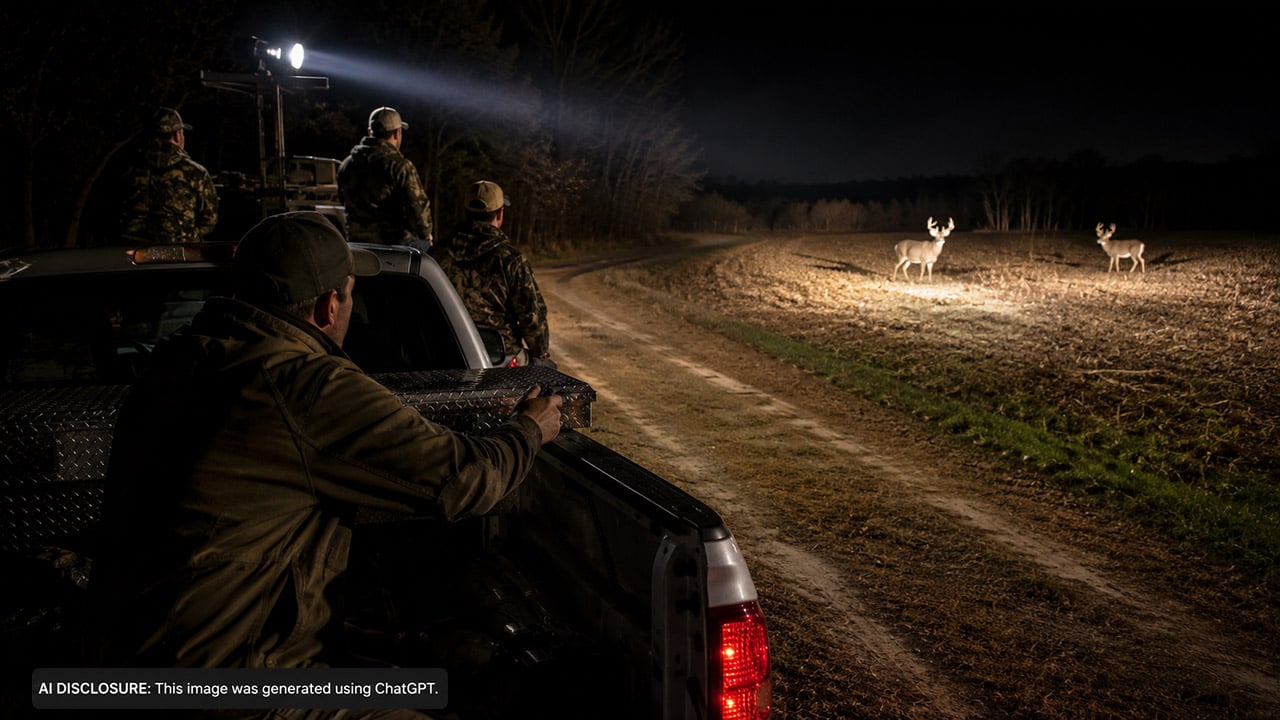
Photo credit: AI-generated image created using ChatGPT. Illustrative only
Spotlighting deer from the road isn’t just “bending the rules.” In Southern Illinois, it turned into a multi-year operation where trophy-class whitetails were allegedly located with lights, shot with rifles, and then hauled back across state lines to be processed and mounted.
Federal court has now wrapped up the case against five Mississippi men tied to that ring, and the details laid out in the original post read like the kind of thing that makes ethical hunters shake their heads—because it’s not just about stolen deer. It’s about safety, trespass pressure, and making honest folks look bad.
1. They used lights to find trophy bucks, then came back to kill them
According to court documents, the group operated from 2018 through 2022 in multiple Southern Illinois counties—Massac, Jefferson, Union, Pope, and Clark—using spotlights to scout whitetails at night. Once a deer was located, they’d get a rifle, spotlight it again, shoot to kill, and later return to collect the carcass.
That’s the part that ought to hit every rural landowner and hunter right between the eyes. Spotlighting and shooting at night isn’t “just poaching.” It’s shooting in the dark, around unknown houses, farm equipment, livestock, and people—often near roads—where a bad decision can turn into a tragedy fast.
2. The haul didn’t stop at the state line—deer went back to Mississippi
This wasn’t a local one-and-done deal. The indictment described deer being transported across state lines into Mississippi, where they were processed and mounted. Crossing state lines with illegally taken wildlife is where things can turn into a federal case in a hurry.
On top of that, court records detailed multiple trips where the men rented motels and cabins in Illinois while they scouted and poached deer. They also reportedly made trips tied to Missouri, while using those Illinois rentals as a base for their night runs.
3. Officials believe the damage is bigger than what they could prove
Even when law enforcement puts a case together, poaching is one of those crimes that’s hard to fully document. Illinois Conservation Police sergeant Heath Tepovich, who worked the case, said they believe the group was responsible for about 60 deer—at least the ones officials know about.
He also said investigators felt they only uncovered maybe a quarter of what the group had done, and that the “main guy” had been doing it for about 20 years. That’s not a weekend of bad choices. That’s a long-running pattern—exactly the kind of thing that drains the age structure in an area and leaves locals wondering why the big bucks “disappeared.”
4. The ringleader took the biggest financial hit—$85,000 by himself
The restitution and fees for all five men totaled just under $120,000, but the bulk landed on 54-year-old Lee Jay Johnson of Saucier, Mississippi. He was ordered to pay $75,000 in restitution and $10,000 in fines for Lacey Act violations—$85,000 total.
All five defendants received five years of probation and avoided jail time. The other men sentenced were Steven J. Pique (56) of Biloxi; Gerald B. Moran (40) of Saucier; Joshua A. Marshall (30); and John M. Pritchard (57) of Biloxi. Whether probation feels like enough is something hunters will debate around tailgates for a while, but the money and the federal conviction are real consequences.
5. Illinois trophy restitution adds up fast, and the mounts are still in custody
Illinois sets trophy poaching penalties based on antler size, and that math gets ugly in a hurry when you’re talking about mature bucks. The state’s structure described in the case: any 8- to 10-point buck triggers a $1,000 fine plus $500 per antler point; any buck with 11 points or more is $1,000 plus $750 per antler.
Tepovich said some seized deer were returned to defendants through agreements with attorneys, but most of the taxidermy remains in U.S. Fish & Wildlife Service custody for now. The mounts and antlers will eventually go back to the Illinois DNR. The fines go to the Lacey Act Reward Account, and restitution fees are turned over to the Illinois Department of Natural Resources—meaning the money is meant to flow back into enforcement and conservation, not somebody’s trophy room.
USFWS leadership didn’t mince words, calling it a calculated, multi-year operation that exploited Illinois wildlife resources and undermined fair-chase hunting traditions. For everyday hunters, the practical lesson is simple: if you see lights sweeping fields at odd hours, shots after dark, or suspicious vehicles making the same loop night after night, don’t “handle it” yourself. Document what you safely can and report it. Cases like this are tough to build, but they don’t get built at all without tips from the people who live there.
Like The Avid Outdoorsman’s content? Subscribe to our newsletter so you never miss an article.
Here’s more from us: