Photo credit: AI-generated image created using ChatGPT. Illustrative only
Two acres of brushy timber doesn’t sound like much until you realize how fast a “small” property line problem turns into a safety issue. One North Carolina landowner says he bought a home two years ago with two lots—one in the city limits and a wooded back lot that’s technically in the county. He’s been improving that back parcel for wildlife, feeding critters, and running a camera deep in the trees to see what’s moving.
Then the camera disappeared. And not long after, he found out a stranger had been treating his woods like a free-access hunting lease.
A missing trail camera and fresh sign in the tree
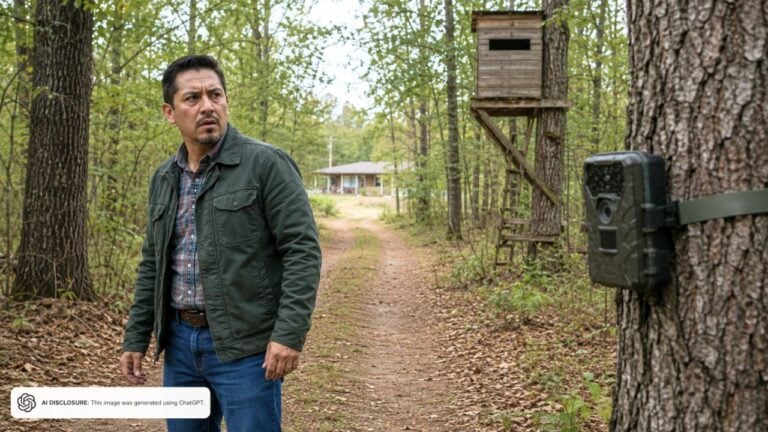
The first red flag was simple: he walked back to swap batteries and realized the camera he’d mounted about 15 feet up a tree was gone. In its place, he noticed evidence that a climbing-style deer stand had been used on that same tree—enough to make him wonder if someone used the stand to reach up and take the camera.
At first he chalked it up to a mistake or confusion in the dark. But he went back the next day, this time carrying a rifle, because if someone was actively stealing off his place he didn’t want to be caught unprepared. That’s when the situation got real.
He caught a camouflaged hunter crossing his property line
When he reached the area where the camera had been mounted, it still wasn’t there. But this time there was a man walking across the property—moving from the east side to the west side—wearing full camouflage and no blaze orange.
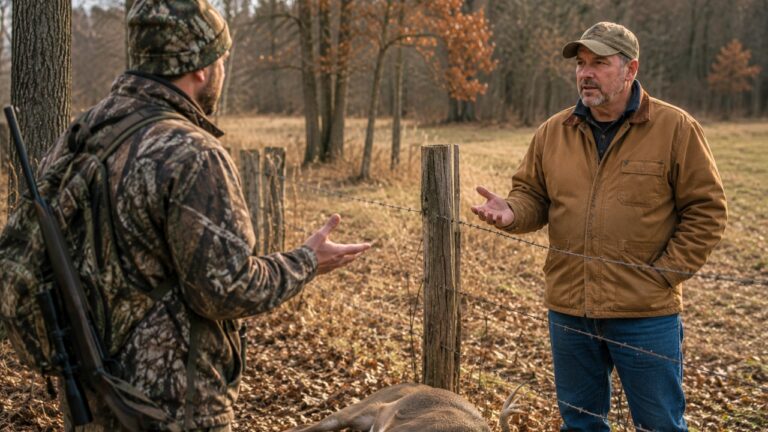
The landowner recorded the interaction and asked the man what he was doing hunting on posted private land. The hunter told him he had permission from the owner of the woods to the west and said he lived on a nearby horse farm. To back it up, the hunter called the woman who owned the woods to the west. According to the landowner, she insisted she’d given him permission to hunt “all the way to the creek,” even though that creek is the landowner’s east-side property line.
Instead of letting it turn into a shouting match, the landowner did the smart, calm thing: he walked the line with the hunter, showed him the corners, and pointed out exactly where the boundary was. The hunter apologized and said he wouldn’t be back on the property, and he also denied taking the camera.
If you’ve ever dealt with boundary-line confusion, you know that’s usually the moment you either get peace—or you learn you’re dealing with a bigger problem than one wandering deer hunter.
The neighbor escalated by posting signs on someone else’s trees
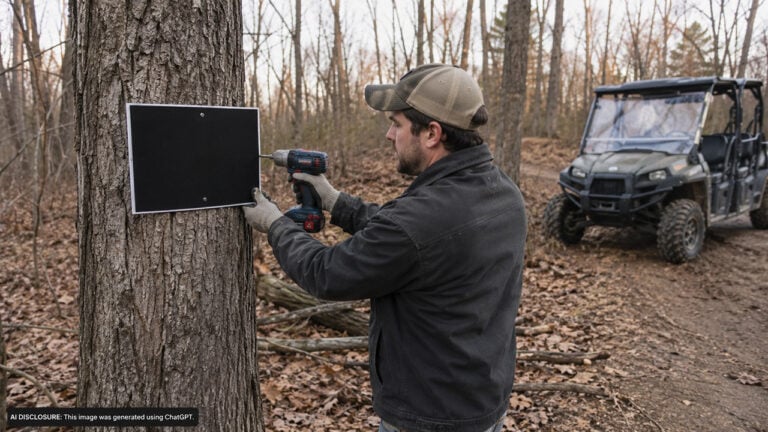
The next day the landowner spent sunrise to sunset on the back lot running heavy equipment and cleaning up. He didn’t notice anyone else out there. But the following morning, he woke up and found “No Trespassing” and “No Hunting” signs nailed to trees along the wood line in his backyard—on the dividing line between his front lot and his back lot.
More signs were posted along the west side of his front lot, which is what led him to believe the west-woods owner had crossed onto his property and put them up. In other words, it wasn’t just a hunter making a mistake anymore. The neighbor appeared to be acting like she could manage—or claim—ground she didn’t own.
That’s where a lot of rural property disputes go from annoying to dangerous. It’s one thing to have a neighbor who argues about a fence. It’s another thing to have somebody “authorizing” hunting where they don’t have the right to authorize anything.
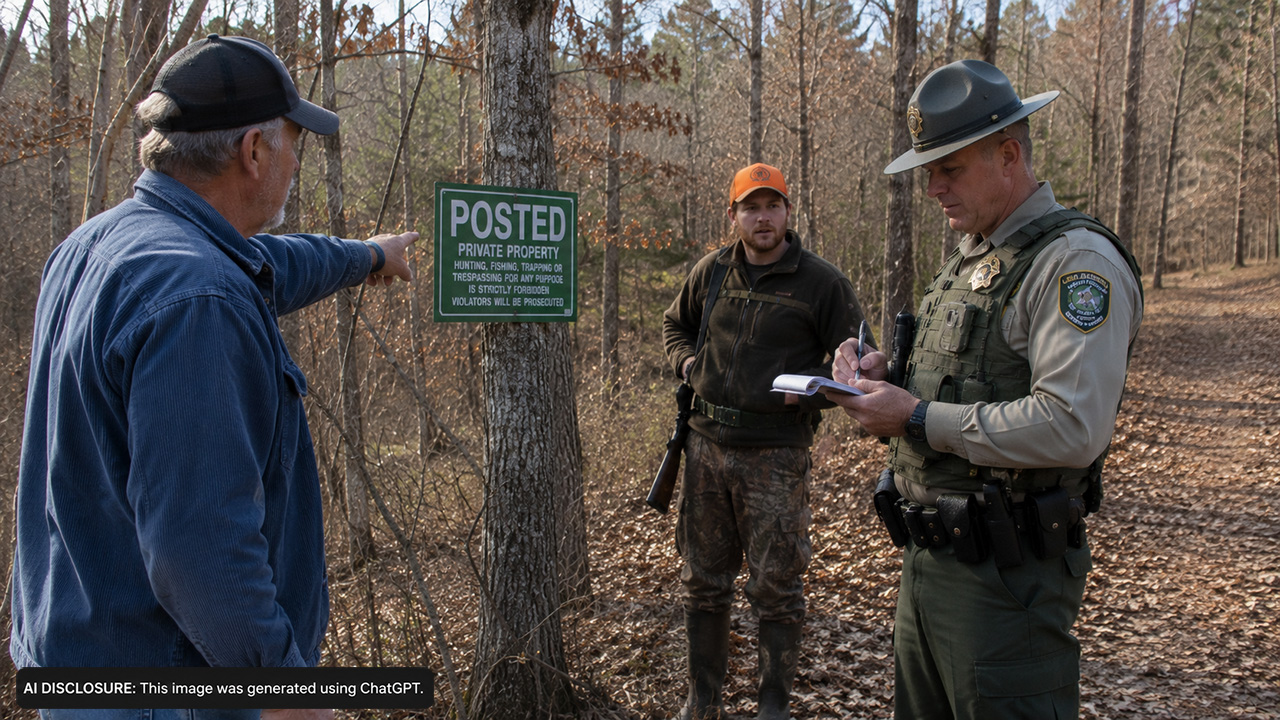
The landowner started calling around for help. He contacted the game warden and says he was told that since it wasn’t an “active violation,” he should call the sheriff. When he called the sheriff, he says he was told there wasn’t much they could do unless he caught someone actively trespassing with intent to “harm or steal.”
That response is frustrating, but it’s also common. In a lot of places, you can have posted signs, paint marks, and even a survey, and still end up being told you need better documentation, a direct witness, or a clear in-progress offense before anything moves quickly.
Meanwhile, the risk doesn’t pause. A person walking around in full camouflage with a weapon—especially without blaze orange—creates a real safety concern when it’s happening near homes, property lines, and a mixed patchwork of city and county rules.
document everything and tighten up the property line
In the the original post, the landowner laid out what he’d already done: he had a legal survey, clearly marked corners, purple paint on trees, and his own no-trespassing signage. From an outdoorsman’s perspective, that’s the start of a solid paper trail and a solid visual trail—exactly what you want before an incident turns into a “he said, she said” mess.
He also raised a practical concern most landowners understand immediately: he wants to put up another camera, but he doesn’t want to be out several hundred dollars again if it vanishes. That’s not paranoia. Once a camera gets stolen, it’s hard to shake the feeling that anything you put up near a boundary is going to walk off.
Even without getting into legal strategy, the common-sense approach here is to keep building clean documentation: photos of posted signs (especially if they’re on your trees), dates and times, copies of surveys, and any video you’ve already recorded. If someone is repeatedly coming onto your land and putting up signage, that’s not “confusion.” That’s behavior.
The landowner in this situation did a lot right. He didn’t start a fight. He showed the hunter the line. He kept his cool. He tried to involve the right authorities. But he’s still stuck with the same problem plenty of rural folks face: how do you stop repeat trespassers when the response feels slow and the violations happen in short windows?
What you don’t want is for this to turn into a face-to-face conflict in the timber during hunting season. Property-line arguments plus camo plus weapons is a bad recipe, even when everyone thinks they’re in the right. The safest play is to keep interactions as controlled as possible—daylight, calm tone, clear boundaries, and law enforcement involvement when it’s appropriate—while you continue to make the line unmistakable.
At the end of the day, two acres is still your ground if it’s on your deed. And if a neighbor is acting like they can grant permission to someone else to hunt it, that’s not just a nuisance—it’s a liability that can put people in the wrong place at the wrong time. When you’ve got marked corners, posted trees, and a survey in hand, you’re not guessing. Now it’s about making sure the next time someone steps over that line, there’s no question what happened and where.
Like The Avid Outdoorsman’s content? Subscribe to our newsletter so you never miss an article.
Here’s more from us: