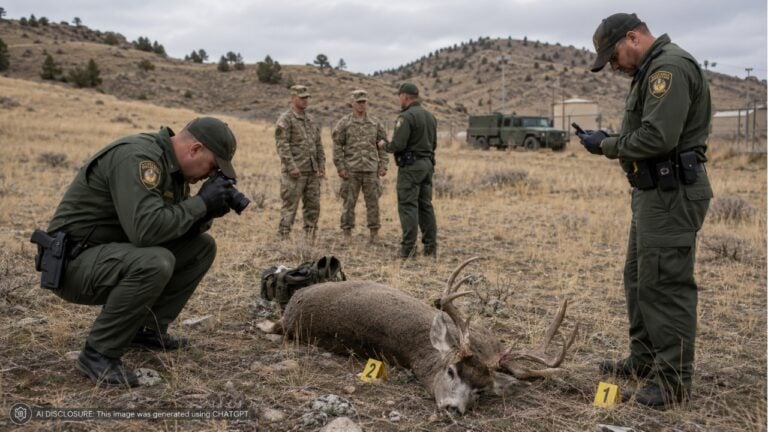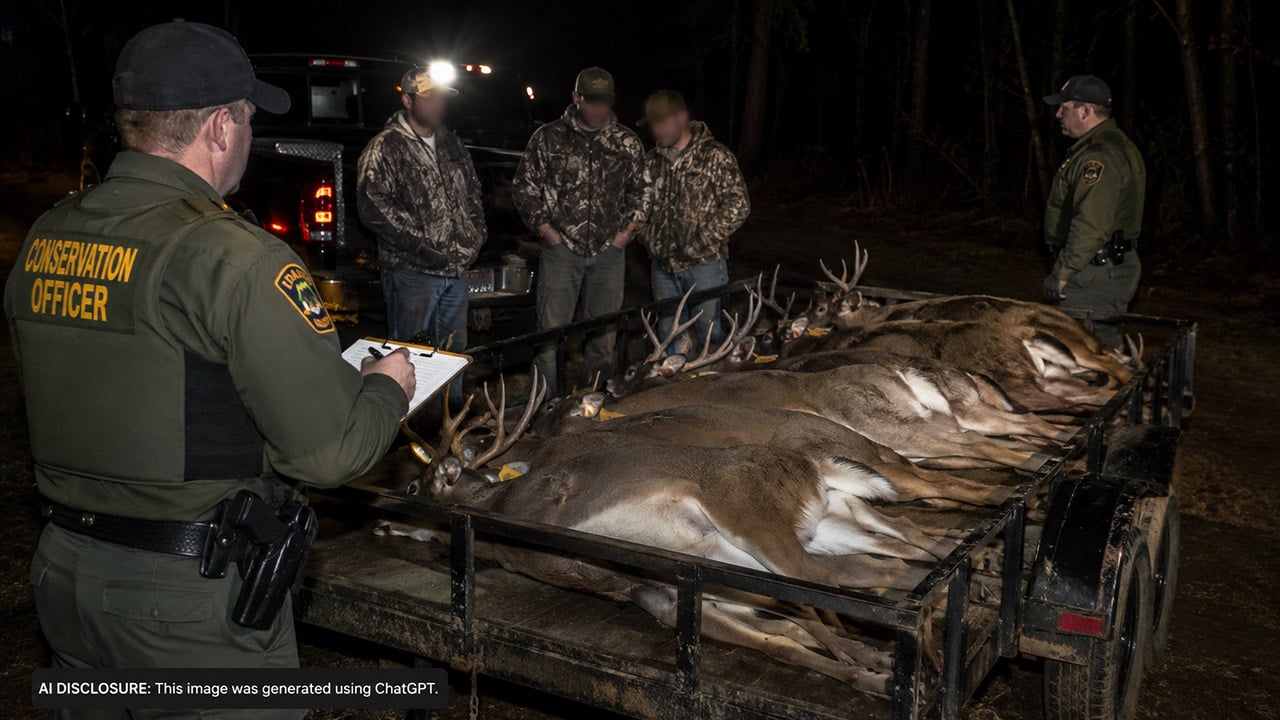
Photo credit: AI-generated image created using ChatGPT. Illustrative only
If you’ve hunted whitetails in the Idaho Panhandle, you know the deal: short legal windows, tight country in places, and a lot of eyes on the road system when November rolls around. That’s why cases like this one get hunters’ attention fast—because it isn’t a “mistake in the dark,” it’s a pattern.
Idaho Fish and Game says three Saint Maries-area residents were involved in the illegal killing of seven mature white-tailed bucks during November 2024, all outside of legal shooting hours. The case ended up stacking up 56 separate wildlife violations, and the final sentencing wrapped on May 11, as detailed in the original post.
How it unfolded: seven bucks, one month, and a pile of violations
Fish and Game identified the individuals as Will Clark, Lucas Mitchell, and Laura Willis. The agency says all seven bucks were taken illegally in November 2024, with five killed within a single 24-hour period. That kind of pace isn’t “one bad decision,” it’s a run.
Officers documented 56 wildlife violations during the investigation. Clark and Mitchell were originally charged on June 27 with eight felony counts tied to the unlawful killing of the deer, showing how quickly a poaching spree turns into a felony-level case once the evidence is laid out and the numbers get counted.
The after-dark piece is where the safety line gets crossed
Every one of the seven deer was reportedly shot outside legal shooting hours. Any hunter who’s been around long enough has heard the excuses—“couldn’t tell,” “thought it was still legal,” “just trying to fill the freezer.” But when all of them happen after hours, that’s not confusion about sunset times. That’s choosing darkness.
Shooting after legal light isn’t just a fish-and-game issue; it’s a public-safety problem. In whitetail country, you’ve got other hunters walking out, landowners checking stock, and folks driving timber roads. Legal shooting hours exist for a reason, and cases like this are exactly why.
Three of the bucks met Idaho’s trophy definition, and that changes the penalties
Fish and Game noted that three of the seven bucks met Idaho’s legal definition of a “trophy” white-tailed deer. In Idaho, that matters because trophy animals carry enhanced civil penalties. Whether a guy personally cares about “trophy” status or not, the state does when restitution is calculated.
Restitution isn’t about bragging rights—it’s about replacing a public resource that was taken illegally. A mature buck isn’t something you “put back” next season. In most places, it takes years of good habitat, mild winters, and a little luck for a buck to reach that age class.
Waste charges are the part that turns hunters’ stomachs
The agency also reported that meat from three of the animals was left to waste. That’s the detail that tends to hit hardest with regular hunters, because it cuts against the basic ethic most of us were raised on: if you pull the trigger, you use the animal.
People who don’t hunt already assume the worst about hunting. Wasting meat hands them ammunition and makes it harder on the rest of us who do things the right way—buy tags, follow hours, pack deer out, and spend our own time and money trying to be ethical.
The sentences: jail, prison time, restitution, and long license revocations
The court outcomes weren’t identical for all three people, but none of them walked away untouched. Restitution, fees, court costs, and license revocations were a big part of the final price tag.
For Lucas Mitchell, sentencing in February 2026 included $17,200 in restitution (jointly shared among the three individuals), $525 in processing fees (shared with Clark), all associated court costs, seven months in county jail, five years of supervised probation, and a 10-year hunting license revocation.
For Will Clark, sentencing in April 2026 included $17,200 in restitution (jointly shared among the three individuals), $525 in processing fees (shared with Mitchell), all associated court costs, and a prison sentence of zero to four years. Fish and Game says he is currently incarcerated. Clark also received a 10-year hunting license revocation.
For Laura Willis, sentencing in May 2026 included $6,000 in restitution (also described as jointly shared among the three individuals), $150 in processing fees, all associated court costs, a $200 fine, one year of unsupervised probation, and a one-year hunting license revocation. Fish and Game said Willis pleaded guilty to charges related to tag transfer and unlawful possession of big game.
What hunters and landowners can take from this one
There are a few practical lessons here, and none of them require being a game warden to apply. First, legal shooting hours aren’t optional, and “I didn’t know” doesn’t hold water when the pattern is consistent. If you’re unsure, you check—because the consequences can follow you for a decade.
Second, don’t play games with tags. The Willis portion of the case points straight at how quickly “helping someone out” or moving a tag around can turn into serious trouble. If you didn’t shoot it, don’t sign for it, possess it, or try to paper it over later.
Third, if you’re a landowner or you’re seeing suspicious activity around your place, Fish and Game specifically thanked the public for staying vigilant and using the Citizens Against Poaching hotline. They’re asking folks to call 1-800-632-5999 or submit a report online, and they noted monetary rewards may be available for credible, detailed information that helps identify suspects and leads to charges.
This is the kind of case that reminds you why ethical hunters get protective of the resource. It only takes a few people cutting corners—after dark, piling up deer, and wasting meat—to put a spotlight on everyone who carries a rifle in November.
Like The Avid Outdoorsman’s content? Subscribe to our newsletter so you never miss an article.
Here’s more from us: