Photo credit: AI-generated image created using ChatGPT. Illustrative only.
A lot of gun owners have a simple rule when a badge shows up at the door: be respectful, be calm, and don’t make anything harder than it needs to be. But there’s another rule that matters just as much—don’t invite trouble inside your home, especially when firearms are involved. One Michigan family learned that lesson the hard way after officers came looking for a relative and left with a house that had been picked over and a gun safe that was suddenly a lot lighter.
A welfare check turned into a search for a felon
Based on the original post, officers from a nearby city arrived at a 75-year-old man’s home in Tuscola County, Michigan, accompanied by a parole officer. They were looking for the man’s uncle—his grandson’s uncle—who had been staying at the house temporarily while helping with concrete work on a new home.
The key detail: the uncle is a felon. And on this day, he wasn’t there. The grandfather told them exactly that, but the visit didn’t end at the front porch.
Detained in the back of a patrol car, consent still on the table
The post says the grandfather was detained in the back of a police patrol vehicle. There’s no confirmation in the account whether Miranda rights were given, but what matters for most homeowners is the practical piece: he was 75, and he was dealing with officers on his property while being physically separated from his own living room and whatever was happening inside it.
That’s a tough spot for anyone, and it’s a spot where a lot of folks start trying to “cooperate” their way back to normal. In real life, that can mean agreeing to things you don’t fully understand—like letting officers come in “just to look.”
They asked to enter, found one shotgun, then the whole place got tossed
According to the account, officers asked permission to enter the home to look for the uncle. Once inside, they found an old shotgun in a closet—described as belonging to the grandfather. That discovery changed the temperature immediately.
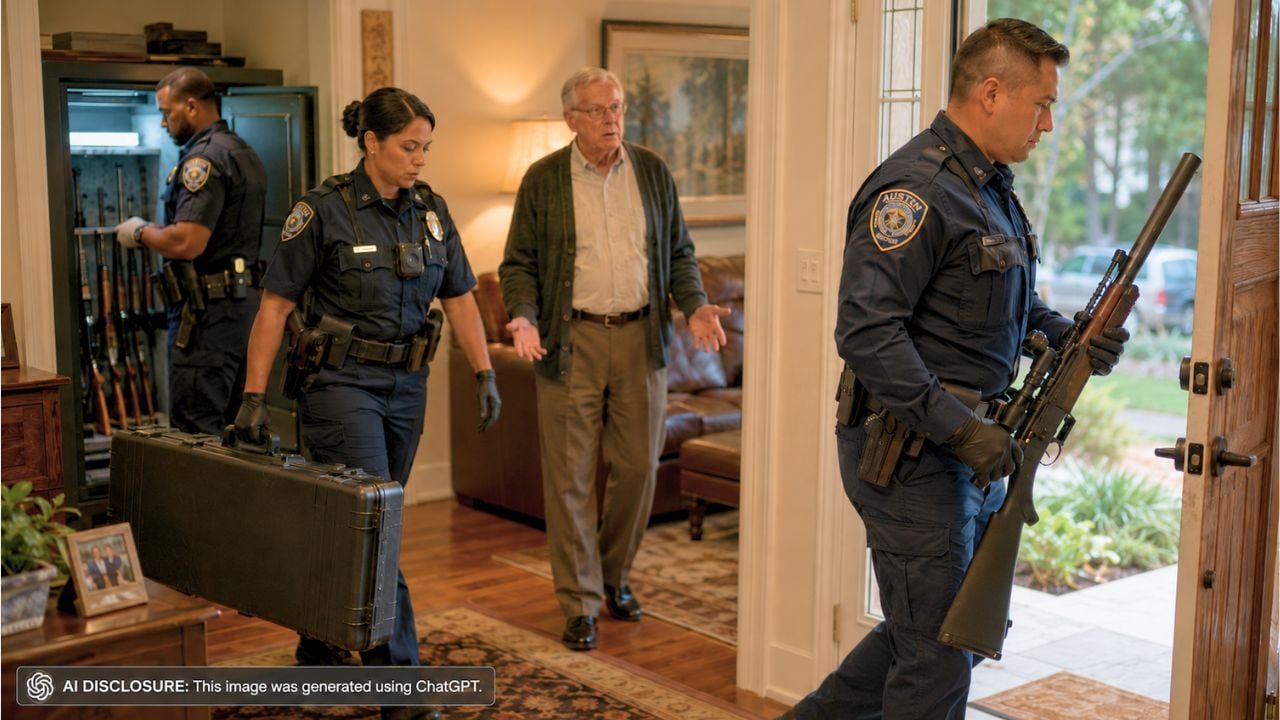
The post says officers then began “tossing the entire house” and eventually confiscated every firearm in the home. No detailed inventory is provided in the source material, but the end result was clear: multiple firearms gone after a consent-based entry turned into a much bigger seizure.
Why “he’s not here” doesn’t always stop the search
Here’s the hard truth that rural gun owners and hunters sometimes don’t learn until it’s too late: when law enforcement is looking for someone with legal restrictions—like a felon or someone under supervision—the presence of firearms in the same residence can trigger a cascade of problems. Even if the guns are owned by someone else.
The family’s concern makes sense. If a felon is staying in a home where firearms are accessible, officers and supervising authorities may view that as a public safety issue or a supervision violation. That doesn’t automatically make every seizure lawful or permanent, but it explains why things can go from “just a few questions” to “we’re taking these for now.”
And from a practical standpoint, this is why letting a prohibited person crash at your place—especially if you’ve got hunting guns in closets, bedroom safes, or a cabinet in the mudroom—can put your own property at risk in a hurry.
The paperwork question: receipts, property logs, and what a gun owner should demand
The headline angle on this story is the part that makes most gun owners sit up: firearms leaving the home with no paperwork. The pasted account doesn’t spell out exactly what documentation was or wasn’t provided on scene, but it does show the family immediately asking, “What are my options?”
In any seizure, one of the most important real-world details is documentation—some kind of property receipt, case number, or inventory sheet that ties specific items to a specific agency and report. Hunters know how this goes with deer camp gear: if you can’t prove what you had and who took it, you’re already behind. Firearms are worse because serial numbers matter, and a vague “they took some guns” won’t help much later.
From a common-sense standpoint, the family’s next steps would typically revolve around identifying which agency actually took possession (city officers, county, or parole), getting the incident/report number, and requesting a full property inventory. If the grandfather was detained in a cruiser while the home was searched, it’s also fair to question how clearly consent was given and whether the search stayed within what was agreed to.
The outdoorsman takeaway: consent at the door can cost you a whole gun cabinet
This kind of situation is why experienced gun owners tend to keep a cool head and a tight script when someone shows up asking to come inside. You can be polite and still protect your rights. “He’s not here” is an answer. “I don’t consent to a search” is an answer. “I’ll speak to my attorney” is an answer.
None of that is about being difficult. It’s about understanding that once the door swings open, you can’t control what gets seen, what gets misunderstood, or what gets treated as “in plain view.” And if there’s a prohibited person connected to the visit, the odds of firearms becoming the center of the story go way up.
The other practical lesson is the one nobody likes to talk about at deer camp: letting a felon stay under your roof can bring consequences even if you didn’t do anything wrong. If you’re going to help family, you need a plan—secure storage, clear separation, and an understanding that a simple knock can turn into a long, expensive headache.
In Tuscola County, this family ended the day without a criminal in the house—but also without the firearms that belonged there. For gun owners, it’s a reminder that “being cooperative” and “protecting your home” aren’t always the same thing, and the line between the two can disappear the moment you say, “Sure, come on in.”
Like The Avid Outdoorsman’s content? Be sure to follow us.
Here’s more from us: