Photo credit: Theavidoutdoorsman.com
It was one of those calm evenings on the water where everybody thinks they’re invisible. A little chop, a little wind, navigation lights blinking across the lake, and a couple guys easing along at no-wake speed with a cooler between their feet. Then the spotlight hit them, and the blue-and-green strobes followed.
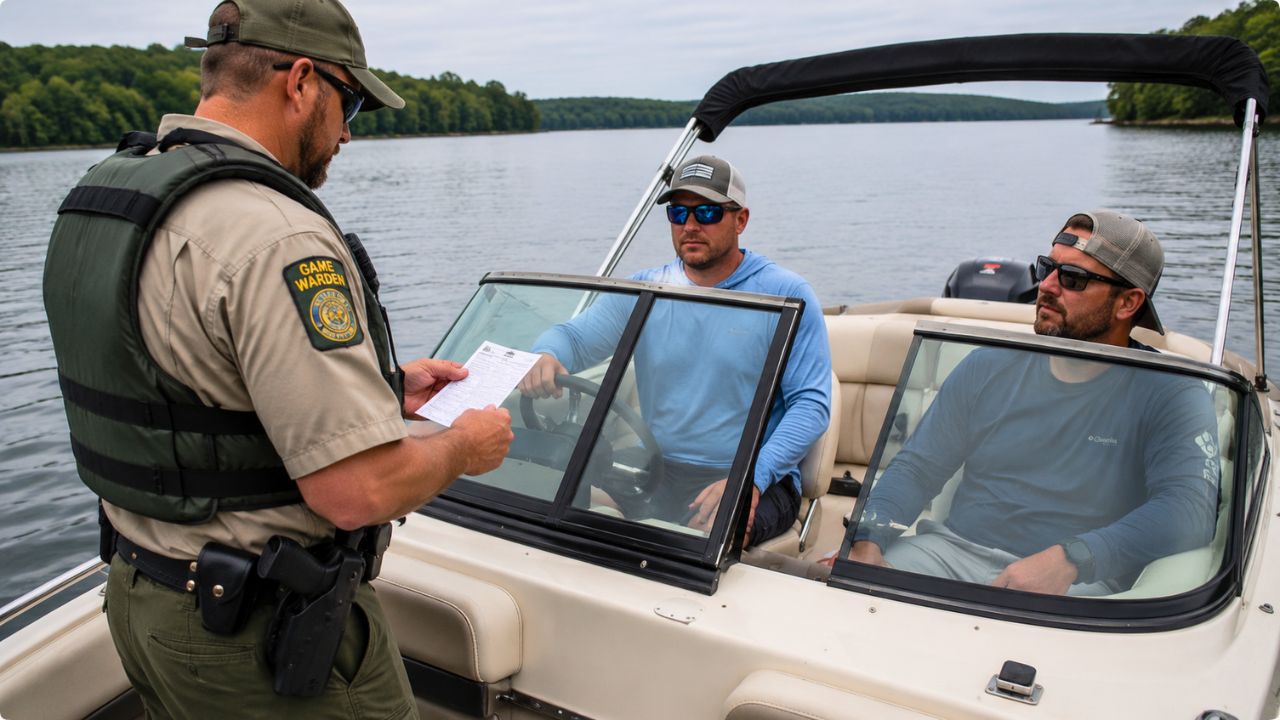
A game warden pulled alongside and did what wardens do—made contact, checked safety gear, and started asking the basic questions. The stop turned into a quick sobriety check on the operator. That part went fine. The part that didn’t? Paperwork, and the assumption that one person’s license covers the whole boat.
A routine boating stop turned into a license check
According to the way the encounter unfolded, the warden approached it like a standard nighttime patrol: operator keeps hands visible, engine in neutral, registration and required equipment ready to show. Wardens on the water are usually looking for the big safety stuff first—life jackets accessible, throwable device, working lights, and whether the boat’s being run responsibly.
Once the basics were squared away, the warden shifted into the “are we good to keep operating?” phase. That’s where the sobriety check came in—conversation, eye contact, simple questions, and a look at whether the driver’s movements matched the situation. The driver appeared to be fine, which is how most of these stops should end.
The driver had a valid license, but that didn’t solve the passenger’s problem
Here’s the snag a lot of folks don’t think about until they’re standing under a spotlight: in many states, each person who is fishing needs their own valid fishing license—even if only one person is actually running the boat. The boat registration and the operator’s boating credentials don’t magically cover everyone aboard for fishing privileges.
During the conversation, the warden learned the driver was the only one with a current fishing license. The passenger either didn’t have one, had an expired one, or couldn’t produce it. Once the warden confirmed the passenger had been fishing—or had gear staged and ready in a way that met the state’s definition of “angling”—the warning window shut fast.
That’s the piece that surprises people: a passenger doesn’t have to be the one holding the tiller to be responsible for their own license. If you’re participating, you’re accountable.
How wardens decide who’s “fishing” in the first place
A lot of folks think the line is simple: “If I’m not holding a rod, I’m not fishing.” Out on the water, it can be more nuanced. Wardens commonly look at things like whether lines were recently in the water, whether the passenger handled fish, baited hooks, netted a fish, operated a trolling motor while another person worked rods, or had their own gear set up and ready.
In plenty of jurisdictions, actively assisting counts. Netting fish, running the boat in a way that’s directly supporting fishing activity, even managing multiple lines can put a passenger squarely in the “participating” category. Some states also have rules about how many rods can be used per licensed angler, which creates another reason wardens want to know exactly who is or isn’t fishing.
That’s why “I’m just riding” doesn’t always hold up if there’s a bait bucket open, tackle spread out, and everybody’s hands smell like cut shad.
The citation wasn’t about being difficult—it was about a clean, enforceable line
From the outside looking in, it can feel petty. The driver passed the sobriety check, the boat was being operated safely, and nobody was tearing up the lake. But licensing is one of the simplest, most enforceable tools wildlife agencies have, and it’s tied directly to conservation funding in a lot of places.
Wardens also run into the same excuse all season long: “I didn’t think I needed one.” If that excuse worked, enforcement would be a waste of time. A license requirement only works if it’s applied consistently, even when the person seems like a decent guy who just didn’t do the homework.
There’s also the fairness angle. Plenty of law-abiding anglers buy licenses every year, sometimes for the whole family, even when money’s tight. Watching someone slide by because they were the “passenger” rubs people wrong, and agencies know it.
What outdoorsmen kept arguing about afterward
This kind of stop always sparks two camps of opinions. One camp says wardens should focus on impaired boating, reckless operation, and true poaching issues instead of paperwork. The other camp says the rules are posted, licenses are easy to buy on a phone now, and there’s no reason to be out there without one.
A third angle comes up a lot too: folks questioning whether the passenger was actually fishing or just along for the ride. That’s where the details matter—if the passenger truly never touched a rod or line and had no role in the fishing activity, some people will argue a warning would’ve been the better call. But most wardens don’t cite passengers unless they’ve got a clear, defensible reason to connect them to the act.
And, predictably, plenty of outdoorsmen pointed out that wardens aren’t “lake cops” so much as they are the one badge you can run into anywhere—boat ramp, back road, sandbar, or duck blind—where compliance is expected, not negotiated.
The practical lesson: don’t treat a fishing license like a group pass
If you take anything from this, make it simple: if you’re going to fish, buy your own license and keep it accessible. Not in the glove box back at the truck, not as a screenshot you can’t pull up when service drops, and not “I thought my buddy had me covered.”
Before the boat even leaves the ramp, it’s worth doing a quick check the same way you check plugs and fuel: everybody legal, everybody knows the rules, everybody understands bag limits, length limits, and who is responsible for what. If someone truly isn’t fishing, keep it clean—no rod in their hands, no baiting hooks, no netting fish, no “just hold this for a second.”
Game wardens spend enough time around water to know when a story doesn’t match the scene. A calm, cooperative attitude helps, but it doesn’t replace the one thing that prevents a citation every time: having the right license in your own name.
Like The Avid Outdoorsman’s content? Be sure to follow us.
Here’s more from us: