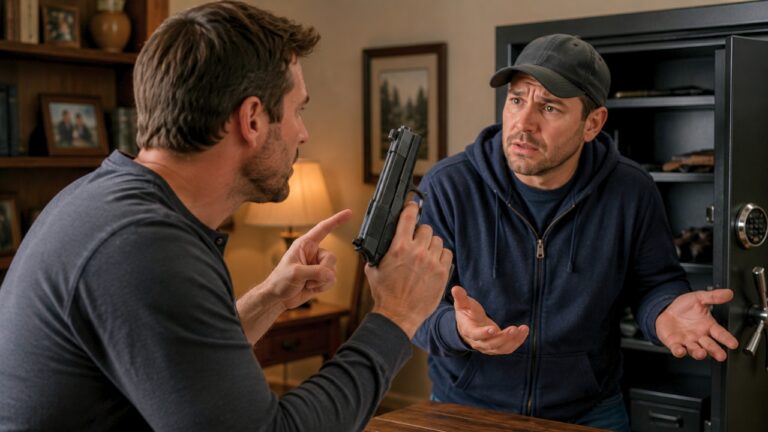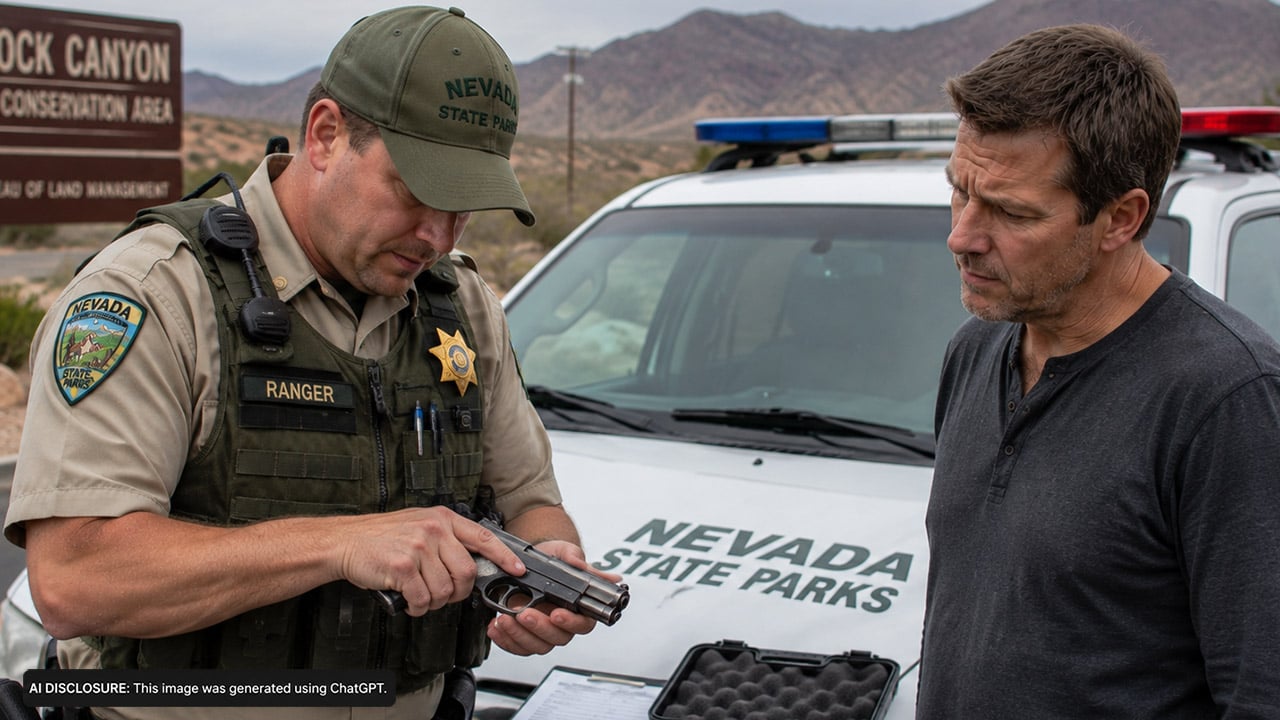
Photo credit: AI-generated image created using ChatGPT. Illustrative only
A routine stop on federal land in Nevada turned into the kind of headache gun owners don’t expect until it happens to them. A visitor says park rangers seized an inherited pistol after running a serial-number check that came back stolen—except the number they checked wasn’t on the pistol’s frame. The details were shared in the original post, and it’s a scenario worth thinking through if you ever carry, camp, or travel with a family firearm.
According to the account, the rangers checked a number on the barrel rather than the firearm’s frame, then took the pistol as stolen property. The owner says they weren’t arrested, only cited, and they also weren’t given a receipt for the seized gun. The firearm, they said, had belonged to their late grandfather for more than 40 years.
How a serial-number mix-up can happen on older pistols
Most gun folks know this in a general way, but it matters when you’re standing on the side of the road—or at a trailhead—with a law enforcement officer looking at your handgun: the legally recognized serial number is typically the one on the frame or receiver. Barrels and slides can carry numbers too, especially on certain makes and older designs, but those parts are also more likely to have been swapped at some point in the gun’s life.
That’s one reason a barrel number can be a trap. If a barrel was replaced during a repair, bought as a spare, or came from a parts bin years ago, it might not match the gun’s original paperwork or history. Even worse, if a barrel from a stolen firearm made its way into circulation, running that number could kick back a “stolen” hit even if the frame isn’t tied to that report.
Seizure on national park land changes the temperature
The poster said this happened in Nevada on national park land. That detail matters. When you’re dealing with rangers on federal ground, you’re often dealing with federal authority and federal procedures layered on top of whatever state law is in play.
For an outdoorsman, it’s easy to think, “I’m in Nevada, so it’s Nevada rules.” Sometimes that’s true in practice. But when a firearm is seized by federal officers in a federal place, you should expect a more formal process for getting it back—and in some cases a longer, slower one. Even when you’ve done nothing wrong, the system isn’t built for speed.
No arrest, a citation, and then the gun is gone
One of the more telling parts of the story is that the owner says they were not arrested and only received a citation. That suggests the contact may have been handled as an alleged violation that didn’t rise to a custodial arrest—or at least the rangers chose not to take it there.
But the practical result is the same for the gun owner: the pistol was taken. Once a firearm is tagged as potentially stolen, officers are generally going to treat it like evidence or recovered property until they can sort it out. And if you’re the one standing there holding it, “sorting it out” rarely happens on the spot.
The missing receipt is the part that should make you tighten up
The poster also said they were not given a receipt for the seized property. That’s the kind of detail that turns a bad day into a drawn-out problem, because a receipt is often the simplest proof of what was taken, when it was taken, and by whom.
In the real world, paperwork is your lifeline. If your gun is sitting in an evidence locker, you want a property sheet, a case number, an officer name, a phone number—something you can point to when you call back. Without it, you’re relying on memory and whatever internal notes the agency kept, and that’s not where you want to be when you’re trying to recover an heirloom firearm.
What the owner said they want—and the steps they were already considering
The pistol, the owner said, had been their late grandfather’s for four decades. Anyone who’s inherited a firearm knows it’s not always about the dollar value. Sometimes it’s the grip wear, the old holster scuffs, the “this is what Grandpa kept in the nightstand” history that makes it feel like part of the family.
They said they wanted the pistol back and were already looking into hiring a lawyer. That’s not a small step, but in a situation involving a seized firearm and a stolen-property hit, it can be the most practical move—especially if you’re dealing with a federal agency and you need someone who knows the process and the right doors to knock on.
The outdoorsman takeaway: inherited guns deserve a quick “pre-trip check”
This kind of mess is exactly why it pays to do some homework before you toss an inherited handgun in the truck and head for public land. If you don’t know the firearm’s full story—and most family guns don’t come with a neat paper trail—assume that something about it could be misunderstood in the field.
At a minimum, it’s smart to know where the official serial number is located on your specific handgun, and to keep any inheritance documents, old bills of sale, or family paperwork you might have in a safe place. That won’t magically prevent a seizure if an officer thinks there’s a stolen hit, but it can help your attorney or you make a clean, documented case later.
It also reinforces a broader point: on public land, small misunderstandings can turn into big consequences fast. You can be calm, cooperative, and doing your best to follow the rules—and still end up watching a family firearm ride away in someone else’s vehicle.
If you ever find yourself in a similar spot, the goal isn’t to argue at the trailhead. The goal is to get the identifying information, keep your citation paperwork, follow up quickly with the agency, and—when the stakes are high—get qualified legal help so you can work the system the way it’s built.
Like The Avid Outdoorsman’s content? Be sure to follow us.
Here’s more from us: