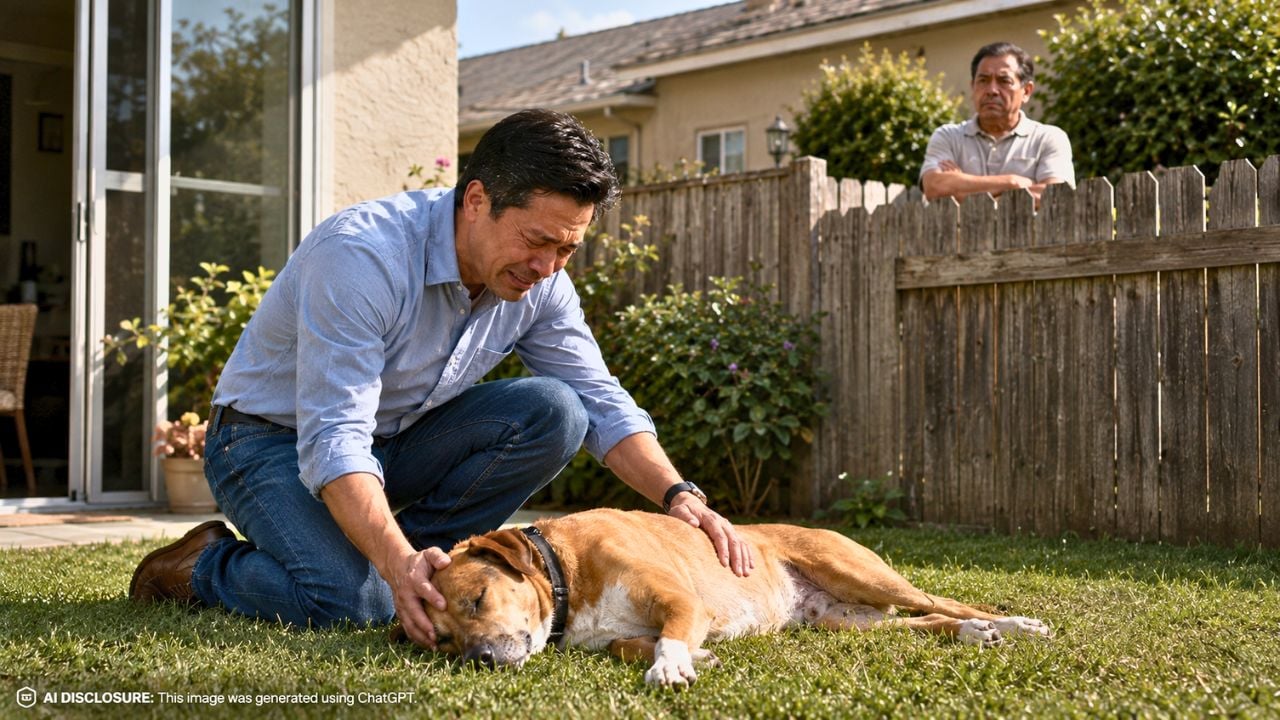
Photo credit: AI-generated image created using ChatGPT. Illustrative only.
Rural living comes with a handshake-style understanding: you handle your business, you respect the line, and if there’s a problem, you talk first. That’s why this South Carolina dog-shooting story hits different. A family thought they had the kind of neighbor who’d pick up the phone over a minor issue—until a gunshot in the yard proved otherwise.
A “country neighbor” relationship that looked solid from the outside
In a post seeking help while sitting at an emergency vet, a dog owner described living next to a man with a lot of acreage and “a lot of dogs,” including kennel dogs he trains out in his fields. The family’s place is about two acres, with fencing only along the sides that meet the neighbor’s property.
They’d had their goldendoodle, Boomer, for three years and believed things were cordial. The neighbor reportedly greeted the dog by name and even tossed him a biscuit when Boomer barked from the far side of the fence. On top of that, when one of the neighbor’s big white dogs got into the family’s trash in the past, the neighbor came over, cleaned up the mess, and the problem stopped. That’s the kind of give-and-take most country folks recognize.
The new dog changed the temperature at the fence line
A few months before the shooting, the family adopted a second dog, Gracie—a pit bull mix described as abused and terrified of people. According to the owner, Gracie’s reaction to the neighbor was immediate and intense: hair up, charging the fence, barking hard.
The owner felt the neighbor treated Gracie differently than Boomer, and the situation started to drift into that gray area where everyone assumes the other guy “knows” what’s happening. The family says the neighbor never raised the issue with their teenagers, who are usually the ones letting the dogs outside and watching them.
What happened the day the shot was fired
The turning point came when one of the kids let the dogs out and sat on the porch. The owner wrote that the kid heard barking, saw Gracie take off past the trees, then heard a gunshot followed by a yelp.
Gracie reportedly ran back bleeding. The owner left work and took her to an emergency vet, where they learned she’d been hit in the front of the chest with an exit wound behind the shoulder, and would need surgery.
In the moment, it’s the kind of thing that makes your stomach drop—because it’s not just about a dog. It’s about somebody firing a gun in a neighborhood setting, about where that bullet could’ve gone, and about the fact that nobody had a face-to-face conversation before it got to that point.
The complaint that never made it across the property line
In the owner’s telling, the neighbor had been “friendly” with their first dog and never voiced a concern about the new one. The only actions described were the neighbor running at Gracie, waving a hat, and yelling when she crossed onto his side to bark—behavior the family interpreted as helping “train” the dog to retreat.
But from a landowner’s perspective, the picture can look different. A dog crossing a property line, especially repeatedly, can be seen as a threat—whether it is one or not. Folks with livestock, working dogs, training dogs, or kids in the yard often have a short fuse for animals that aren’t under control.
That still doesn’t explain why the neighbor wouldn’t say something directly to the adults in the home, especially after years of seemingly positive interactions. The owner’s frustration wasn’t just the injury—it was the sense the neighbor had a problem and let it build until the trigger got pulled.
What practical next steps looked like from the vet’s waiting room
The owner’s immediate focus was the right one: get the dog medical care first, then figure out the rest. After that, they were trying to sort out the normal rural “what now” list—calling police, calling animal control, and wondering if they needed a lawyer to recover veterinary costs.
They also asked about contacting organizations like the ASPCA and wanted to warn other people who bring their dogs to the neighbor’s property for training. That last part tells you how uneasy they felt about the neighbor after the incident—not just as a pet dispute, but as a safety issue around animals and gunfire.
If you’ve lived out where fences are partial and property lines are marked by trees, you already know what a mess these situations become without documentation. Dates, vet records, photos of injuries, a clear map of where the dogs were, and any history of prior incidents matter—not for internet arguments, but for the people in uniforms who have to sort out what happened and whether it was lawful.
Why this kind of situation is a warning for rural dog owners and landowners
This story is a collision between two realities that exist at the same time in the country. One is that dogs are family, and people assume “my dog doesn’t bother anyone.” The other is that property owners—especially those running dogs, training dogs, or protecting livestock—often have very little patience for a loose dog, even one that’s “just barking.”
The hard truth is that “my dog ran right back” isn’t the same as “my dog never crossed the line.” The owner here acknowledged Gracie had crossed the tree line onto the neighbor’s property to bark at him before. That’s a problem that needs fixing fast, because once a dog is labeled a repeat trespasser, the next steps tend to be harsher and faster than folks expect.
On the flip side, firing a gun at a neighbor’s dog is the kind of escalation that can fracture a community for good. Even if someone believes they’re justified, there are questions any responsible shooter should be thinking about: what’s behind the target, where are the houses, where are the kids, and what happens if that bullet skips, glances, or sails.
The full details will matter if law enforcement gets involved, but the day-to-day lesson is clear enough: if you’ve got dogs and no full perimeter fence, you’re living on borrowed time. Leashes, supervised yard time, recall training, and cameras pointed at the problem area are cheap compared to emergency surgery and a neighbor dispute that may never heal.
The owner’s account, shared in the original post, reads like a situation that could happen on a lot of rural roads—two properties, two different views of what’s “normal,” and one moment that can’t be taken back. If you’re the dog owner, tighten up control before your neighbor makes the decision for you. If you’re the landowner with a complaint, say it out loud early—because the first time it comes out shouldn’t be down the barrel of a gun.
Like The Avid Outdoorsman’s content? Be sure to follow us.
Here’s more from us: