Photo credit: The Avid Outdoorsman
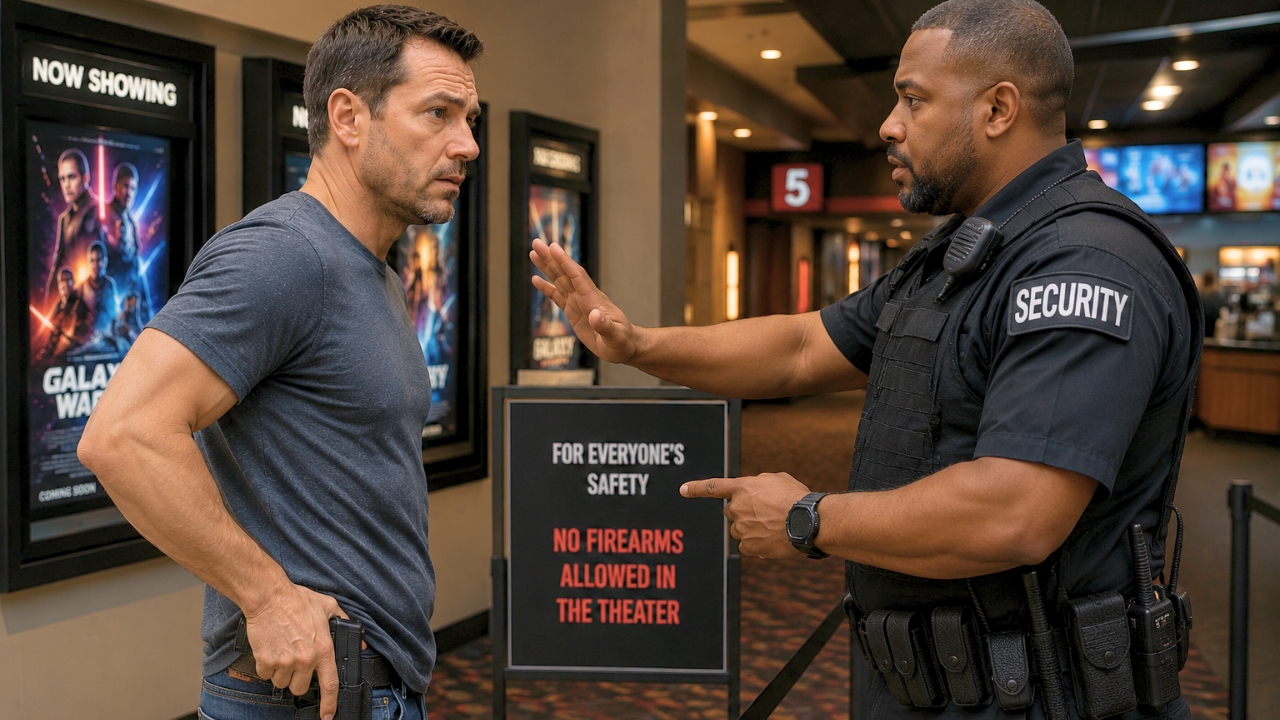
A concealed carrier in Reddit’s r/CCW described a movie-theater trip that stopped feeling routine almost the second he made it through the door. He said he was carrying at 3 o’clock IWB and walked into a theater that had several “no firearms allowed” signs posted. In his state, he said those signs did not carry legal force on their own, so he went in anyway. But before he ever got settled, an armed guard at the entrance noticed the gun immediately and told him he had to return to his car and take it off. You can read the original Reddit thread here: https://www.reddit.com/r/CCW/comments/yvit5z/ever_been_caught_carrying_ccw/
The way he told it, the part that bothered him most was how fast the guard saw it. He did not say he was badly printing, and he did not describe his shirt riding up or the gun hanging out. What he did say was that a trained eye could spot it “from a mile away.” That line says a lot. To ordinary shoppers or moviegoers, his setup may have looked fine. To someone whose whole job involved watching for trouble at the door, it was obvious enough that the conversation started instantly.
That is what gives the story its shape. He was not pulled aside by a nervous manager halfway through the movie. He was not ratted out by another customer after sitting down. The armed guard caught it at the threshold, which made the entire encounter feel less like a public scene and more like a very direct professional read from someone who knew exactly what to look for. In some ways, that almost makes the whole thing sting more. It means the setup did not fail dramatically. It failed quietly, in the one place where a trained person was most likely to detect it.
The theater environment matters too. Movie theaters are one of those places where carry debates often get more emotional than they do in ordinary stores or restaurants. People sit in the dark with families, exits are limited, and mass-public-space fear sits closer to the surface there than in a lot of other businesses. That is probably part of why so many theaters have signage even in states where the signs do not create a criminal violation on their own. The carrier in this story knew that. He saw the signs, knew the legal weight they did or did not have, and still chose to go in. The problem was not that he misunderstood the theater’s preference. The problem was that the theater had someone at the door who was ready to enforce it the moment he picked up on the gun.
There is also something especially uncomfortable about being made by security rather than by an ordinary customer. If a random stranger notices printing, that can still feel like bad luck. When an armed guard spots it instantly, it feels more like your carry method just got professionally graded and failed. That seems to be the real tension in the comment. The guard did not need a long look or a dramatic reveal. He saw enough, quickly enough, to send the carrier back out before the whole outing even really started.
The fact that the signs did not carry legal force in his state added another layer to the situation. Legally, he did not seem to think he was walking into criminal trouble just by crossing the threshold. But private property still has its own reality. A business can tell someone to leave, and once that happens, the legal question often changes from “can I carry here?” to “am I now trespassing if I refuse?” That is why the encounter likely felt so frustrating while still ending quietly. He could be right about the law and still lose the argument with the armed guard standing in the doorway.
That difference between legal right and practical outcome runs through a lot of carry stories like this. People often focus on whether a sign has statutory force and overlook the fact that an employee, manager, or security guard can still force a decision in real time. If you are made at the door and told to take it back to the car, the clean choices narrow very quickly. You either comply, leave, or escalate something that probably is not worth escalating over one movie ticket.
The replies in the Reddit thread treated the story as both relatable and mildly unsettling. One of the first responses was basically, “Wow, new fear unlocked,” which captures the mood pretty well. Other commenters pointed out that many theaters post signs like that, and in states where the signs do not carry criminal weight by themselves, the most they usually give the business is the ability to trespass someone who refuses to comply. In other words, the guard’s demand may not have been about gun law so much as theater policy backed by the theater’s right to make him leave.
Some people focused on the trained-eye part of the story more than the legal angle. That was really the point that stuck. A normal concealment setup can look fine all day until it passes by the one person who has both the job and the experience to read it correctly. The carrier said he was not printing badly, but that did not matter to someone who knew what subtle bulges, clips, and body language look like. For a lot of readers, that seemed to be the real takeaway: concealment that fools average people may still be obvious to the one person whose entire role is to notice it.
In the end, the story is not loud or dramatic. A man walked into a theater carrying, an armed guard saw it right away, and the guard sent him back to his car before the movie ever started. But for anyone who carries, the quietness is part of what makes it useful. Nothing exploded into chaos. The setup just met a trained eye at the wrong doorway, and that was enough.
Like The Avid Outdoorsman’s content? Subscribe to our newsletter so you never miss an article.
Here’s more from us: