Photo credit: Theavidoutdoorsman.com
It started like a lot of small-acreage projects do: a couple bags of feed, a post in the ground, and a plan to enjoy more wildlife on a little slice of country. The homeowner had five private acres behind his house, a trail camera on the back corner, and a new wildlife feeder set up where he could watch deer filter through in the evenings.
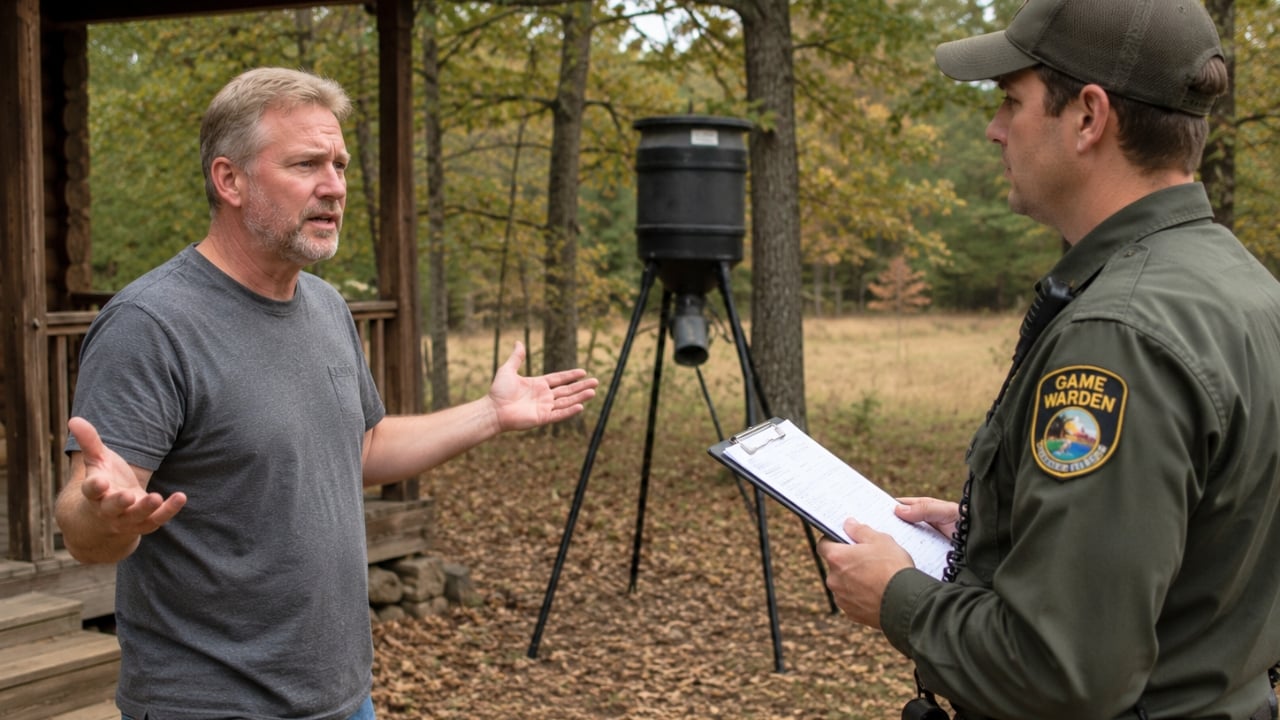
He wasn’t trying to run a high-fence operation or stack up a “deer buffet.” He wanted pictures, maybe some shed antlers to pick up in the spring, and the simple satisfaction of seeing critters use his place instead of only the neighbor’s hay field. Then a game warden rolled in and told him the feeder wasn’t just a feeder—it was illegal baiting under a rule he’d never heard of.
A simple feeder turned into an enforcement stop
The homeowner’s setup was the kind you see all over rural America: a timed spin-cast feeder hung off a tripod, dropping corn and a pellet mix once or twice a day. It was tucked back from the road, but not hidden. Anyone walking the property line could’ve seen deer tracks converging on it like spokes on a wheel.
According to the homeowner, the warden didn’t come in hot. It sounded more like a “heads up” that quickly turned into paperwork once the warden confirmed the feeder had been active recently. The point that surprised the landowner wasn’t that baiting is illegal in some places—he knew that can be a touchy topic. It was the specific way the rule was written and how it applied even on private ground, even when you weren’t actively hunting.
The rule that tripped him up: “influence” and “time windows”
Most hunters understand baiting as “feed something to pull game in, then hunt it.” The problem is that a lot of regulations don’t stop at that common-sense definition. Some states treat a feeder as bait if it’s placed in a way that could reasonably influence wildlife movement for hunting, whether you personally hunt there or not.
The homeowner’s surprise came from the time component. In many places, it’s not enough to simply turn a feeder off when season opens. Rules can include a removal requirement and a “cooling off” window—often measured in days or weeks—before that area is considered legal to hunt again. Even leftover corn on the ground can keep the clock running. On five acres, that’s a big deal, because “the area” can effectively mean the whole property.
What made it worse is that “bait” isn’t always just corn. Minerals, apples, “protein pellets,” and even certain attractant blocks can fall under the same umbrella. The homeowner thought he was on the safe side because he wasn’t sitting over it with a rifle. The warden’s view was simpler: the feeder is active, deer are using it, and that’s enough to meet the definition under that rule.
Five acres makes the setback problem real fast
On large tracts, you can usually create separation. If the law says you can’t hunt within a certain distance of bait, you can place the feeder way off on one end and hunt the other end. But five acres is small. You’re talking about a parcel that might be 330 feet by 660 feet if it’s shaped like a rectangle—and plenty of small properties aren’t even that clean.
Setback distances, buffer zones, and “area of influence” language can make a small place effectively off-limits for the season if a feeder was used wrong. It doesn’t matter if your stand is 150 yards away if the rule says 300, or if the baited “zone” is measured by property boundaries instead of tape measure.
Then there’s the neighbor factor. Small acreage means deer are crossing lines constantly. If the guy next door runs a feeder, your deer are his deer and vice versa. Some landowners learn the hard way that you can be doing everything right and still get questioned if you’re hunting close to a bait site across the fence. It’s not fair, but it happens.
How the conversation usually goes when a warden shows up
This is where things can go sideways for folks who aren’t used to dealing with game wardens. They aren’t regular patrol cops, and they’re not there to debate the spirit of the law. They enforce what’s written. If their interpretation is that the feeder equals bait under that regulation, arguing on the spot rarely helps.
The smarter move is what a lot of experienced landowners do: be polite, ask what rule is being applied, and request clarity on what fixes it. Is it “remove all feed and clean it up”? Is it “move it to a non-hunt area”? Is it “it’s fine outside season but must be removed by X date”? Those answers vary, but getting them directly matters.
Also, wardens pay attention to the whole scene. If there’s a feeder, a well-worn trail, and a box blind pointed at it, you’ve created a picture they can’t ignore. Even if you haven’t hunted it yet, it looks like a plan. And in wildlife law, intent can be inferred from what’s set up, not just what you say.
What other outdoorsmen zeroed in on: feeders, cameras, and paperwork
Most guys who heard about the incident didn’t argue about whether feeding attracts deer—everybody knows it does. They argued about consistency and communication. A common complaint is that baiting rules are explained in a way that makes sense to seasoned hunters, but not to newer landowners who are just trying to enjoy their property.
A lot of folks also brought up trail cameras. Cameras themselves usually aren’t the issue, but a camera on a feeder is basically a neon sign that says, “I’m concentrating deer right here.” Some outdoorsmen recommended moving cameras to natural funnels, scrapes, rub lines, and travel corridors—areas where deer already want to be—rather than creating an artificial hub that could draw scrutiny.
Then there’s documentation. Experienced landowners keep texts, emails, or notes from conversations with local officials. Not because they’re looking for a fight, but because wildlife regulations can be interpreted differently depending on the region, the season, and local disease-control rules. Having written guidance can save a lot of grief when someone new rotates into an enforcement district.
Practical options for small-acreage landowners who want wildlife without trouble
If you’re on a small piece of ground, the safest path is to assume anything that concentrates deer can create a hunting problem later—even if your original goal is photography or watching deer from the porch. Food plots, native browse improvements, and water sources are generally viewed differently than piles of feed, but even those can have rules attached in certain areas.
One workable compromise some landowners use is “off-season only” feeding with a hard stop well ahead of hunting season, followed by cleaning up the site. Another is shifting to habitat work that doesn’t involve dumping feed: hinge-cutting in the right spots, planting shrubs, letting edges grow up, and creating security cover so deer choose your place naturally.
And if you plan to hunt your five acres, it’s worth calling the local office before you ever buy a feeder. Ask simple questions: What counts as bait here? What’s the distance rule? How long does an area have to be bait-free before it’s legal to hunt? Get the answer, follow it, and you won’t be standing in your driveway trying to explain why you thought a “wildlife feeder” didn’t count.
The hard truth is this: small properties don’t have much margin for error. A feeder can be a great way to enjoy wildlife, but it can also turn your whole parcel into a headache if you stumble into the wrong regulation. The best move is learning the rules before the corn hits the ground—because once a warden sees it spinning, the “I didn’t know” card usually doesn’t buy you much.
Like The Avid Outdoorsman’s content? Be sure to follow us.
Here’s more from us: