Photo credit: AI-generated image created using ChatGPT. Illustrative only
Cleaning out a foreclosed property is usually a mix of busted furniture, trash bags, and the odd forgotten tool in a kitchen drawer. But one Georgia real estate worker got a very different surprise when he found a handgun left behind in the house his company had just taken possession of.
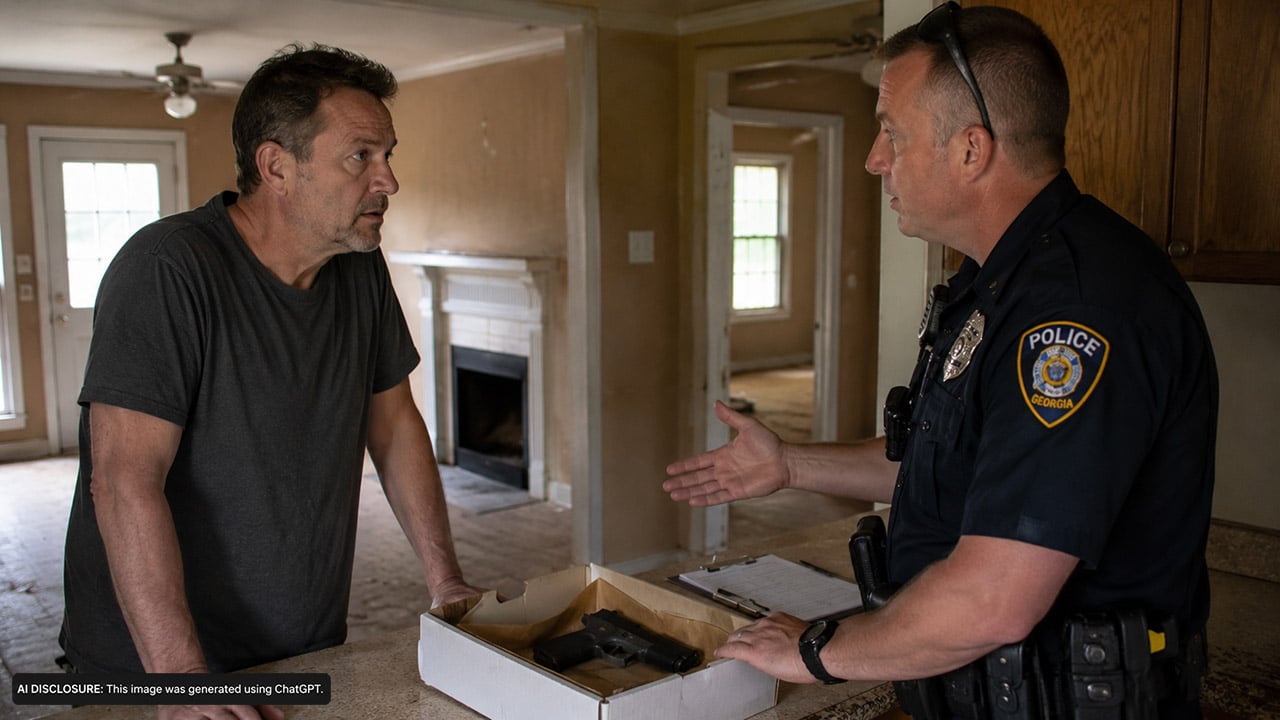
In the original post, the man said his company purchased the home at foreclosure, the tenants moved out a few days before the eviction, and he went through the place looking for anything that wasn’t junk. Instead of a box of old DVDs, he opened up a gun case and found a CZ-75 P-07 pistol inside. He did what a lot of responsible folks would do—he walked it into a police station—then got an answer that didn’t feel like an answer at all.
A foreclosure cleanup turned into a firearm problem
The setup matters here. The tenants weren’t still living there, and this wasn’t a situation where a gun was discovered in the middle of a heated move-out or confrontation. The company took possession, did a walkthrough, and the pistol was simply sitting there in a case—apparently left behind.
That “left behind” part sounds simple until you put a serial number on it. A firearm isn’t like a ladder or a pressure washer you can toss in the truck and call it a day. Once it’s in your hands, you’re suddenly responsible for how you handle it, how you store it, and what you do next.
The gun: a CZ-75 P-07 in a case
The pistol he found was a CZ-75 P-07, a compact-ish, polymer-framed CZ that’s common enough in the carry and home-defense world. Folks buy them because they tend to run well and fit the hand nicely, and they’re not rare collector pieces that you’d expect to find hidden in a wall.
But even if it’s a “normal” handgun, the biggest questions aren’t about the model. They’re about who it belongs to, whether it’s stolen, and whether it’s tied to anything that would make law enforcement treat it as evidence instead of lost property.
He tried to do the right thing—and got a vague answer
After finding the pistol, the man went to the police station and explained the situation. He said the officer was vague on whether he’d get to keep it after it was “ran… through their system.” That’s the kind of non-committal response that leaves a person feeling like they might be punished for being honest.
And that’s the tension in this whole scenario: if you keep it, you risk being accused of keeping someone else’s gun. If you turn it in, you risk never seeing it again—even if it turns out it isn’t stolen and nobody comes to claim it.
Why “keeping it” isn’t as straightforward as finding it
In the outdoors world, we’re used to the idea that abandoned stuff on your own land can become yours after a while. But guns are a different animal. They’re regulated, they have serial numbers, and they can carry baggage you don’t see—like being reported stolen years ago or being connected to a person who isn’t legally allowed to possess one.
Even if the house is now owned by the company, that doesn’t automatically mean everything inside it becomes the new owner’s property in a clean, simple way. Foreclosures, evictions, and tenant property can involve timelines and procedures. A firearm found during a cleanup can wind up treated as found property, seized property, or evidence, depending on what a records check shows and how the agency handles it.
That’s likely why the officer didn’t give him a clean “yes” or “no” at the counter. Until a gun is checked for a stolen report or other flags, nobody wants to promise a return—especially in a public-facing interaction where a single bad promise can turn into a liability.
The practical moves gun owners tend to focus on in this situation
The man asked two straightforward questions: is there a chance he gets possession of the gun, and is there anything additional he should do? Even without more details, the practical mindset is easy to understand. Nobody wants a stray firearm floating around unsecured, and nobody wants their good deed turned into a headache.
When outdoorsmen talk through situations like this, the common themes are usually documentation and process. If you find a gun, the smart move is to treat it like it could be loaded, keep it pointed in a safe direction, and store it securely until you can transfer it properly. Past that, it becomes a paperwork and policy issue: how the gun is logged, whether it’s treated as evidence, and what the local rules are for returning found firearms or transferring ownership if no rightful owner is identified.
There’s also a big difference between “can I keep it?” and “can I possess it legally today?” A person who can legally own a firearm may still have to go through the correct process to avoid trouble later—especially when the gun’s history is unknown.
What this means for anyone buying property and cleaning it out
If you buy rural property, flip houses, or manage rentals, this is the kind of curveball you should plan for. It’s not just guns, either—knives, ammo, old reloading components, or even black powder can show up in closets and crawlspaces. The moment you find it, you’re in the chain of custody whether you like it or not.
The key is to slow down and handle it like an adult. Secure it. Don’t show it off. Don’t toss it in a glove box and “figure it out later.” If you decide to involve law enforcement, understand that the answer you get might be cautious and non-committal until the gun is checked and properly entered. That can be frustrating, but it’s also part of why stolen guns sometimes make it back to their owners.
In this Georgia case, the man’s question—whether he’ll ever see that CZ again—hinges on things he can’t control: what the records check shows and what the agency’s policy is for found firearms. But the bigger lesson is clear enough for the rest of us: when a cleanup surprise has a serial number, treat it like it matters, because it does.
Like The Avid Outdoorsman’s content? Be sure to follow us.
Here’s more from us: