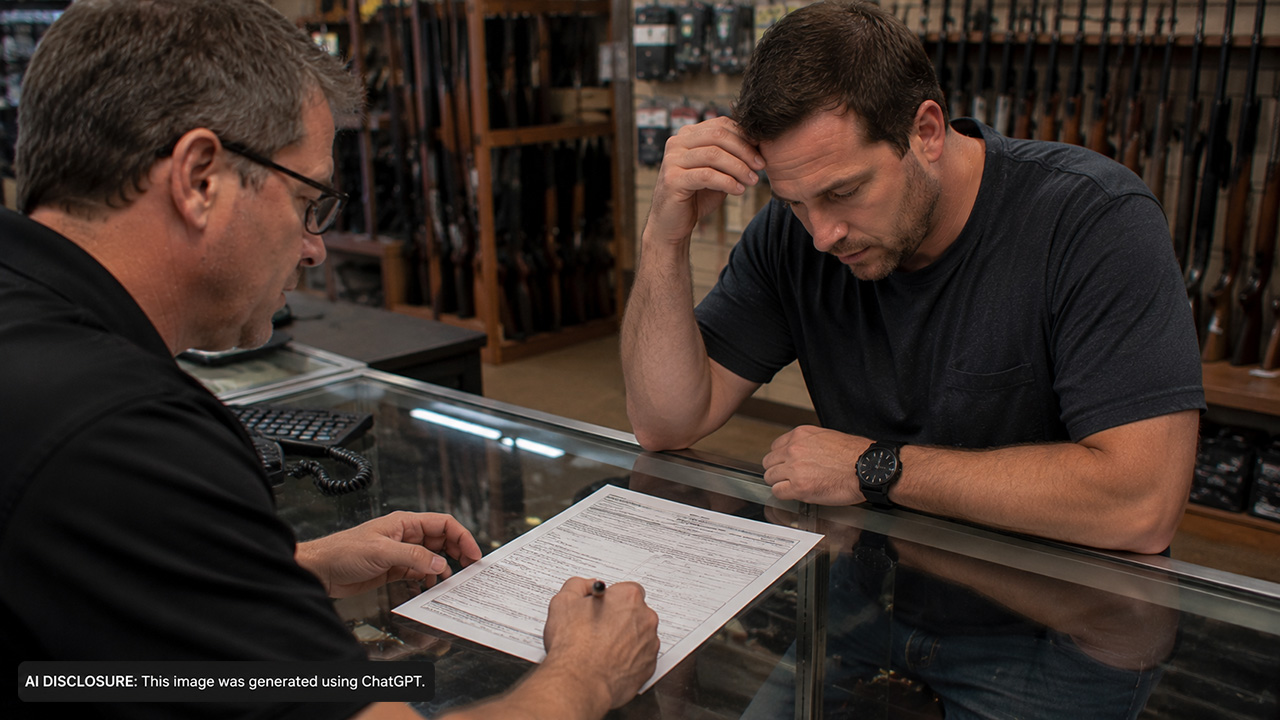
Photo credit: AI-generated image created using ChatGPT. Illustrative only
Buying a firearm shouldn’t feel like taking a vision test under pressure, but that’s basically what one shopper described after trying to buy a gun at Cabela’s. In his telling, the whole thing went sideways on the yes/no section of ATF Form 4473—the part that can end a sale in a hurry if you click the wrong answer.
The customer said he had trouble reading the questions on the store computer, misunderstood what one of them was asking, and answered “yes” when he meant “no.” The result wasn’t a pause or a chance to fix it. He said the transaction was immediately denied the moment he submitted the form, and then a bigger hammer dropped: he was told the form stayed in the store’s system and he could never purchase a firearm from that retailer again. The full account is in the original post.
How a single wrong click can stop a sale cold
Most outdoorsmen are familiar with the basic flow: pick the firearm, fill out the 4473, the dealer runs the background check, and you either get a proceed, a delay, or a denial. What people sometimes forget is that the form itself matters even before the background check result comes back—because certain answers on the form effectively make you a “no-go” right there at the counter.
That’s why this kind of mistake feels so jarring. The shopper wasn’t describing a criminal history issue or some long, drawn-out appeal. He described a reading/misunderstanding problem on an electronic form that immediately kicked the transaction out.
The counter correction that doesn’t always erase the original problem
The headline angle here is the hard part: even if you catch the mistake right away, the question becomes whether “fixing it” is treated like a clean correction—or whether the first answer still exists somewhere as the record of what you initially certified.
In the customer’s case, he said he was told the form remained in the retailer’s system. That detail is what spooked him. Outdoorsmen hear “it’s in the system” and immediately think of permanent flags, law enforcement follow-up, or an accusation that they lied on a federal form.
There’s also a real-world, practical side to it. Big-box stores tend to have tight compliance policies. Once a transaction is denied or a form is marked a certain way, the employees often don’t have the authority to “make it go away,” even if the situation looks like a simple mistake made on a kiosk.
The legal worry: mistake vs. “false statement”
The buyer’s main question was blunt: should he be worried about legal repercussions and call a lawyer, or is the worst-case scenario simply being banned from buying at that store?
In plain English, he’s worried that a wrong “yes” answer could be treated like a deliberate false statement on the 4473. That fear isn’t random—gun owners have all heard the warning that the 4473 is a federal form and you’re certifying the answers under penalty of law.
But intent matters in the real world. A misread question on a hard-to-see screen is a very different situation than someone trying to sneak past a disqualifier. The catch is that a customer standing at the counter can’t always tell where the line is between “clerical error” and “problematic answer,” because the form isn’t written for comfort. It’s written to be legally precise.
Why the store’s “never again” line may be the biggest consequence
What stands out in the account isn’t just the denial—it’s the alleged permanent ban from purchasing firearms at that retailer. That’s not the government talking; that’s a store policy decision, and big retailers are known for drawing hard lines to protect their license and keep compliance simple.
From the store’s point of view, a transaction that ended in a denial—especially one tied to how the form was answered—can look like a compliance risk. Retailers with high volume and lots of employees often rely on bright-line rules: if X happens, do Y every time. It keeps them from making case-by-case judgment calls that can bite them later.
From a hunter or gun owner’s point of view, it feels personal. A guy makes one mistake on a screen he can’t read well, tries to buy a legal firearm, and now he’s told he’s done there forever. Whether that’s “fair” isn’t really the question. The question is whether it’s believable—and if you’ve spent any time in large chain stores during a busy weekend rush, it is.
Practical lessons for the next time you fill out a 4473
This isn’t legal advice, but it is the kind of common-sense field advice you’d give a buddy before he walks back up to the counter. First, slow down. The yes/no section isn’t the place to power through on autopilot, especially on a small screen with glare or bad font size.
Second, if you can’t read it clearly, say so before you hit submit. Ask for the screen brightness to be adjusted, request help navigating the kiosk, or ask if there’s an alternative method the store allows. Plenty of folks wear readers, have astigmatism, or struggle with screen glare under store lighting. That’s normal. Guessing isn’t worth it.
Third, don’t let embarrassment make the decision for you. A quiet, straightforward “I’m having trouble reading this—can you help me make sure I’m answering correctly?” is a lot better than clicking the wrong box and dealing with a denial that may stick in a store’s internal records.
What people tend to fixate on in stories like this
When gun owners talk about these situations, they usually zero in on two things: what exactly was answered “yes,” and what the word “denied” really means in that context. In everyday conversation, “denied” can get used loosely—sometimes people mean the background check was denied, and sometimes they mean the sale was stopped because of a form answer.
The buyer’s account makes it sound like the transaction ended immediately after the form was submitted because of the answer he clicked, not because of a long wait for a response. And that’s an important distinction for anyone trying to make sense of what happened at the counter.
The other fixation is the “forever ban.” Even without extra details, that’s the part that changes the tone from “simple mistake” to “now I’m worried.” A temporary headache is one thing. Being told you’re permanently cut off at a major retailer is another.
What a grounded next step looks like
If you find yourself in this situation, the calm approach is usually the best approach. Document what you remember while it’s fresh—date, store, what you were told, and the general nature of the misunderstanding—then take a breath. Getting spun up at the counter won’t help, and arguing with a clerk won’t rewrite store policy.
There’s a difference between store consequences and legal consequences, and the buyer’s story highlights how easily those two get tangled in a person’s mind when a form goes wrong. In the end, the most useful takeaway for the rest of us is simple: if you can’t clearly read the questions on that screen, don’t guess. Stop the process, get clarity, and protect yourself from a problem you never intended to create.
Like The Avid Outdoorsman’s content? Subscribe to our newsletter so you never miss an article.
Here’s more from us: