Photo credit: Theavidoutdoorsman.com
It’s a familiar setup in rural country: a shortcut that’s been used so long folks start calling it “the way in,” even though it was never theirs. One landowner got tired of it after buying a tract that sat between a county road and a chunk of public ground, with an old two-track crossing the corner. For two decades, hunters had slipped through that corner to save themselves a long walk.
Then the new owner did what a lot of people talk about doing but don’t: they posted the boundary, marked trees, and blocked the trail with a gate and a line of rocks. It was clear, visible, and not confusing. The surprise wasn’t the posting. The surprise was how many people tried to act like it didn’t apply to them.
The access “everyone used” wasn’t a legal access at all
The old two-track had the look of something official—ruts worn in, grass pushed down, and just enough use to keep it from growing over. But “used for years” and “public right-of-way” are two different things. In a lot of places, unless there’s a recorded easement, a county right-of-way, or a documented access agreement, it’s private ground no matter how many boot prints are on it.
The new owner had already dealt with little problems that came with that trail: trash in the ditch, a few empty shotgun hulls by the fence line, and trucks parked where they shouldn’t be. What really changed the tone was realizing that people weren’t just walking through. They were cutting across within sight of the house and outbuildings during hunting season, sometimes before daylight.
Posting the line and blocking the two-track
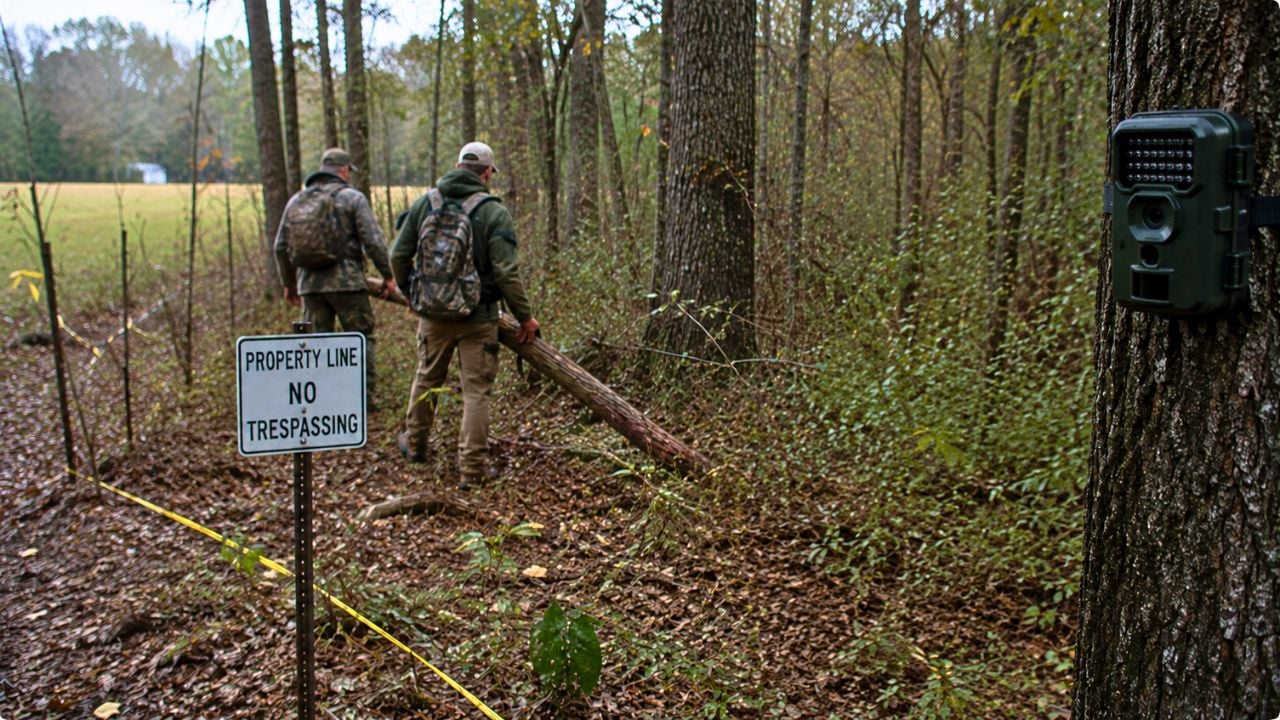
Instead of relying on a couple of faded signs, the landowner went the full route: fresh “No Trespassing” postings at normal intervals, bright paint on boundary trees, and a physical barrier where the trail entered. It wasn’t decorative. It was meant to stop vehicles and make walkers pause long enough to read.
That kind of move usually does one of two things. It either ends the problem overnight, or it exposes how entitled some people feel about access they never owned. In this case, it did the latter. After the first weekend of gun season, the landowner noticed tracks skirting the barrier—wide boot prints in the damp soil and tire marks where someone had eased off the two-track and pushed through the grass to rejoin it on the other side.
The camera was set for deer, not people
Most of us hang trail cameras to see what’s moving at night and which bucks are still alive. But cameras are just as good at showing what’s moving during legal shooting light, too. The landowner set one high, angled back toward the blocked entrance, and another down the line to catch anyone who tried to go around.
It didn’t take long. The images showed two hunters coming in from the road, standing at the barrier long enough to look at the posting, and then stepping off to the side. They didn’t appear lost. They didn’t turn around. They just acted like the rule was for somebody else.
Then came the part that made it more than an argument about “where the line is.” In the next sequence, the camera caught one of them pulling a folding saw from a pack and cutting a gap through brush to open a clean path around the block. Not a big clearcut—just enough to make it easy and quiet next time. That’s the kind of thing that turns a passive trespass into an active decision to defeat a boundary.
Why landowners get serious when it’s hunters doing the crossing
Most landowners I know aren’t looking to pick fights with outdoorsmen. Many of them hunt, too. The issue is what comes with it: loaded firearms, low light, and the possibility of a bad decision close to homes, barns, or livestock. When someone is willing to ignore a posted line, it’s fair to wonder what other lines they’ll ignore—shooting direction, safe backstops, or “no hunting” zones near buildings.
There’s also the liability and neighbor-relations side. If a wounded deer crosses property, that’s one thing. If hunters are regularly crossing to access other ground, they’re essentially using private land as a free corridor. That corridor can become a problem spot for litter, rutted ground, and confrontations with family members who don’t know who’s coming through.
And once someone starts trimming lanes or cutting brush on land that isn’t theirs, it’s no longer an “oops.” It’s ownership behavior. That tends to make landowners react fast, because it signals the problem isn’t going to fix itself.
Commenters zeroed in on easements, mapping apps, and calling the right people
When stories like this make the rounds in hunting circles, the same themes show up. Some folks insist that long-term use should create a right to cross. In reality, that’s highly dependent on the state and on specific facts. A handshake permission from a previous owner doesn’t automatically follow the deed, and “we’ve always done it” isn’t the same as a recorded easement.
A lot of experienced hunters pointed out the practical side: modern mapping apps make this avoidable. If you’re hunting public, you can usually find the legal access points, parking areas, and boundary lines before you ever leave the house. If your only way in requires stepping over a posted line, that should be a bright warning that you’re about to make your day more expensive and your season more complicated.
Others focused on documentation. Photos of the signs, screenshots of parcel boundaries, GPS pins of where the camera was placed, and clear timestamps matter when it becomes a “he said, she said.” People also urged the landowner not to handle it face-to-face. When firearms and tempers mix, even a simple conversation can go sideways.
What the landowner actually did next
Instead of waiting at the gate or trying to run people off in person, the landowner gathered the basics: the trail-cam photos, a simple sketch of the entrance, and proof of where the property line sat. Then they contacted the appropriate local authorities and asked for guidance on how to handle repeat trespass during hunting season.
In many rural areas, that can mean a game warden, a sheriff’s deputy, or both, depending on how the call is framed. If the core problem is trespass with hunting gear, wildlife officers often have the most context. If it involves property damage—like cutting brush, breaking a gate, or moving barriers—then it may shift into a different lane.
The landowner also reinforced the physical side: moving the barrier slightly to eliminate the easy “walk-around,” placing signage where it would be in-frame for the camera, and keeping the entrance tidy so it was obvious that someone had altered it. The goal wasn’t to bait anyone. It was to remove excuses.
Hunters who haven’t dealt with the landowner side of this should take note: the quickest way to lose access in a whole neighborhood is to treat one person’s boundary like it doesn’t matter. If you’re not sure, ask. If you can’t ask, don’t cross. And if you’ve got a long walk from a legal access point, that’s just part of hunting public ground the right way.
The woods are big, and there’s usually another route. The moment you start cutting your own path across someone else’s place, you’re not just breaking a rule—you’re gambling with your season, your wallet, and somebody else’s peace of mind.
Like The Avid Outdoorsman’s content? Be sure to follow us.
Here’s more from us: