Photo credit: AI-generated image created using ChatGPT. Illustrative only
Most folks who live out where you’ve got a little space between you and your neighbors don’t call the police unless they really have to. When something goes sideways, you want it handled quick, documented right, and you want to get back to keeping your family and your home secure.
One homeowner says he tried to do exactly that after being robbed—only to watch the situation snowball into officers accusing him of setting up the crime and then arresting his wife anyway. The account was shared in the original post, and it’s the kind of story that makes you think hard about documentation, home security, and what you say when law enforcement shows up.
A street robbery turned into a home-security problem fast
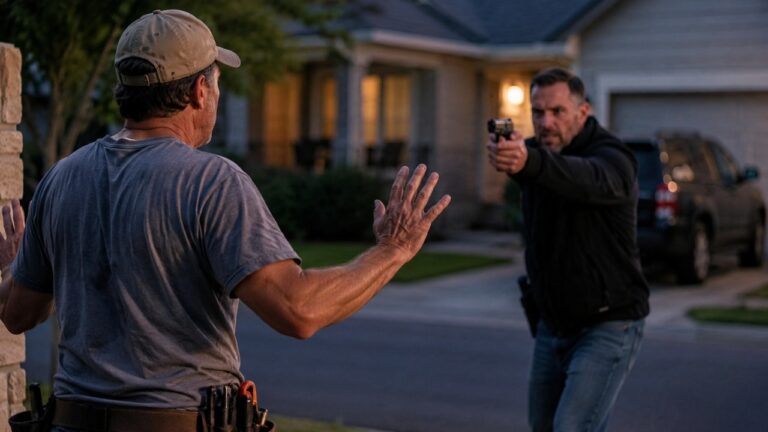
According to the homeowner, the trouble started with him getting robbed away from the house. The thieves took his wallet—containing his driver’s license with his home address—and also took his house keys. They tried to take his car too, he said, but couldn’t because his wife had the key and she wasn’t there at that moment.
That’s the nightmare scenario a lot of us think about: keys and address together. The homeowner said that when officers responded to the initial robbery, he asked them to check his house because whoever robbed him now had what they needed to walk right in. He says an officer brushed it off, suggesting the thieves were probably more interested in running credit cards than hitting the house.
He came home to a ransacked bedroom and called again
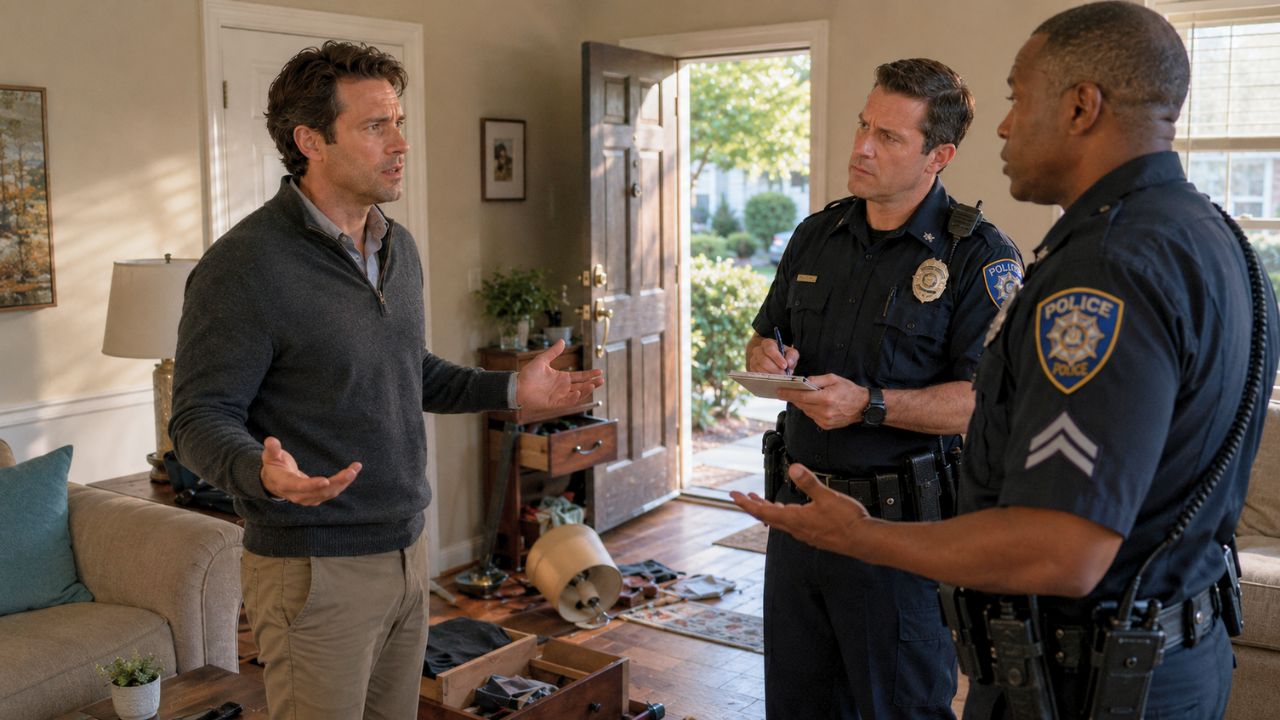
When he returned home, he says he found the house burglarized. In the bedroom, every drawer was open and clothes from drawers and closets were piled in the middle of the room. He described even the bed being moved.
He also said he made a point not to enter the room once he realized what he was looking at, because he wanted to preserve evidence. He immediately called police to report the burglary and asked for them to respond.
Officers reportedly decided it looked staged
Instead of treating it like a fresh burglary scene, the homeowner says officers took one look at the mess and decided his wife had been packing a suitcase. He stated that both his wife’s suitcases and his own were on the floor, and that her suitcases were empty—implying they’d been pulled from the closet during the search, not used for packing.
He admits something looked odd: large items like a TV and computer weren’t taken. But smaller items were, including a camera and an Xbox controller. He says officers treated the fact that he couldn’t immediately list everything missing—because the house was still in disarray—as more “evidence” that the burglary wasn’t real.
The homeowner offered a practical explanation that’ll sound familiar to anyone who’s lived behind a gate or fence line: he later realized the thieves may have had to get in by hopping a wall into the gated community. In his mind, that could explain why they grabbed what they could carry and didn’t bother trying to haul out a big TV.
From burglary call to interrogation—and then an arrest
What really ramped up the tension, he says, was how the response changed once officers made up their minds. He claimed they refused to collect evidence, performed about a one-minute search, and then spent roughly a half hour outside interrogating the couple. During that time, he says, one officer yelled at him and accused him of staging the burglary.
Then came the turn he didn’t see coming: he says officers arrested his wife for domestic violence. The homeowner acknowledged they’d argued earlier about her phone, describing it as part of an already bad night, but he insists there was no violence.
He also said the injuries he had were from the earlier robbery, not from anything that happened at home. In his view, the domestic violence arrest felt like punishment for insisting the burglary was real and asking police to do their job.
He says the written reports didn’t match reality
Afterward, the homeowner obtained copies of the police reports connected to both the burglary and the domestic violence case. He claims the reports contained statements that were not just mistaken, but flat-out fabricated.
He gave a couple examples that stuck out: the report allegedly referenced plates and framed pictures on the ground that were undamaged, implying they must have been placed carefully as part of staging. The homeowner says they don’t have framed pictures on the walls, and their plates are plastic and don’t shatter.
He also said he took photos of the damage before police arrived, and believes those images show the written narrative doesn’t line up with what was actually in the home.
A neighbor’s alleged statement became a big pressure point
One detail he flagged as especially troubling involved a neighbor who walked by and got involved while the couple argued outside. The homeowner describes the neighbor as trying to de-escalate things, and says it helped calm the situation.
But in the police report, the homeowner says officers wrote that the neighbor told them he heard the wife beating the husband through an open door. The homeowner says he’s “90% certain” the neighbor never said that, and planned to talk to him about it.
Even if the neighbor did tell police something along those lines, the homeowner questioned how a claim about sounds “through an open door” could be treated as conclusive evidence of assault—especially when the only visible injuries were tied, in his account, to the earlier robbery.
The hard lessons for homeowners who plan for worst-case nights
Whether you live in town or down a gravel road, this is the part that hits home: when a scene gets labeled “staged” early, everything after that can tilt against you. The homeowner said it plainly—he felt he would have been better off not calling at all, which is a brutal thing for a law-abiding person to conclude after getting burglarized.
From an outdoorsman’s perspective, the practical takeaways are about controlling what you can control. If keys and a wallet get taken, treat your house like it’s already targeted. If you find a burglary scene, take wide-angle photos from the doorway, don’t touch more than you have to, and write down what you see while it’s fresh. If you’ve got cameras—trail cams aimed at a driveway, doorbell cams, or a basic home system—save the footage immediately and back it up.
And if law enforcement starts steering the conversation toward accusations, it’s worth slowing down and being careful. The homeowner in this account said money was tight for an attorney, especially after losing $2–3k in property, having no burglary coverage, and paying bail. But when criminal accusations enter the picture—especially domestic violence—getting competent legal help quickly can be the difference between clearing things up and getting buried under paperwork.
In the end, this wasn’t just a story about stolen property. It was about how fast a bad night can flip from “we need help” to “you’re the problem,” and why documentation, cameras, and level-headed communication matter when the stakes are your home, your family, and your record.
Like The Avid Outdoorsman’s content? Be sure to follow us.
Here’s more from us: