Photo credit: AI-generated image created using ChatGPT. Illustrative only
It’s hard to beat a 200-acre Iowa farm laid out in timber, ravines, and cover when you’re thinking about whitetails. But the same tucked-away corners that grow big deer can also hide problems—especially when the neighbor line is more “old fence and good luck” than something you’d bet your season on.
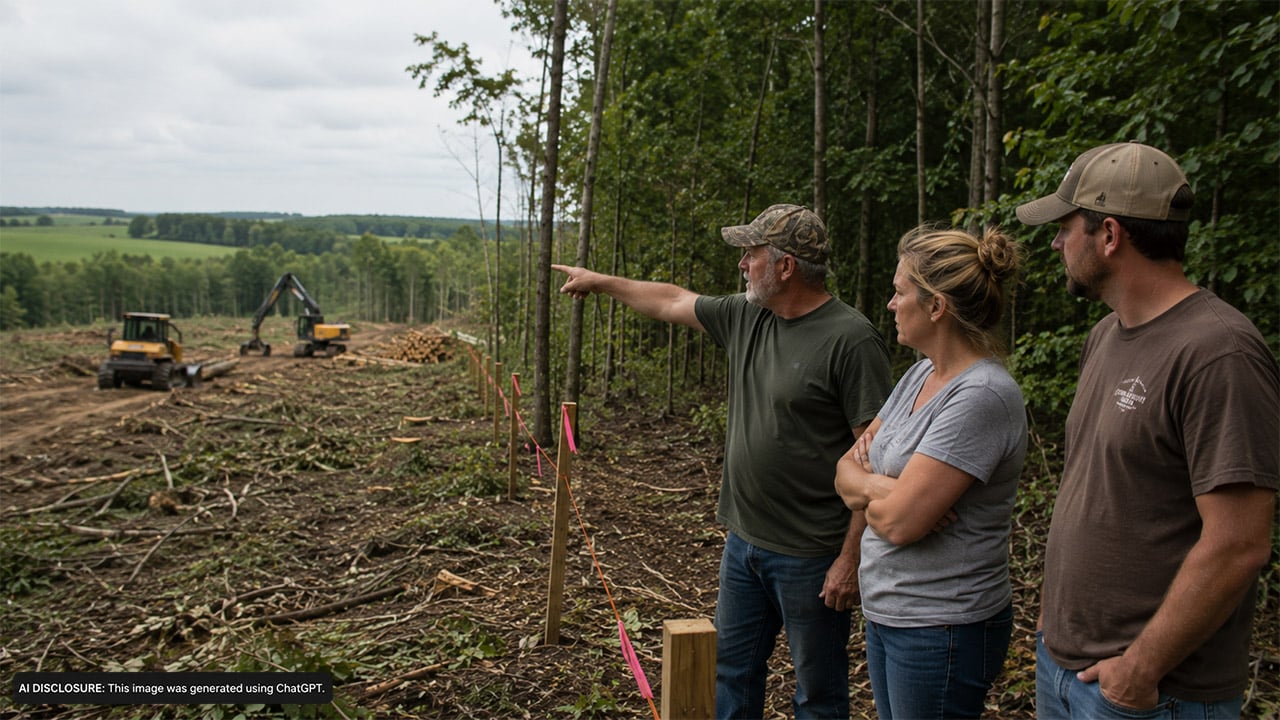
That’s exactly what one family ran into when a new owner bought the land directly north of their property and started marking trees for removal along a questionable boundary. In the original post, the writer describes finding roughly 50 trees flagged to be cut near an ancient, broken fence that no longer cleanly matches the lay of the land—particularly around a stream where the fence doesn’t line up at all.
A fence line that doesn’t match the ground
The family property is described as a backward “L”: two 80-acre stretches running north-south, plus an additional 40 on the southwest corner. It’s remote enough that the north side doesn’t get constant eyes on it, and the fence that’s supposed to mark the boundary is “ancient and broken in many places.” That’s the kind of setup where folks start treating a line like it’s “where the fence is” instead of where the deed says it is.
What raised the hair on the back of the poster’s neck was evidence of an even older fence line sitting about 20 yards into the neighbor’s side in places. That can mean a lot of things—an old boundary, a moved fence, a bad memory, or just generations of patchwork repairs—but none of them are good when someone fires up a saw.
When marked trees show up, it stops being theoretical
The situation went from “we should really fix that fence someday” to “this could cost real money” when the writer found trees marked for removal near the boundary. Some of those marked trees reportedly had remnants of the old fence wrapped around them. At least one tree was literally part of the current fence—barbed wire wrapped around it decades ago, now swallowed by the growing trunk.
If you’ve spent time around timber sales, you know how fast a job can move once a crew is scheduled. Marked trees are often the last calm moment before the noise starts. And when the boundary is unclear, it’s not just about losing a few trees. It’s about losing a precedent, too.
Landlocked ground and the access question hunters understand
There’s another detail that matters to anyone who hunts farm country: the north parcel appears to have no road access. The family had been offered 40 acres abutting their land to the north and declined to buy because land prices had shot up and the parcel was landlocked.
That immediately raises the practical question: how does the new owner—or the logging crew—plan to get in and out? The writer doubted they’d come through the family’s place due to ravines, but in the real world, “landlocked” often turns into somebody trying the easiest route and hoping nobody complains. That’s how trespass arguments start, and it’s also how deer seasons get ruined when strangers begin crossing your best bedding cover like it’s a county park.
Boundary trees, fence trees, and why a survey is the first real move
The poster’s questions were the ones any rural landowner eventually asks: who owns trees that are right on the line, can a neighbor cut them, and what do you do if they cut yours anyway? With a fence that doesn’t clearly match the stream and older fence remnants appearing in different places, guessing is a losing game.
The practical move in a situation like this is to get the line established in a way that holds up later—meaning a survey, not just a handshake. The writer floated that idea themselves, along with contacting the new owner and asking for a survey before cutting begins. That’s not being difficult; that’s protecting yourself before the evidence is hauled off the property and turned into lumber.
Just as important: if the family intends to repair the fence or flag it so a contractor can’t claim ignorance, doing it thoughtfully matters. The writer mentioned running wire to temporarily repair sections and adding flagging tape to make it obvious they’re watching. That kind of visibility can stop “oops” mistakes, and it can also stop the more deliberate kind of line-pushing that happens when someone thinks the back corner never gets checked.
Trail cameras, documentation, and keeping things from turning into a feud
Any experienced deer hunter knows trail cameras aren’t just for velvet pictures. They’re also the simplest way to document what’s happening on your own ground, especially in places you don’t visit often. The writer asked if they’d be within their rights to place concealed trail cameras on their side of the fence to document logging activity.
That tells you where their head was at: they weren’t looking to pick a fight in the timber; they wanted clean proof if trees started disappearing. And proof matters. Stumps can be argued over. Fresh tire tracks can be explained away. But date-stamped images of a crew working past a marked line are hard to hand-wave.
The other smart instinct in the post was the question of what to do if someone uses their land to access the landlocked parcel. In rural areas, a lot of problems start with “we’ve always gone this way,” which is usually code for “it was easier than asking.” When it comes to hunters or contractors crossing property, calling the sheriff is an option the writer mentioned—one that can keep the situation from turning into a direct confrontation in the woods.
The quiet fear under it all: losing acres over time
Buried inside all the tree talk is the bigger worry: did the fence get “adjusted” decades ago in a way that cost the family ground? The writer wondered if the old fence line suggests a former landowner moved the boundary to their advantage, and whether it could add up to “maybe a dozen acres.”
That’s not pocket change in today’s whitetail country, especially in a part of Iowa where the writer says out-of-state buyers are snapping up hunting land. It’s also why they asked about adverse possession—whether a misplaced fence built long before their relative bought the farm could affect ownership now.
Even without getting into a courtroom lesson, most landowners understand the common-sense side of it: if you let a wrong line sit long enough and everybody treats it like the real line, it can get messy to unwind. That’s why the right time to take it seriously is before the trees are cut and before another season goes by with everyone pretending the broken fence is “close enough.”
For hunters and rural families, this is one of those moments where being neighborly and being firm have to happen at the same time. A quick conversation with the new owner, a clear request to pause cutting near the boundary until it’s surveyed, and quiet documentation on your side can keep “prime deer ground” from turning into a long-running property fight that nobody wins.
Like The Avid Outdoorsman’s content? Be sure to follow us.
Here’s more from us: