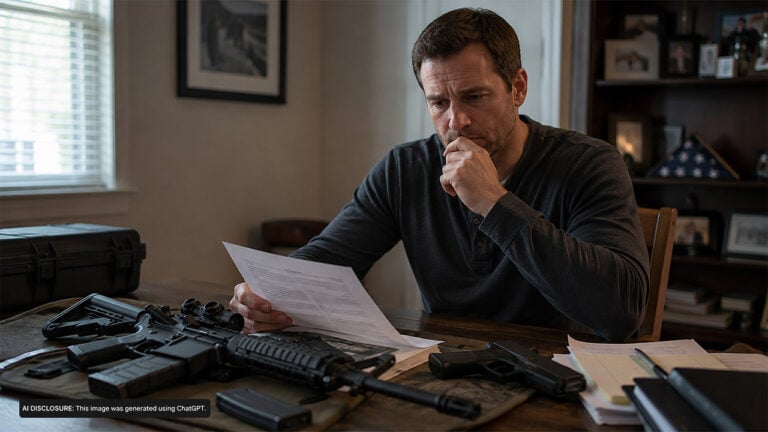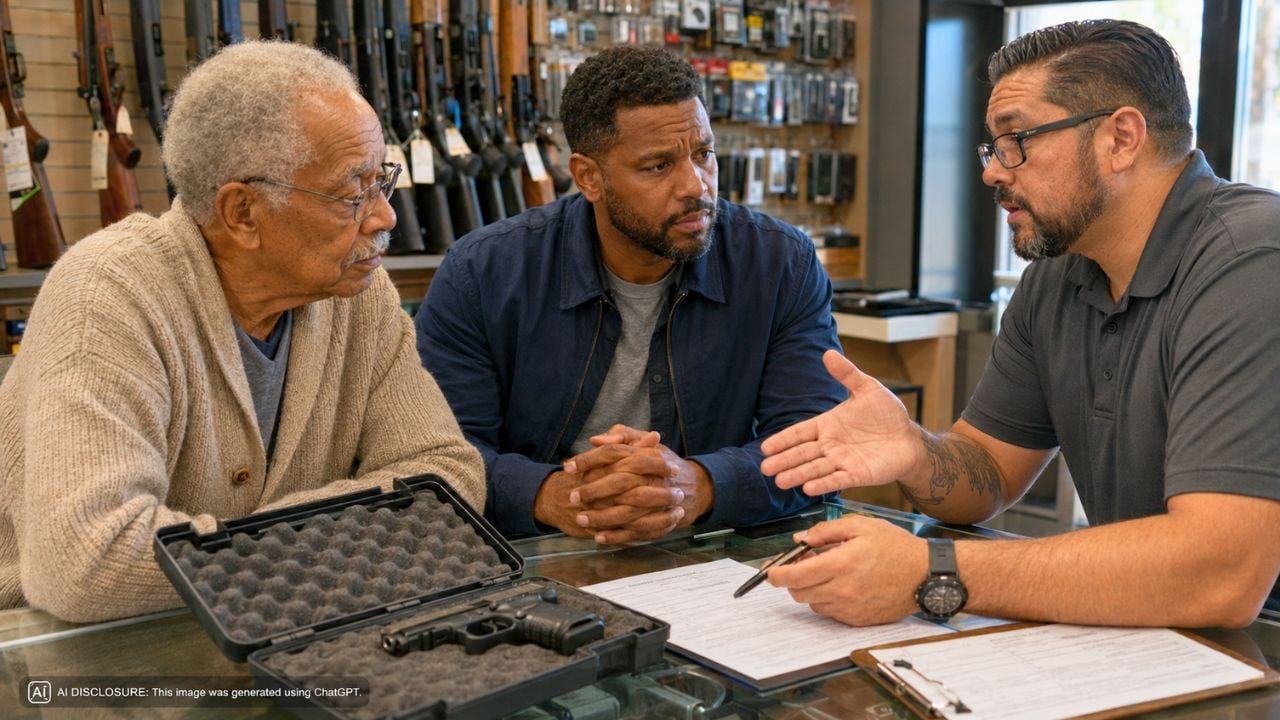
Photo credit: AI-generated image created using ChatGPT. Illustrative only
A lot of families have one or two “old guns” floating around the edges of the estate plan—something Grandpa hunted with, kept behind a bedroom door, or leaned in the corner of a farmhouse closet for decades. Most of the time, passing one down is simple. But when the person Grandpa wants to receive it has a felony on his record, it turns into a problem that isn’t sentimental at all.
That’s the situation laid out in the original post, where a family in Pennsylvania is trying to navigate a dying grandfather’s wishes, a Power of Attorney holder’s responsibilities, and the reality that a prohibited person can’t legally possess a firearm—even if it’s “just a family gun.”
A verbal promise ran into a hard legal wall
Years earlier, the grandfather had made it known—verbally—that he wanted one of his guns to go to a specific family member. The catch is the intended recipient has a felony conviction, and while he’s no longer on probation, the family understands he still may not be allowed to possess any gun.
Now the grandfather is nearing the end of his life, and the person acting under Power of Attorney (and later expected to be a co-executor) doesn’t want to hand the gun over. Not out of spite, but out of concern that following Grandpa’s wish could drag other family members into criminal trouble.
It wasn’t “a pistol,” it was a long gun—still a big deal
The firearm in question is described as a long gun that is not required to be registered in Pennsylvania. That detail matters to gun owners because a lot of folks hear “no registration” and assume that means “no paper” and therefore “no big deal.”
But legality doesn’t hinge on whether the gun is registered. The key issue is possession—who can legally have it, who can control it, and who might be considered to have transferred it. A long gun is still a firearm, and prohibited-person rules don’t care whether it’s a deer rifle, a turkey shotgun, or Grandpa’s old .22.
The POA’s dilemma: do you get in trouble for seeing what’s coming?
The Power of Attorney holder is hesitant to let the felon family member have the gun and doesn’t plan to hand it over. The question is whether the POA could face legal consequences in two scenarios.
First: what if the POA allows another family member to receive the gun, knowing full well it’s ultimately going to end up with the person who can’t legally possess it? That’s the kind of “wink and a nod” transfer that makes responsible gun owners nervous, because it can look like intentionally routing a gun around the law.
Second: after the grandfather passes away, what if the other co-executor gives the gun directly to the prohibited family member? The original poster is essentially asking, “If I don’t do it, but someone else does it in the estate process, do I get dragged into this?” It’s a fair concern—especially when you’re trying to keep the peace at the worst possible time for a family.
Why the licensed-dealer step matters for regular folks
When gun owners talk about “doing it right,” what they usually mean is using a licensed dealer when required and not trying to shortcut the transfer—especially when there’s any doubt about eligibility. In a lot of states and situations, certain transfers can be done privately. In others, a dealer is the cleanest path even when it’s not strictly mandatory, because it creates a lawful process and puts the background check question where it belongs.
In this Pennsylvania scenario, that dealer step becomes the practical dividing line between “family tradition” and “family liability.” If the intended recipient is prohibited, a lawful transfer through a dealer is going to stop right there. That’s not because the family is being difficult—it’s because the system is designed to prevent possession by someone who can’t legally have a gun.
And from a nuts-and-bolts standpoint, using a dealer forces the truth into the open early. It keeps the POA or executor from becoming the guy who “made it happen” behind closed doors.
Estate guns can turn into real criminal exposure fast
Most hunters and rural gun owners understand straw purchasing in the context of buying a new handgun for someone else. But families sometimes miss that “straw” behavior can show up in estates and gifts, too—especially when the plan is to park the gun with one relative as a temporary pass-through.
The question asked in the source material goes straight to that fear: if one family member knowingly hands it to another, with the understanding it will be passed along to the prohibited person, could that first person be on the hook? The concern isn’t abstract. When everyone “knows what’s going on,” it can be hard to later claim it was innocent.
The same goes for executors. Being a co-executor isn’t just a ceremonial title; it’s a job. And when firearms are part of an estate, doing the job wrong can create consequences that follow you long after the funeral—especially if a gun ends up where it never should have been and something bad happens.
The cleanest options are also the least dramatic
Nothing in the source material suggests the grandfather put this wish in writing, and it isn’t reflected in the will. That matters in a practical way: a verbal request might carry emotional weight, but it doesn’t magically erase firearm restrictions or turn a prohibited person into a lawful owner.
In real-life terms, families facing this kind of situation usually have a few grounded paths that don’t involve risky handoffs. One is simply not transferring the firearm to anyone who can’t possess it, even if that disappoints someone. Another is transferring it to an eligible family member who will keep it and treat it as a family heirloom—without it becoming a “placeholder” for someone else.
And if the family wants to avoid suspicion and future infighting, the best move is to keep everything aboveboard: secure storage, clear documentation inside the estate, and a transfer process that follows Pennsylvania rules. That often means using a licensed dealer when any part of the transfer feels questionable, because the short-term inconvenience beats long-term legal trouble.
There’s a time to honor Grandpa’s wishes, and there’s a time to protect the rest of the family from making a bad decision under pressure. When a firearm and a felony record collide, the smart play is boring, lawful, and crystal clear—because the alternative can turn a keepsake into a problem nobody asked for.
Like The Avid Outdoorsman’s content? Be sure to follow us.
Here’s more from us: