Photo credit: AI-generated image created using ChatGPT. Illustrative only
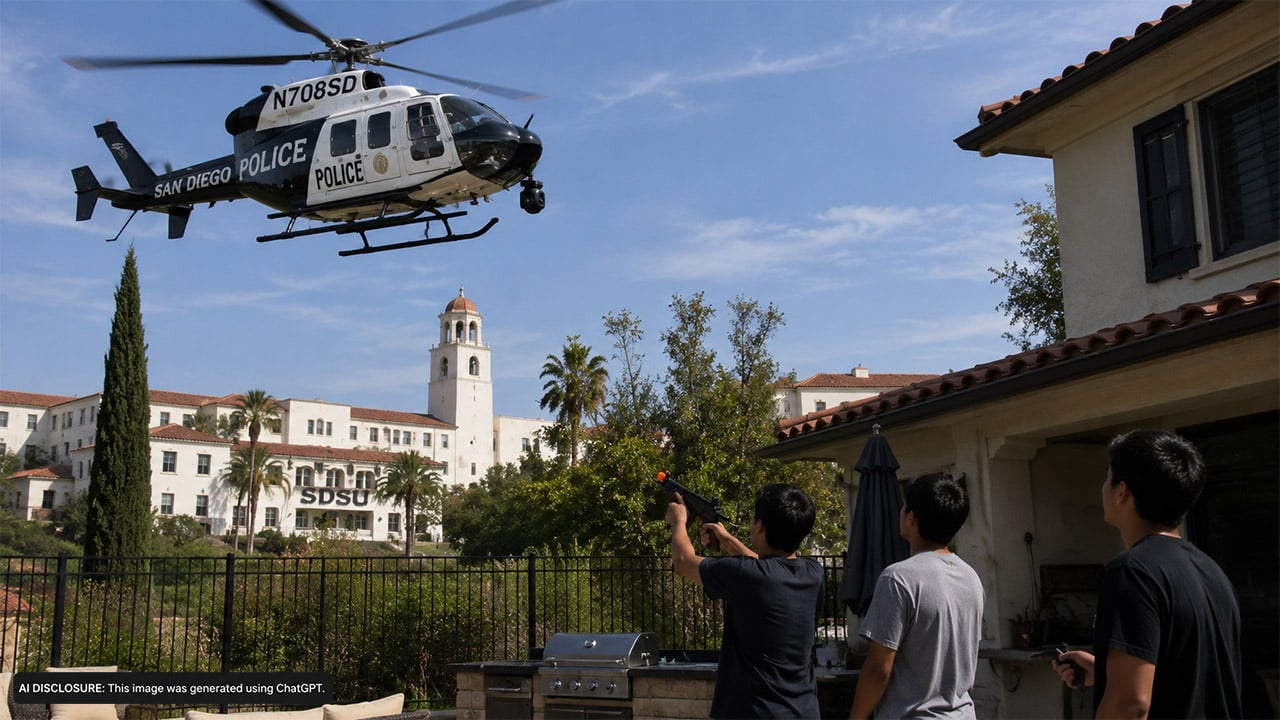
A group of San Diego State University students thought they were just burning off steam in the backyard with BB guns. Then a neighbor saw what looked like firearms, called police, and the whole thing escalated fast—right up to a helicopter circling overhead. The twist is what came later: after they were released without criminal charges, they were told they might still be on the hook for a massive bill tied to the response.
The details come from the original post written by one of the students involved. He said the incident happened in San Diego, California, at an off-campus house, and that the school later called the students in for investigative meetings—along with talk of a $19,000 charge and possible suspension or expulsion.
A backyard BB gun session that looked a lot worse from next door
According to the student, he and a few roommates were “playing around” in their backyard with BB guns. From their perspective, it was harmless. But from the neighbor’s viewpoint—especially at a distance—BB guns can look an awful lot like the real thing.
That’s a reality gun owners and outdoorsmen understand: perception matters. Plenty of airguns are made to mimic real firearms, and it doesn’t take much for a quick glance through a fence line to turn into a 911 call about “people with guns.” The students didn’t know anyone had called police until they noticed a helicopter circling their house.
The moment the helicopter showed up, bad decisions piled on
Most folks who’ve spent time around firearms—real ones or airguns—know the golden rule when law enforcement shows up: keep your hands visible, keep your mouth shut, and don’t do anything that can be mistaken for a threat. The students did the opposite.
The poster said they flipped off the helicopter, and one roommate “thought it would be better to point the BB gun at the helicopter.” That one move changes everything. Whether it’s a pellet rifle, a BB pistol, or a real handgun, pointing it at an aircraft is a fast track to a high-risk police response. It’s also the kind of action that makes it hard for anyone—school officials included—to treat the situation as “kids being kids.”
Detained, searched, and released—yet the consequences didn’t stop
The student wrote that officers searched the house and detained them, then ultimately let them go without charges. In a lot of people’s minds, “no charges” feels like the end of the story.
But anybody who’s dealt with schools, workplaces, or even hunting access disputes knows there can be a second set of consequences that has nothing to do with a courtroom. Here, the student said the school was notified because they were SDSU students, and they started getting called in “one by one” for investigative meetings.
That’s where it got expensive. The roommates who already attended meetings reportedly came back saying the school intended to charge them the cost of the police work—$19,000—on top of possible suspension or expulsion.
How can you get billed if you weren’t charged with a crime?
The student’s questions are the same ones most reasonable people would ask: If nobody was charged, how can there be a bill? If it happened off campus, does the school have authority? And can police—or anyone—charge you for the cost of responding to a call?
From a common-sense, outdoorsman angle, here’s the hard truth: “not charged” doesn’t always equal “no consequences.” Schools often have student conduct rules that reach off-campus behavior, especially when it involves weapons or actions that create a public safety response. You can beat a criminal charge and still get hammered by an administrative process.
As for billing, the poster described it as the school charging them for “the cost of the police work,” not necessarily the police department sending them an invoice directly. That distinction matters. Schools sometimes try to treat these situations like restitution or reimbursement under student conduct policies, even when the incident happened at a private residence.
What outdoorsmen should take from this: airguns still demand real-gun discipline
There’s a lesson here that applies whether you live in a subdivision, a college rental, or out in the county with a safe backstop: treat BB guns and pellet guns with the same discipline you’d use for a .22. Not because they’re equally powerful, but because everyone around you—and every responding officer—has to make decisions based on what it looks like, not what it is.
If you’re shooting anything in a backyard, you need a legit backstop, a clear line of fire, and you need to think through what a neighbor might see from a window or over a fence. And if law enforcement arrives, the correct move is simple: set it down, step away, hands open, and comply. The poster’s account of someone pointing a BB gun at a helicopter is the kind of thing that can get somebody hurt even if it never turns into a criminal case.
For gun owners, hunters, and landowners, it’s also a reminder that “private property” isn’t a force field. Local ordinances, nuisance laws, and reckless behavior can still create problems. And in tight neighborhoods, the margin for error is small.
The real pressure point: a school process can move faster than a court process
The student seemed caught off guard that the school was now the main driver of consequences. That’s pretty common. Administrative investigations don’t have to follow the same playbook as criminal cases, and they can impose penalties based on a different standard than “beyond a reasonable doubt.”
Even if a prosecutor declines to file charges, a university may still decide the conduct violated policy. And the student’s own description includes a few things schools tend to treat as serious on their face: a weapons-related call, a police helicopter, and behavior that can be interpreted as threatening.
The money piece—being told the school would charge $19,000 for the response—is what makes this story stand out. Whether that number holds up or gets walked back, it shows how fast “messing around” can turn into a real financial gut punch.
Outdoorsmen tend to be practical about risk. This is one of those situations where the risk wasn’t the BB gun itself—it was the chain reaction: neighbor perception, helicopter response, a reckless gesture, and then an institutional process that doesn’t care that it started as backyard horseplay.
Like The Avid Outdoorsman’s content? Be sure to follow us.
Here’s more from us: