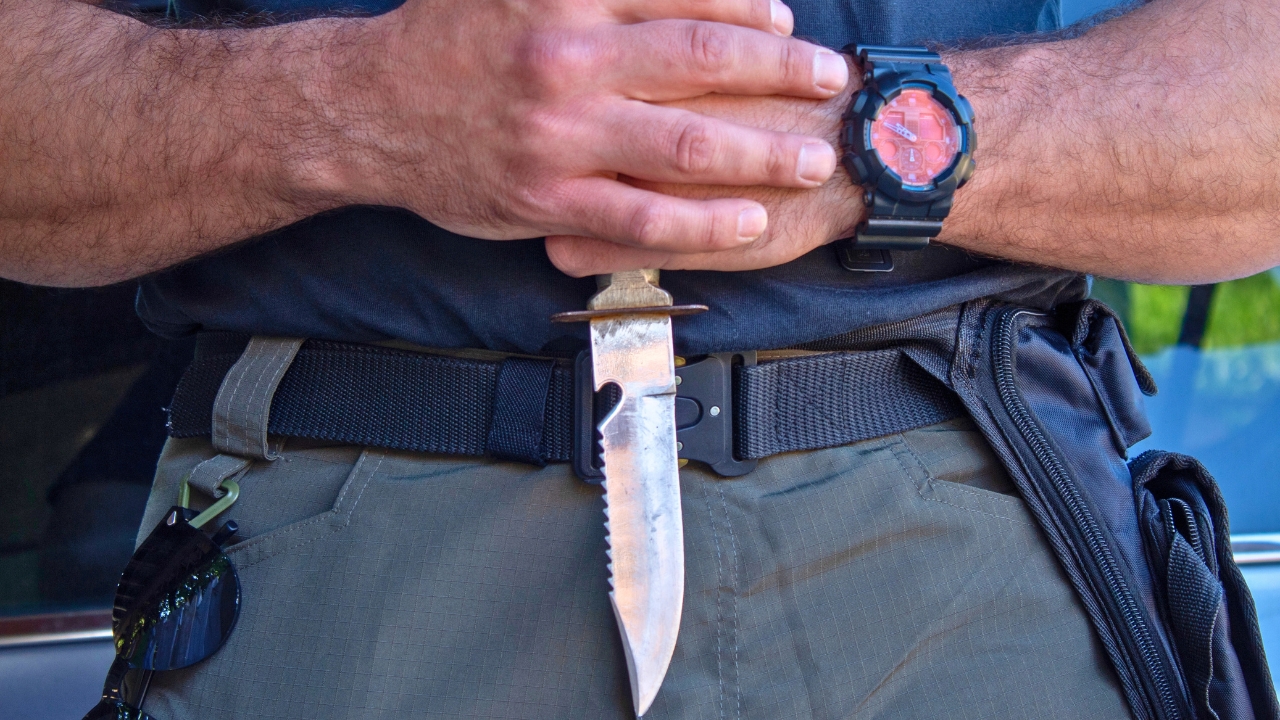
Photo credit: Danre/Shutterstock.com
Traveling with a pocketknife has always carried a quiet risk for you, not because you intend to break the law, but because crossing a state line can turn an everyday tool into contraband. A carefully drafted “safe passage” fix could finally give you predictable rules for moving through hostile jurisdictions, instead of leaving you to guess what happens if your flight diverts or your road trip detours. To understand what is at stake, you need to see how knife laws evolved, how advocates are trying to repair them, and what that means for your next trip.
The patchwork problem you face every time you travel
When you toss a folding knife into your checked luggage or glove box, you are stepping into a legal maze that shifts from county to county. One state may treat your locking folder as a perfectly ordinary tool, while the next labels the same blade a prohibited “gravity knife” or “dangerous weapon.” You are expected to know those distinctions even when you are only passing through, which means a simple drive from Pennsylvania to New York or a layover in New Jersey can expose you to criminal liability you never intended to assume.
The practical effect is that you carry a constant background risk whenever you travel with a blade, even if you are meticulous about airline rules and local ordinances at your destination. A delayed connection, a missed flight that forces you to overnight in a different city, or a wrong turn off the interstate can suddenly put you under a new set of statutes that treat your gear very differently. That uncertainty is what the “safe passage” concept is designed to fix, by giving you a predictable legal shield when you are simply moving between places where your knife is lawful.
How “safe passage” is supposed to work
The core idea behind a safe passage fix is straightforward: if your knife is legal where your trip begins and where it ends, you should not be prosecuted just because you cross a jurisdiction that bans it. In practice, that protection usually comes with conditions. You are expected to keep the knife secured, typically in checked baggage or a locked container, and you cannot make unnecessary stops that turn a transit into a new visit. The law is meant to distinguish between someone who is merely passing through and someone who is deliberately carrying a prohibited weapon into a place that has chosen to outlaw it.
For you as a traveler, a robust safe passage rule would function like a legal corridor that follows you from origin to destination. It would not give you license to ignore local restrictions once you step out of that corridor and start using or openly carrying the knife in a restrictive state. Instead, it would narrow the focus to your status as a traveler in transit, so that an emergency landing, a highway closure, or a missed connection does not suddenly turn you into a criminal for possessing something that is lawful at both ends of your journey.
Why knife advocates say the current protections fall short
Advocates argue that existing federal and state protections are too narrow, too vague, or too poorly enforced to give you real confidence when you travel. In some places, safe passage language is limited to firearms, leaving knives in a gray zone where officers and prosecutors have broad discretion. In others, the law technically covers knives but uses terms that are undefined or interpreted inconsistently, so you cannot easily tell whether your specific folder, fixed blade, or multi-tool qualifies for protection.
That ambiguity has real consequences for how you plan a trip. If you cannot tell whether a locking folder with a pocket clip is treated as a “weapon” or a “tool” in a transit state, the safest choice is often to leave it at home, even if you rely on it for work or outdoor activities at your destination. Advocates see that chilling effect as a sign that the law is not doing its job, because a right that you are too afraid to exercise in practice is a right that exists mostly on paper.
Knife Rights and the long campaign to normalize carry
One reason a safe passage fix is even on the table is that knife policy has already shifted dramatically in your favor in much of the country. Over the past decade and a half, the advocacy group Knife Rights has pushed a steady wave of reforms that rolled back some of the most restrictive statutes. According to its own legislative tally, the organization’s efforts have resulted in 49 bills enacted that repealed knife bans in 31 states and over 200 cities, a scale of change that would have been hard to imagine a generation ago and that is documented in its detailed year-end review.
For you, those numbers translate into a map that is steadily becoming more permissive, with switchblade bans repealed, outdated gravity knife definitions narrowed or scrapped, and preemption laws limiting what local governments can outlaw on their own. Yet the very success of that campaign has highlighted the remaining gaps. As more states legalize common folding and automatic knives, the friction you feel when you cross into a holdout jurisdiction becomes more pronounced, and the need for a clear transit rule grows more urgent.
What a stronger safe passage rule would change for you
If lawmakers adopt a robust safe passage fix, the most immediate change you would notice is psychological. Instead of treating every trip as a legal minefield, you could plan around a simple checklist: is the knife legal where you start, legal where you end, and properly secured while you are in motion. That clarity would let you focus on the practical questions of travel, like airline baggage limits or hotel security, instead of trying to decode overlapping statutes in every state you cross.
On a practical level, a stronger rule would also reduce the risk that an unexpected disruption turns into a criminal case. If your flight from Dallas to Burlington diverts to New York and you are forced to reclaim your checked bag overnight, a well drafted safe passage law would recognize that you are still in transit, even though you are temporarily stuck in a restrictive jurisdiction. The same logic would apply if a snowstorm forces you off the interstate into a town with a local blade-length ordinance that would otherwise make your everyday carry illegal the moment you step out of the car.
The limits that would still apply, even with a fix
Even the most generous safe passage language would not give you a blank check to ignore local knife laws once you decide to stay, work, or recreate in a restrictive jurisdiction. The protection is tied to your status as a traveler, which means it typically ends when you stop being in transit and start treating the place as a destination. If you choose to spend a weekend in a city that bans certain knives, you would still be expected to comply with those local rules, regardless of how permissive your home state might be.
You would also need to pay close attention to the conditions attached to any safe passage rule. Legislatures often require that protected items be unloaded, inaccessible, or locked away, and they may define “continuous travel” in ways that limit how long you can linger before you lose the shield. A long detour to visit friends, a side trip to a state park, or an overnight stay that is not forced by circumstances could all be treated as evidence that you turned a transit into a new destination, which would put you back under the full weight of local restrictions.
How you can prepare for today’s rules while waiting for reform
Until a safe passage fix is enacted and tested in court, you still have to navigate the existing patchwork with care. That starts with researching the laws in every state you plan to cross, not just where you begin and end. You should pay attention to blade length limits, definitions of prohibited mechanisms, and any special rules for schools, government buildings, or public events. When in doubt, choosing a more conservative knife, such as a small non-locking folder or a multi-tool, can reduce your exposure in jurisdictions that treat locking or assisted-opening designs as weapons.
How you store the knife during travel also matters. Keeping it in checked baggage on flights, locked in a case in your trunk on road trips, and out of reach in public transit can all help you demonstrate that you are not carrying it as an immediate weapon. Documenting your itinerary, such as keeping boarding passes or hotel confirmations, can also be useful if you ever need to show that you were genuinely in transit rather than using safe passage as a pretext to carry a prohibited knife into a restrictive city.
Why the politics of knives are shifting in your favor
The broader political climate is another reason a safe passage fix is gaining traction. As more states repeal outdated bans and normalize everyday carry, knives are increasingly framed as tools associated with work, outdoor recreation, and self-reliance rather than as symbols of crime. That reframing makes it easier for lawmakers to support transit protections, because they can present the change as a way to protect ordinary travelers rather than as a concession to criminal behavior.
At the same time, the steady record of legislative wins gives advocates a persuasive story to tell hesitant legislators. When you can point to 49 enacted bills across 31 states and over 200 cities without a corresponding surge in knife crime, it becomes harder to argue that allowing lawful owners to travel with their gear is inherently dangerous. That track record helps shift the burden of proof, so opponents must explain why travelers should remain at risk for conduct that has been normalized in much of the country.
What to watch for next if you care about carrying legally
If you want to see a safe passage fix become reality, your attention should be on the details of any bill that claims to offer that protection. The definitions of “in transit,” the list of covered items, and the conditions for storage will determine how much security you actually gain. A law that only protects a narrow class of knives, or that treats any voluntary stop as the end of your journey, may leave you almost as exposed as you are today, even if it sounds reassuring in a press release.
You should also watch how courts interpret any new language, because case law will shape how officers and prosecutors apply the rules on the ground. Early test cases will reveal whether judges are willing to give travelers the benefit of the doubt when flights divert, roads close, or plans change mid-trip. Until those questions are answered, the safest approach is to treat any new safe passage rule as an additional layer of protection, not as a license to stop thinking critically about where you are, how you are carrying your knife, and which jurisdiction’s laws apply at that moment.
Like The Avid Outdoorsman’s content? Be sure to follow us.
Here’s more from us: