
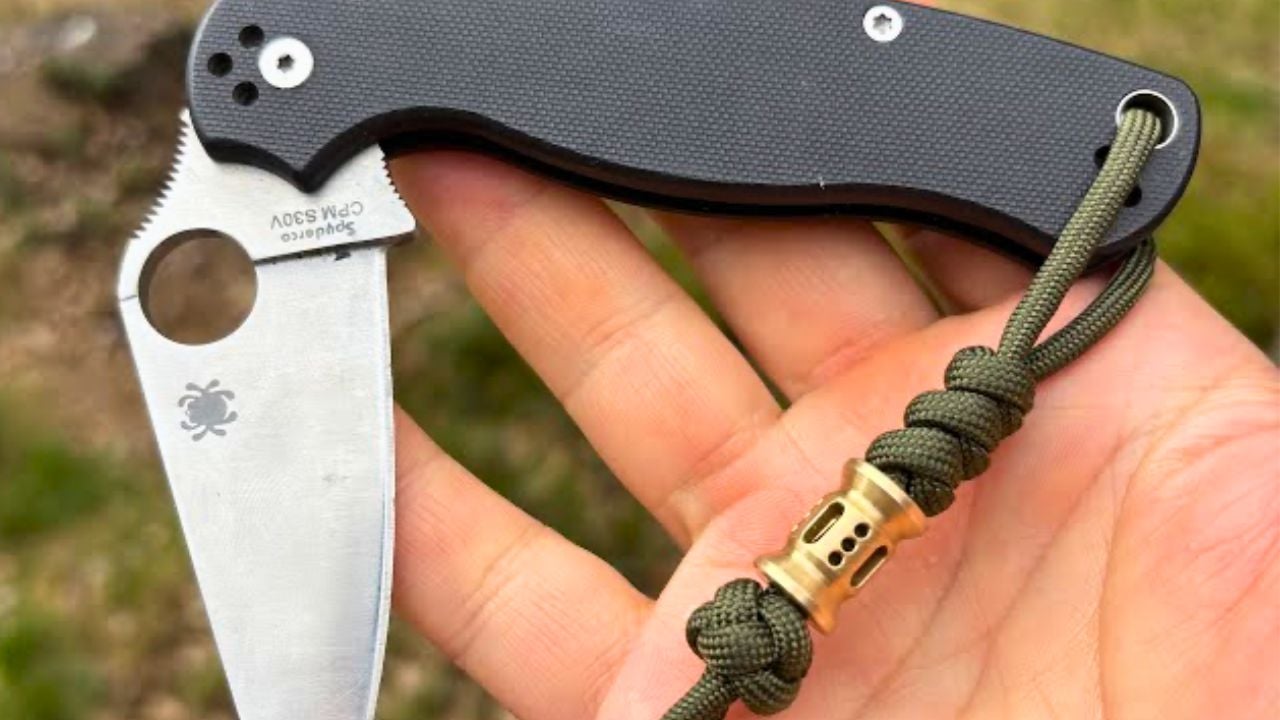
Photo credit: Kruger Paracord and EDC/YouTube
Pocket knives used to be unremarkable travel companions, tucked into pockets and backpacks without much thought. Today, you can carry the same tool, under the same written law, and still find yourself pulled aside, questioned, or forced to surrender it. The rules on paper often look stable, yet in airports, train stations, and city transit systems, the way those rules are enforced is tightening in practice.
If you travel with a blade, even a tiny one, you now have to think less like a casual tourist and more like a compliance officer. The gap between what is technically legal and what security staff will actually tolerate is widening, and that disconnect is reshaping how you pack, where you carry, and what risks you are willing to take with your everyday gear.
How pocket knives became a quiet flashpoint in modern travel
You might think of a pocket knife as a mundane tool, closer to a bottle opener than a weapon, but security agencies increasingly treat it as a symbol of where they draw the line on risk. Serious pocket knife and EDC enthusiasts already know that traveling with knives can be difficult, because the same blade that feels harmless at home can trigger confiscation or delays once you step into a controlled space. One guide for enthusiasts notes that Serious collectors and everyday carriers alike are running into a patchwork of rules that make even routine trips more complicated.
What has changed is not always the statute, but the mindset. After years of high profile security scares, agencies and operators have embraced a more conservative reading of existing regulations, often defaulting to “no” even when the law leaves room for discretion. That is why a tool that is perfectly lawful in your state can still be treated as contraband when you enter a federal checkpoint, board a train, or cross an international border, and why you now have to plan around enforcement culture as much as black letter law.
The TSA’s written rules versus what actually happens at checkpoints
Nowhere is the gap between law and lived experience clearer than at the airport. On paper, the Transportation Security Administration draws a bright line: pocket knives are banned from carry on bags but allowed in checked luggage. The agency’s own list of permitted and prohibited items spells out that a pocket knife must go into checked baggage if you want to fly with it at all. That is the formal rule, and it has not meaningfully loosened in years.
Travel gear companies that field constant questions from customers echo that message in plain language. One guide framed under “Everything You Need” to “Know” explains in its “Key Takeaways” that “Pocket” knives are not allowed in carry on bags on any U.S. flight and stresses that keeping blades away from passengers protects everyone onboard, reinforcing that you should always check a knife if you bring it at all, as summarized in Everything You Need. In practice, officers sometimes go further, flagging even keychain tools that technically fit the rules, or treating multi tools with tiny blades as knives first and gadgets second, which means you should expect the strictest possible reading of the policy every time you line up at security.
The 2.36 inch myth and why “small” no longer means “safe”
Many travelers still cling to the idea that a very short blade is acceptable in a carry on, a belief rooted in a short lived proposal that never took effect. A detailed FAQ on knife travel notes that when people ask, “Can I bring a pocket knife in my carry on if the blade is under 2.5 inches,” the answer is no, and it explains that The TSA once floated a plan to allow blades up to “2.5” inches but ultimately kept the full ban in place, as described in the FAQ. That history fuels confusion, because the numbers live on in blog posts and forum threads even though they never became binding policy.
Front line officers are blunt about this disconnect. In one discussion, a TSA employee reminded travelers that the agency has never allowed knives in carry on bags and recalled that in 2013 it only “floated” a proposal to allow very small blades, citing a figure of “2.36” inches as the size that was debated but never adopted, a point emphasized in the Dec thread. The result is that even a tiny penknife on a keychain can be treated as a prohibited item, and officers who have had to repeat that explanation “a hundred times, no less” are increasingly inclined to seize first and argue later.
How airlines and new 2026 rules are tightening the screws
Even where the federal baseline has stayed constant, airlines and airport operators are layering on their own expectations. Recent coverage of new rules for U.S. travelers in 2026 notes that carriers are rolling out stricter policies that focus on size and weight limits for personal items and cabin baggage, a shift that gives them more leverage to scrutinize what you pack, as described in a report on When airlines tighten rules. While those changes are framed around luggage dimensions, they also encourage more detailed inspections of bags that might previously have slipped through with minimal attention.
Private guidance aimed at travelers reinforces a conservative approach. One brand that sells wood and resin accessories tells customers in a piece titled “Can You Bring a Pocket Knife on a Plane?,” framed around Dec and the idea that Traveling is educational, that you should assume any blade in the cabin is off limits and that you must pack knives in checked luggage if you bring them at all, as explained in its section on “Can You Bring” a “Pocket Knife” on a “Plane” while “Traveling” in Can You Bring. Another part of the same guidance stresses that TSA prohibits both domestic and international passengers from carrying knives in the cabin and warns that checked bags are still subject to inspection by baggage handlers and inspectors, so you should pack carefully and expect scrutiny, as laid out in the section explaining that TSA prohibits knives in carry ons. The message from both regulators and airlines is clear: if there is any doubt, the knife will not fly with you.
Beyond planes: trains, buses, and city transit are quietly cracking down
Airports get most of the attention, but your pocket knife is increasingly unwelcome on the ground as well. A travel advisory from a knife industry group points out that Traveling by “Rail and Bus” can be even more restrictive, noting that Rail operators often impose blanket bans that go beyond local law. It highlights that Amtrak, for example, bans knives completely, and that They enforce those rules even where state or municipal regulations do not explicitly address blades on trains, as detailed in the section on Traveling. That means you can be fully compliant with state law yet still be turned away at the platform or asked to surrender your knife before boarding.
Local transit systems are following a similar path. In Washington State, a bill signed into law in Mar effectively bans knives on public transport by targeting “transit stations” rather than just vehicles, so unless you manage to board and get off somewhere other than a designated station, you are likely violating the rule if you carry a blade, as explained in the update on the Mar legislation. Separate guidance on weapons notes that Public transportation like city buses, subways, and regional commuter trains often enforces strict regulations on firearms regardless of whether you have a valid concealed carry permit, a pattern that mirrors the way knives are being treated on shared transit, as described in the section on Public transport rules. The trend is clear: once you step into a shared vehicle or station, operators are asserting broad authority to say no to blades.
State lines, “sensitive places,” and the rise of zero tolerance zones
Inside the United States, the legal landscape for knives is fragmented, and that patchwork is becoming more consequential as enforcement tightens. A survey of state rules notes that there are broad Prohibitions that apply to people with certain criminal convictions and that There are also location based bans that cover schools, courthouses, and critical infrastructure such as nuclear power generating stations, among other “sensitive places,” as outlined in the overview of Prohibitions. Those restrictions are not new, but as agencies and private operators adopt more aggressive screening, you are more likely to encounter them in day to day travel, especially when you move between states with different thresholds for what counts as a prohibited knife.
At the federal level, some lawmakers are trying to push in the opposite direction by standardizing protections for lawful owners. A bill listed as S346, described as the Knife Owners’ Protection Act of 2025, was noted in its Introduced Session summary as aiming to protect people who are transporting blades across state lines, by clarifying that they can pass through jurisdictions where their knives might otherwise be restricted as long as they comply with origin and destination laws, as summarized in the entry on the Knife Owners “Protection Act of” 2025. Yet even if such a measure passes, it would not override the authority of the Transportation Security Administration, Amtrak, or local transit agencies to set their own carriage rules, which means you still have to navigate both statutory law and institutional policy every time you travel.
Crossing borders: why Canada, Mexico, and the UK feel stricter than home
International travel adds another layer of complexity, because you are no longer dealing only with U.S. law or U.S. style enforcement. If you fly north, you enter a jurisdiction where federal and provincial rules interact in ways that can surprise American visitors, and where customs officers have wide discretion to seize items they view as risky. Even a basic search for knife rules in Canada quickly surfaces warnings about prohibited blade types and import restrictions, a reminder that what you casually carry in your pocket at home can be treated as a controlled item at the border.
Head south and the picture shifts again. Travelers heading to Mexico will find that local enforcement can be particularly strict in tourist zones and near government buildings, where officers may treat any blade as a potential weapon regardless of size. A second look at information about Mexico underscores that you are dealing with a different legal system, one that may not distinguish as finely between tool and weapon as some U.S. states do. In Europe, the United Kingdom has some of the most restrictive knife laws in the region, with tight limits on blade length and locking mechanisms in public, and another overview of the United Kingdom reinforces that enforcement there is robust, especially in cities. The common thread across these destinations is that customs and police have broad authority to interpret intent, which means a pocket knife that feels routine in your hometown can become a legal liability once you cross a border.
Why enforcement feels harsher even when the rulebook looks the same
Part of the reason pocket knife travel feels more fraught is that security agencies are leaning into their discretion. Official guidance on TSA Guidelines emphasizes that When it comes to air travel, safety is paramount, and the Transportation Security Administration warns that failing to follow its rules can lead to confiscation of your item, as spelled out in the section on TSA screening. That language gives officers wide latitude to decide that a particular knife, even if arguably permitted, poses enough concern to justify taking it away, and in a risk averse culture, they are increasingly likely to exercise that option.
There is also a track record of the agency stretching its authority in other areas, which shapes how it approaches knives. A civil liberties analysis of body scanner policy notes that the TSA, formally the Transportation Security Administration, failed to follow required rulemaking procedures and has been flouting the law for years in how it deployed scanners, a pattern documented in a timeline introduced with the word “Here,” as described in the critique of Here. If an agency is willing to push boundaries on surveillance technology, it is not surprising that it also interprets knife rules aggressively, erring on the side of seizure and referral to law enforcement even when the underlying statute has not changed.
How to travel smarter with a knife in a world of stricter practice
For you as a traveler, the practical takeaway is that the safest assumption is often the strictest one. Knife makers themselves now tell customers that a pocket knife should never be brought onto an airplane, with one guide bluntly stating, “First and foremost, a pocket knife should never be brought onto an airplane,” and warning that carrying one on a plane poses serious safety risks, advice that appears in a discussion of whether pocket knives are a good investment under the heading “First and” foremost in First and. That is not just a legal point, it is a recognition that even if you could argue a technical exception, you are unlikely to win that argument at a checkpoint with a line of impatient passengers behind you.
If you still choose to travel with a blade, you need a checklist mindset. Confirm that your knife is legal at your origin, destination, and every jurisdiction in between, including any “sensitive places” you might enter. Assume that airlines, rail operators, and transit agencies can and will impose stricter carriage rules than local law, and that their staff will enforce those rules with little patience for nuance. Above all, remember that the culture around knives is shifting: what once passed unnoticed is now a focal point for security, and until that pendulum swings back, the burden is on you to adapt your habits to a world where the rules on paper are only the starting point for how your pocket knife is treated in practice.
Like The Avid Outdoorsman’s content? Be sure to follow us.
Here’s more from us:


