Image Credit: RANGER Shooting Range Prague/YouTube.
There’s something special about a lever-action rifle. It’s got history, character, and a smooth, fast action that just feels right in your hands. Whether it’s an old-school Winchester from the Wild West or a modern Henry built for serious hunting, these rifles have a dedicated following for a reason.
Americans have been obsessed with lever guns for over a century, and that’s not changing anytime soon. They’re reliable, easy to shoot, and just plain fun. Some are built for cowboy-style plinking, while others can take down big game with authority. No matter what you’re after, there’s a lever-action rifle that fits the bill.
Henry Side Loading Gate

Henry Repeating Arms made a name for itself in 1996 with its classic American-made lever guns. But for years, their rifles could only be loaded through the magazine tube, just like the original Henry 1860. That was fine for some, but it left a lot of shooters wanting a more practical option.
Eventually, Henry introduced their side-loading gate models, giving shooters the convenience of feeding rounds into the receiver just like a Winchester or Marlin. This update made their lever actions far more user-friendly while still keeping the signature smooth action and high-quality build that Henry rifles are known for.
Henry Long Ranger

The Henry Long Ranger is built for hunters who need more range and accuracy than a traditional lever-action rifle can offer. Competing with the Browning BLR, the Long Ranger ditches the tube magazine in favor of a detachable box magazine, allowing it to fire pointed Spitzer bullets safely.
Available in calibers like .223 Remington and .308 Winchester, this rifle gives lever-gun fans an option for hunting at longer distances. It’s smooth, well-built, and offers a nice balance between classic lever-action feel and modern performance. If you want a lever gun that stretches beyond the typical short-range role, the Long Ranger is worth a look.
Henry Classic Lever Action .22

If there’s one rifle that made Henry Repeating Arms a household name, it’s their Classic Lever Action .22. Introduced in 1996, this little rimfire rifle quickly became a favorite thanks to its affordable price, smooth action, and reliable performance.
It loads through the magazine tube, much like the Marlin Model 60, and offers a lightweight, easy-to-handle design that’s perfect for plinking, small-game hunting, or teaching new shooters. Henry’s Classic Lever Action .22 is one of those rifles that just about everyone enjoys shooting, and for good reason—it’s simple, accurate, and a whole lot of fun.
Savage Model 99

The Savage Model 99 was ahead of its time when it hit the market in 1899. Unlike most lever guns, which relied on tubular magazines, the Model 99 used a rotary magazine that allowed it to safely fire Spitzer bullets. That gave it a serious edge in the hunting world, as it could chamber high-performance rounds that traditional lever guns couldn’t.
Over a million were made before production ended in 1997, and they still have a loyal following today. Many hunters consider the Model 99 one of the best lever actions ever built, and if you come across one in good condition, it’s worth holding onto.
Browning BLR

The Browning BLR is not your typical lever-action rifle. Introduced in the late 1960s, this rifle broke tradition by using a detachable box magazine instead of a tubular one. That meant it could safely chamber high-powered rifle rounds like .450 Marlin, .300 Winchester Magnum, and 7mm Remington Magnum—something most lever guns simply can’t do.
This rifle is built for hunters who love the fast follow-up shots of a lever action but need the power and accuracy of a bolt gun. Made by Miroku under the Browning brand, the BLR remains a solid choice for anyone who wants a modern take on the classic lever gun.
Marlin 336

If there’s one Marlin rifle that everyone knows, it’s the 336. Introduced in 1948 as the successor to the 1893, the 336 became one of the best-selling .30-30 rifles ever made, competing directly with the Winchester 1894 for the title of “America’s Favorite Deer Rifle.”
With over 4 million units sold, it’s been the go-to lever gun for generations of hunters. Like other Marlins, it has a solid top receiver and side ejection, making it more durable and scope-friendly than the Winchester design. Now produced by Ruger under the Marlin brand, the 336 is still one of the best lever-action rifles you can buy today.
Marlin 39A

The Marlin 39A is a legend. Not just among lever actions, but among all rimfire rifles. Introduced in 1922 and produced until 2007, it holds the record as the longest continuously produced rifle in the world. That alone says a lot about how good it is.
Designed for .22 LR, it’s one of the most accurate and well-built lever-action .22s ever made. Over two million were sold, and it became the gold standard for small-game hunting and plinking. Right now, it’s unclear if Ruger will bring the 39A back, but if they do, it’ll be a huge deal for lever-gun fans.
Marlin 1893

The Marlin 1893 went toe-to-toe with the Winchester 1894, offering a strong, well-built rifle that could handle smokeless powder rounds like .30-30, .38-55, and .32-40.
What set the 1893 apart was its solid top receiver and side-ejecting design, making it tougher and better suited for mounting optics—something Winchester lever guns struggled with for decades. It was bulkier than its Winchester rival, but plenty of shooters preferred the added durability. Production ran until 1936, but its influence lives on in Marlin’s later rifles.
Marlin 1894

The Marlin 1894 was built to give the Winchester 1892 some real competition. Like its predecessors, it had a solid top receiver and side ejection, which made it more weather-resistant and easier to scope. Designed for pistol calibers like .44 Magnum, .357 Magnum, and .45 Colt, it became a favorite among ranchers, hunters, and cowboy action shooters.
One of the big selling points was its reliability in extreme conditions—unlike Winchester’s open-top design, the Marlin 1894 didn’t let in as much dirt and snow. Ruger now produces these under the Marlin name, keeping this legendary pistol-caliber lever gun in the hands of modern shooters.
Marlin 1895

Marlin first introduced the 1895 as an update to its earlier big-bore rifles, but it really hit its stride when it was brought back in 1972 chambered in .45-70 Government. Suddenly, shooters had a lever-action rifle capable of taking down anything in North America, from deer to bear to bison.
This thing packs a punch, and thanks to its solid construction and side-ejecting action, it’s built to last. It became one of the most popular brush guns out there, especially in thick woods where fast follow-up shots matter. Today, Ruger continues to produce the 1895 under the Marlin name, keeping this hard-hitting lever gun alive for modern hunters.
Winchester 1892

The Winchester 1892 took everything great about the 1873 and made it better. John Browning designed this rifle to be stronger and smoother, thanks to a more modern action borrowed from the Winchester 1886. It was built for pistol calibers like .44-40, .38-40, and .32-20, making it a great lightweight option for ranchers and cowboys who already carried revolvers in those calibers.
If you’ve watched old Westerns, chances are you’ve seen an 1892—Hollywood used them as stand-ins for the 1873 because they were easier to find. Winchester stopped making them in the mid-1900s, but companies like Rossi and Uberti keep this classic alive with modern reproductions.
Winchester 1894

If you grew up hunting, you’ve probably handled a Winchester 1894 at some point. Designed by John Browning, this was the first civilian rifle built for smokeless powder cartridges. When it hit the market, it was an instant success, and it’s still one of the best-selling rifles of all time.
Chambered in .30-30 Winchester, it became the go-to deer rifle for generations of hunters. Over seven million were sold before Winchester discontinued it in 2006, but demand brought it back. Today, you can still get new ones, and it remains a favorite for hunters who appreciate a lightweight, reliable lever gun.
Winchester 1895

The Winchester 1895 was a total departure from previous lever actions. Instead of a tubular magazine, it had a box magazine, allowing it to safely handle pointed bullets. That meant it could chamber serious rifle cartridges like .30-40 Krag, .30-06, and even .405 Winchester.
This was one of the few lever actions that saw real military service, issued to Russian troops during World War I. Production ended in the 1930s, but Browning and Winchester (via Miroku) brought it back in the 1980s and ‘90s. If you want a lever gun that can handle full-power rifle rounds, this is the one.
Winchester Model 88

The Winchester Model 88 was not your granddad’s lever action. Unlike traditional designs, it used a rotating bolt and a detachable box magazine, making it look and function more like a bolt-action rifle. Winchester introduced it in the 1950s to compete with modern hunting rifles, chambering it in rounds like .243, .308, and .358 Winchester.
Despite its futuristic design, the Model 88 still had the fast cycling of a lever gun, which hunters loved. It was discontinued in 1973, but its influence is still seen in modern rifles like the Browning BLR, which carried on the idea of a box-magazine lever action.
Marlin 1881

Marlin might not have been first to the lever-action game, but the 1881 put them on the map. This rifle beat Winchester to the punch by offering a lever action that could handle full-power rifle cartridges—most notably the .45-70 Government. That gave it a serious edge over the Winchester 1876, which was stuck using proprietary rounds.
This rifle’s success forced Winchester to rethink its strategy, leading them to contract John Browning to design the Winchester 1886. Marlin kept producing the 1881 until the early 1900s, but its impact was clear: Marlin had established itself as Winchester’s biggest competition in the lever-action world.
Henry 1860

The Henry 1860 was the rifle that changed everything. It wasn’t the first lever action ever, but it was the first one that actually worked well. Designed by Benjamin Tyler Henry, it fed .44 Henry rimfire rounds from a 15-shot tube magazine—an insane amount of firepower for the time. Compared to the slow, single-shot rifles of the Civil War era, this thing was lightyears ahead.
Soldiers who got their hands on one didn’t want to give it up, but the rifle never saw widespread military use because it was expensive to produce. Only around 14,000 were made, but modern reproductions from Uberti and Henry Repeating Arms (a different company than the original) keep its legacy alive today.
Winchester 1866

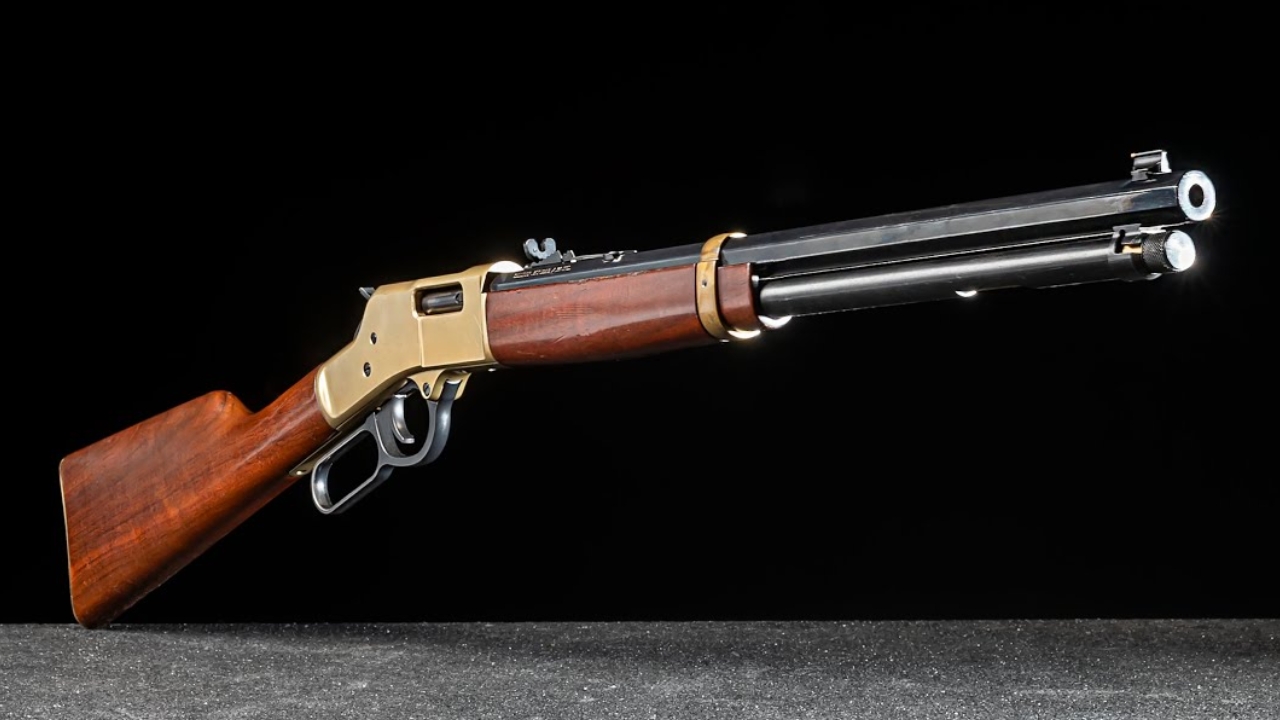
After the Civil War, Winchester took the Henry rifle and made it even better. The Model 1866, nicknamed the “Yellow Boy” for its brass frame, fixed some of the Henry’s biggest issues. It added a wooden forend, a side-loading gate, and a magazine secured with a barrel band—small changes that made a huge difference in durability and usability.
It was still chambered in .44 Rimfire, just like the Henry, but the added features made it much more practical. The 1866 stayed in production until 1899, and today, you can still get a high-quality reproduction from Uberti if you want to experience this classic firsthand.
Winchester 1873

The 1873 was a serious upgrade over the 1866. Winchester swapped the brass frame for steel and introduced the .44-40 Winchester cartridge—a centerfire round with more power and better reliability. The result? One of the most legendary rifles in American history.
This was the rifle of the Old West. Cowboys, lawmen, and outlaws all relied on it. Its reputation was so strong that it earned the nickname “The Gun That Won the West.” Winchester stopped making them in 1923, but today, you can get modern versions from Uberti and Miroku (the latter under the Winchester brand).
Winchester 1876

The Winchester 1873 was great, but it had one big downside—it was built for pistol-caliber rounds like the .44-40, which meant it lacked the stopping power hunters needed for big game. Enter the Winchester 1876, the first lever gun to chamber full-powered rifle cartridges like the .45-60.
This rifle gave hunters and long-range shooters an alternative to single-shot rifles like the Sharps. While it wasn’t as widely adopted as its smaller-caliber cousins, it was a big step forward. Production ended in 1897, but if you want to shoot one today, there are solid reproductions available.
Winchester 1886

By the 1880s, Winchester wanted a stronger lever action that could handle serious rifle rounds. That’s where John Moses Browning came in. His design for the Winchester 1886 improved on the 1876 by ditching the old toggle-link system for a much stronger locking mechanism. The result? A lever-action rifle that could fire hard-hitting rounds like the .45-70 Government.
The 1886 was such a success that it slowly replaced the 1876 and stayed in production for decades. Even now, you can still buy new ones from Winchester (made by Miroku) or get a reproduction from brands like Uberti and Chiappa. If you want an old-school rifle with serious stopping power, this is the one.
*This article was created with the assistance of AI.