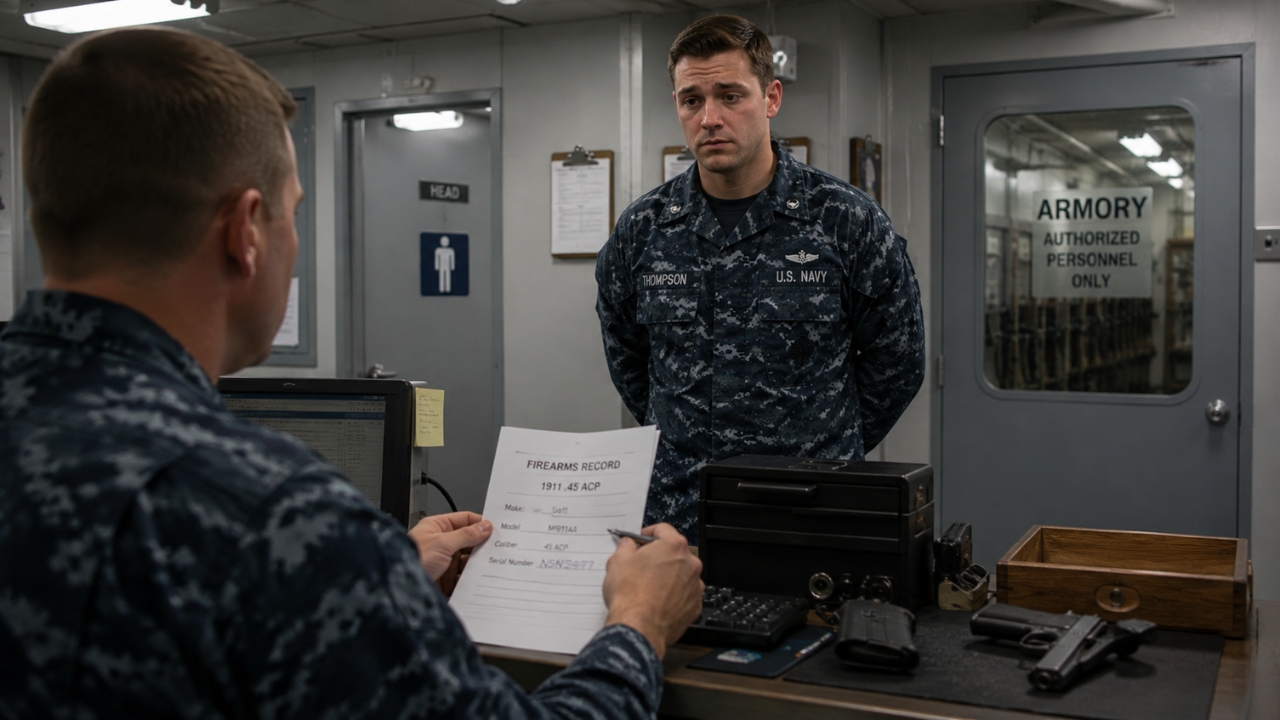
Photo credit: The Avid Outdoorsman
The sentry’s mistake did not stay private for long.
That is the thing about leaving a government-issued sidearm behind. It is not like forgetting sunglasses, a coffee cup, or even a pocketknife. A missing pistol has a paper trail, a serial number, an armory record, and a whole chain of people who are going to care very quickly.
And this one was left in a bathroom.
In a Reddit thread, people were talking about the problem of taking a gun off in a bathroom and leaving it behind. One story involved a Navy sentry who forgot his .45 in the restroom. An armory worker found it, checked the serial number, and tracked down the person it had been issued to.
That is about the fastest way to turn a bathroom mistake into a career-level embarrassment.
A sentry carrying a .45 is supposed to have control of that weapon at all times. That is the whole point of issuing it. The gun is not personal gear being carried casually during errands. It is part of a duty assignment. Every step of that process is supposed to be controlled, documented, and serious.
Then the gun ended up left in a bathroom.
Bathroom gun mistakes usually start with the same bad decision: the firearm comes off the body. Maybe the person sets it on a toilet tank, shelf, sink, paper dispenser, or hook. Maybe he lays it somewhere “just for a second” while dealing with his belt or gear. Then the routine gets interrupted. He finishes, washes his hands, walks out, and the gun stays behind.
In civilian carry, that is already bad.
In a military or duty context, it is even worse.
A duty weapon left unattended is a security problem immediately. Anyone could find it. Another service member, a civilian worker, a contractor, a visitor, or someone with no business touching it. If the wrong person gets to it before the right person does, the consequences could be far beyond embarrassment.
The armory worker finding it was the best possible version of a bad situation.
That person knew what it was, knew it needed to be secured, and had a way to trace it. The serial number told the story. That is the part that makes duty weapons different from a random pistol found in a gas station bathroom. There is a record. Someone signed for it. Someone was responsible for it. And now that person’s name was going to be attached to one very stupid moment.
You can imagine the dread when the sentry got the call or visit.
There is no good explanation. “I forgot it” is honest, but it does not make it better. “I only set it down for a second” may be true, but that is exactly the problem. A weapon issued for duty cannot depend on memory once it leaves the holster.
The fact that he was tracked down by serial number probably made the whole thing feel even more official. This was not a buddy quietly handing it back and saying, “Man, don’t do that again.” This was the system doing what the system does when controlled equipment is found where it should not be.
There are layers of consequences possible in a situation like that. A chewing out. A written report. Loss of trust. Extra training. Discipline. Depending on the command and circumstances, maybe worse. Even if the story ended short of major punishment, the sentry’s reputation probably took a hit.
And in duty environments, reputation matters.
People need to trust that the person posted with a weapon is awake, aware, and responsible. Leaving that weapon in a bathroom tells everyone the routine failed somewhere. It may have been one mistake, but with firearms, one mistake is enough to raise real questions.
The broader lesson applies to anyone who carries.
If you have to use the bathroom while armed, the gun should stay attached to you or your clothing whenever possible. If the holster comes off, the whole system needs a plan that makes forgetting impossible. The gun should not sit on a surface that allows you to walk away without it. A final check before leaving the stall should be automatic.
Phone. Wallet. Keys. Weapon.
For someone on duty, that check should be even stricter. A sentry’s weapon is not optional gear. It is the main piece of responsibility he is carrying. If the bathroom routine creates a risk of leaving it behind, the routine has to change immediately.
The armory worker saved the situation from getting worse by finding the .45 first. But he also made sure the mistake could not be buried. The serial number led right back to the person responsible.
That is the thing about firearms. They have a way of turning careless little habits into very official conversations.
The sentry left the bathroom without his pistol.
The armory made sure he did not get to forget that part.
Commenters treated the story as a clear warning against taking a gun off and setting it down in a restroom.
Several people said the firearm should stay holstered and physically connected to the carrier whenever possible. The second it gets placed on a toilet tank, dispenser, sink, or shelf, forgetting it becomes possible.
Others focused on how much worse the mistake becomes with a duty weapon. A civilian leaving a carry gun behind is serious enough, but an issued sidearm comes with accountability, records, and command consequences.
A lot of commenters pointed out that the armory worker did exactly what needed to happen. Secure the gun, check the serial number, and find the person responsible. There was no reason to guess or let it slide.
Some people also said bathroom routines need to be practiced like any other part of carry. It may sound boring, but it prevents the kind of mistake that can end a career or endanger someone else.
The main takeaway was simple: if you are armed, the bathroom does not pause your responsibility. The gun stays under control until it is properly secured again.