Photo credit: BTL Supply/GunBroker
The P320 debate refuses to die because neither side is completely wrong. People want it to be simple—either the gun is great or it’s trash—but the truth lives in the middle, and that’s uncomfortable. The P320 does some things extremely well, and it also carries tradeoffs that don’t magically disappear just because someone likes the platform. Every time the argument resurfaces, it’s because people are talking past each other, focusing on different priorities, and assuming those priorities should apply to everyone else.
What keeps the argument alive isn’t internet drama. It’s that the P320 forces shooters to decide what they value most. Modularity, shootability, ergonomics, trigger feel, institutional adoption—all of that matters. So do simplicity, consistency, and how a gun behaves across different users and setups. When a platform sits right at the intersection of those competing values, the debate never settles. It just cycles.
Modularity is a strength—and a source of confusion
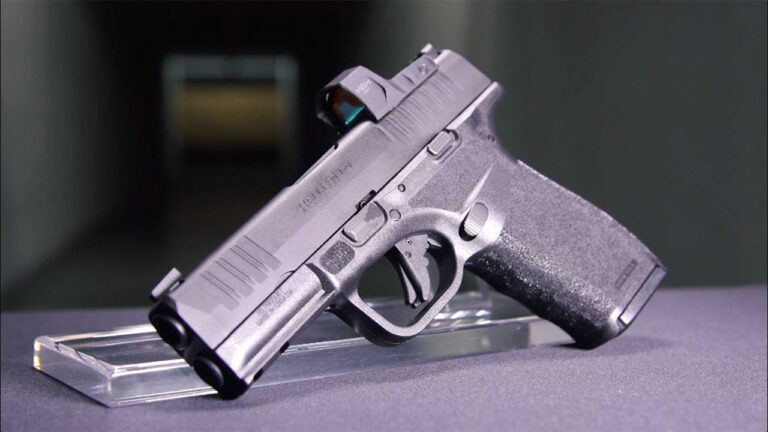
The P320’s biggest selling point is also one of its biggest complications. The modular fire control unit lets you change grip modules, slide lengths, calibers, and configurations without buying an entirely new gun. For shooters who like tuning a system to fit their hand and role, that’s appealing. You can make the gun fit you instead of adapting yourself to the gun, and that’s not nothing. Ergonomics matter, especially for shooters who struggle with one-size-fits-all frames.
The flip side is that modularity introduces variables. Different grip modules change trigger reach, balance, and recoil feel. Different slide lengths change timing and sight tracking. Two P320s can feel like completely different pistols even though they share the same core. That’s great if you understand what you’re doing. It’s a problem if you don’t. People arguing online are often talking about different P320s while assuming they’re talking about the same experience.
The trigger feel splits shooters cleanly
Trigger feel is another fault line. Some shooters genuinely prefer the P320 trigger. They like the break, the reset, and the overall feel compared to striker-fired alternatives. Others find it vague or less predictable under speed. Neither group is lying. Trigger preference is deeply personal, and it’s influenced by hand size, grip pressure, and shooting background. What feels controllable to one shooter feels mushy to another.
Where the argument heats up is when people pretend trigger feel doesn’t matter. It does. Not in the sense that one trigger magically makes you accurate, but in how much effort it takes to shoot well consistently. If a shooter has to work harder to manage a trigger, fatigue shows up faster. That’s why some people thrive with the P320 and others quietly move on after trying to love it. The disagreement persists because both outcomes are real.
Shootability depends heavily on configuration
A full-size or carry-size P320 can be very easy to shoot well. The grip angle, bore axis, and mass work together in a way that feels stable to many shooters. Put that same fire control unit into a smaller grip module or lighter slide, and the experience changes. Recoil impulse sharpens. Timing feels different. Suddenly the gun that felt smooth now feels demanding. People who only shoot one configuration often assume everyone else is wrong.
This matters because many arguments about the P320 ignore context. Someone praising the platform may be talking about a duty-size setup with a full grip and long slide. Someone criticizing it may be talking about a compact or subcompact variant that doesn’t behave the same way. Without acknowledging that, the conversation goes nowhere. The platform isn’t inconsistent—the expectations are.
Institutional adoption muddies the conversation
The P320’s adoption by large organizations adds fuel to the debate. For some shooters, that’s validation. If big agencies trust it, it must be good. For others, institutional adoption doesn’t carry the same weight because individual needs are different. A gun that works well in a standardized, policy-driven environment isn’t automatically the best choice for a private citizen with different carry habits and training volume.
This is where people talk past each other the most. One side points to adoption as proof. The other points to individual fit and performance as proof. Both arguments are valid in their own lane. The problem is assuming one lane cancels out the other. It doesn’t. Institutional success doesn’t erase personal tradeoffs, and personal preference doesn’t negate institutional use.
Consistency versus customization is the real divide
At its core, the P320 argument is about consistency versus customization. Some shooters want a gun that feels the same every time, across years of use, with minimal temptation to change things. Others want the ability to adjust grip size, texture, and configuration as their needs evolve. The P320 sits firmly in the second camp. That attracts one type of shooter and frustrates another.
Neither approach is wrong, but they lead to very different experiences. A shooter who values consistency may feel like the P320 invites tinkering that distracts from training. A shooter who values fit may feel like other platforms force unnecessary compromise. When those two shooters argue online, they’re not disagreeing about facts. They’re disagreeing about philosophy.
Reliability expectations aren’t identical either
Most modern duty pistols are reliable, and the P320 is no exception. But reliability expectations vary. Some shooters define reliability as “it runs if I do my part.” Others define it as “it runs even when things aren’t ideal.” Differences in grip pressure, ammo choice, maintenance habits, and configuration all influence perception. A gun that runs flawlessly for one shooter can feel finicky to another if the setup isn’t matched to them.
This is why hands-on time matters more than arguments. Handling and shooting different configurations side by side reveals more than any spec sheet. Retailers like Bass Pro Shops make that comparison easier, and those comparisons are often what finally clarify where a shooter stands. The argument fades when experience replaces theory.
Why the debate keeps restarting
The P320 debate never ends because new shooters enter the conversation constantly. Each wave brings different expectations, different training backgrounds, and different needs. Some discover the platform fits them perfectly. Others discover it doesn’t. Both groups feel compelled to explain their experience, and both assume it should generalize. It doesn’t.
The platform itself invites discussion because it doesn’t force a single answer. It gives options, and options create disagreement. As long as shooters value different things—simplicity versus adaptability, consistency versus customization—the argument will keep coming back.
Like The Avid Outdoorsman’s content? Subscribe to our newsletter so you never miss an article.
Here’s more from us: