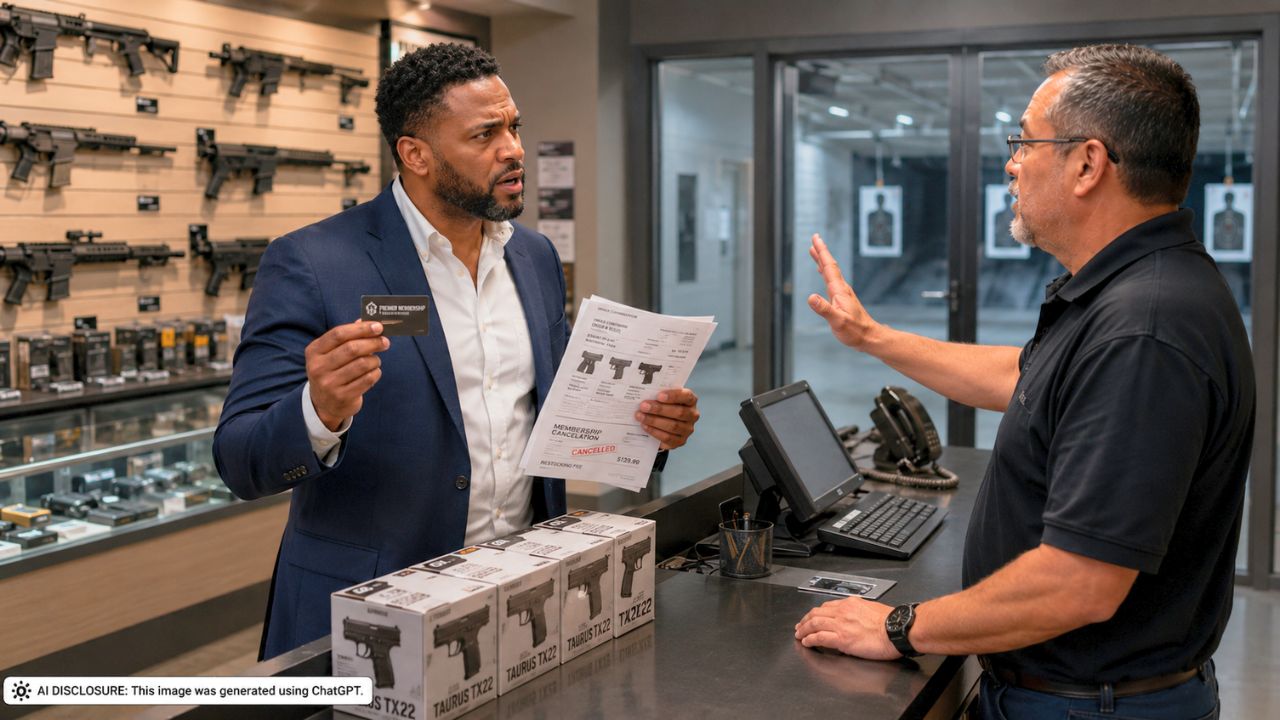
Photo credit: AI-generated image created using ChatGPT. Illustrative only
Buying a handful of the same pistol at a big-box-style gun counter usually doesn’t raise eyebrows. But one firearms manufacturer says a routine online order turned into a canceled membership, a lifetime ban, and an attempted “restocking fee” on guns that never even shipped.
The details come from the original post, where the shooter explains he’s an FFL Type 07 Manufacturer and a Class 2 SOT who wanted to get hands-on with the Taurus TX22—one of the most common .22 pistols people ask about—so he could better support customers and understand the platform.
How a simple TX22 order turned into a red flag
According to the post, the first order was for 15 Taurus TX22 pistols placed through Range USA’s website for pickup. The reason was straightforward: his usual suppliers didn’t have them in stock, and he wanted inventory and familiarity with a high-demand rimfire pistol.
Before anything moved—no shipping, no transfer, no paperwork—he contacted Range USA and asked if the purchase could be converted into a dealer transaction and have sales tax removed, since he has a resale certificate. That’s the kind of thing a lot of FFLs try to square up early, because once a transaction is in motion, “fixing it later” can get messy.
Range USA’s response, per the post, was simple: they don’t do dealer purchases, they wouldn’t move the order to his FFL, they wouldn’t redirect the firearms to another FFL, and they canceled the order. Annoying, sure, but still within the normal “their store, their policy” territory.
Why the second order escalated everything
The part that changed the temperature was what happened next. The shooter later placed a separate order for five TX22s—this time, he says, for personal use, multiple builds, and content creation. Not inventory, not resale.
Range USA apparently didn’t buy that explanation. The shooter says the company assumed the second order was another attempt to work around their policy and canceled it as well. Then came the bigger hit: he received an email stating his membership was canceled, he was accused of effectively being his own straw purchaser, and he was told he appeared to be attempting to violate federal firearms and tax laws.
On top of that, he says Range USA permanently banned him from purchasing in-store or online and banned him from using the range. For a lot of gun owners, losing access to a convenient local range is more than an inconvenience—it changes your whole training rhythm.
The undisclosed policy problem that has gun owners paying attention
If you run a range or a gun shop, you’re allowed to set policies that go beyond the bare minimum legal requirements. Most shooters understand that. The hang-up here is that the shooter believed he was trying to do things the right way by contacting the company before any transfer happened—before any 4473, before any gun left anyone’s possession.
From his perspective, he didn’t get warned about a policy up front. He says the orders were simply treated like an attempted workaround, and the punishment came down hard: canceled transactions, membership terminated, and a permanent ban.
That’s what gets regular members thinking: if there’s a policy against quantity purchases, suspected resale, or certain patterns of ordering, is it clearly disclosed to members? Because “we reserve the right” language is common, but it doesn’t help a law-abiding shooter avoid stepping on a land mine. Clear written policies do.
This also touches a nerve in the firearms world because “straw purchase” isn’t a casual accusation. It’s serious language. If a retailer is going to use that term with a customer—especially one who holds an FFL—it’s reasonable for people to want the exact rule and the exact reason, not just a vague label.
The restocking fee claim is where it really gets practical
Then there’s the money. The shooter says Range USA is trying to charge a 25% “restocking fee” even though the firearms never shipped, no 4473 was completed, no transfer occurred, and the inventory never left Range USA’s possession.
Whether a restocking fee is fair depends on what actually happened behind the scenes. If a store truly allocated inventory, incurred costs, or moved product between locations, they might argue there’s a real expense. But from the shooter’s telling, the orders were canceled before anything left wherever it was sitting.
That’s why this matters to everyday gun buyers, not just licensees. A restocking fee can be a sting on one gun; on multiple pistols it can become a real hit. If you’re ordering online for store pickup, it’s worth reading the fine print on cancellations, returns, and “store discretion” policies—especially if you’re buying more than one of the same firearm.
What other shooters zeroed in on: documentation and “don’t look like a reseller”
The post itself doesn’t include a comment thread in the pasted material, but it does show what many gun owners immediately latch onto when something like this happens: the paper trail. The shooter stresses that he contacted the company before any regulated transfer took place and that no guns shipped and no 4473s were done.
That’s an important habit for anyone doing frequent transactions—FFL or not. Keep emails. Save order numbers. Screenshot policy pages at the time you buy. If a dispute comes up later over fees or bans, the strongest position you can be in is calm, organized, and documented.
The other practical point is perception. Buying 15 of the same model, then coming back for five more, looks like stocking shelves even if your intent is legitimate. Retailers are jumpy about anything that resembles unlicensed dealing, tax issues, or purchases that could come back on them in an audit. That doesn’t mean the buyer did anything wrong—it means the retailer may have a hair-trigger internal rule set.
What options a shooter realistically has when a chain range shuts the door
A permanent ban from a range and retail operation is hard to unwind unless the company wants to revisit it. In situations like this, the most realistic moves are usually unglamorous: take the conversation up the chain politely, ask for the exact written policy that was violated, and request a clear explanation of the fee being charged—especially if the retailer canceled the order rather than the buyer.
For everyone else watching from the cheap seats, there’s a simple lesson: if you’re going to bulk-buy a popular pistol—whether it’s a TX22, a Glock, or anything else—expect extra scrutiny from some retailers. If your intent is personal use, competition spares, training guns, or builds, it can help to keep purchases spaced out, and it can help to buy through channels that understand high-volume customers.
Most gun owners just want to buy a firearm, follow the rules, and get back to the range. When a retailer’s internal policies aren’t clearly disclosed, it creates exactly this kind of mess—where a customer believes he did the responsible thing by communicating early, and the business treats that communication as a reason to hit the eject button.
Like The Avid Outdoorsman’s content? Be sure to follow us.
Here’s more from us: