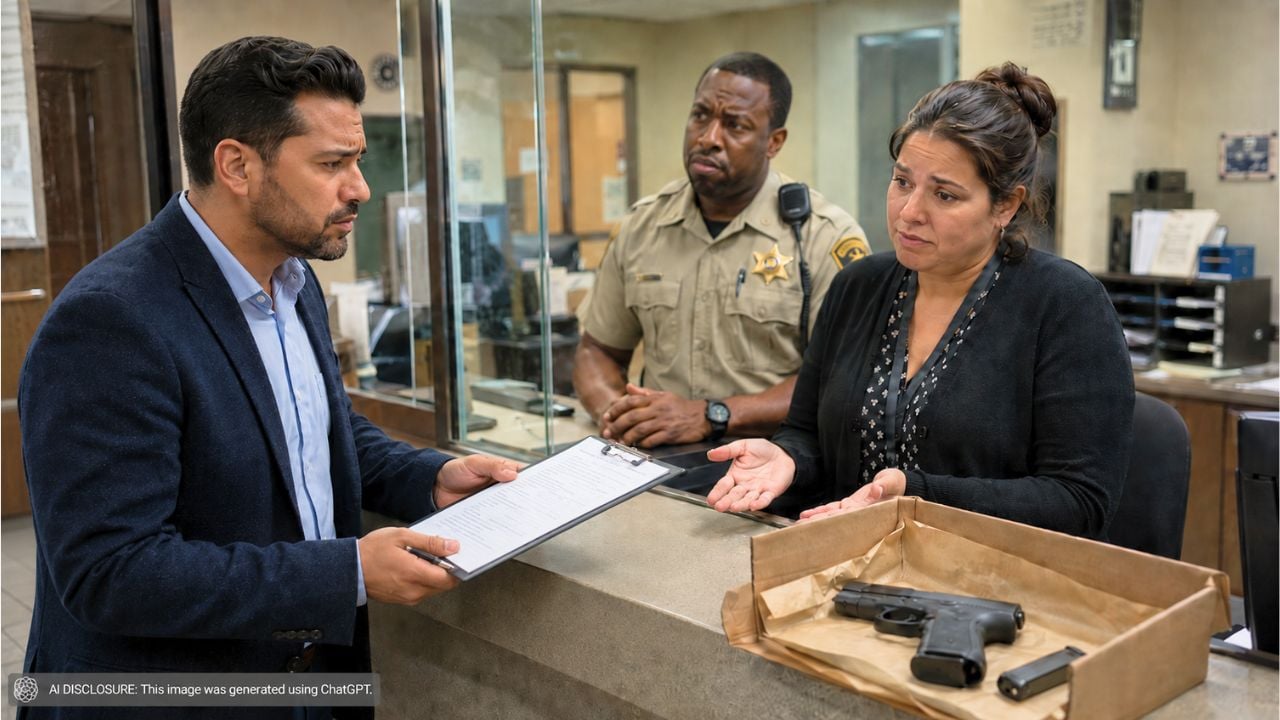
Photo credit: AI-generated image created using ChatGPT. Illustrative only.
Most outdoorsmen I know keep their paperwork squared away—tags, licenses, serial numbers, purchase receipts, the whole deal. So when a caller claiming to be with the Harris County Sheriff’s Office reached out and said they’d recovered “his” stolen handgun, the response wasn’t excitement. It was confusion.
In the original post, the man explained that he was called repeatedly and told deputies had recovered a gun that had been reported stolen back in 2023. The problem: he said he’s never owned a gun, never lived at the address tied to the report, and didn’t understand how his name and phone number ended up attached to a stolen firearm case in the first place.
The call was specific, and that’s what made it unsettling
According to the account, the caller verified his name—described as uncommon—and his phone number. Then the caller gave an address connected to the report, but it was an address the man said he’d never lived at.
That’s where the hair on the back of your neck stands up, especially if you’re a gun owner or a landowner who’s had to deal with law enforcement paperwork before. It’s one thing to get a wrong-number call. It’s another when the person on the other end has accurate personal info and is talking about handing you back a firearm you don’t recognize.
“I was just trying to give you this Ruger back”
The man pressed the caller about whether someone might be registering guns under his name. The response he relayed was blunt: “I don’t know anything about that. I was just trying to give you this Ruger back, but if you say it’s not you, it’s not you. Have a good day.”
Even if the simplest explanation is a data-entry mistake, you can see why this would bother somebody. A gun—specifically described as a Ruger—was tied to his identity in a theft report. For anyone who carries, hunts, or keeps firearms around family, the idea of your name being attached to a gun you’ve never touched is a serious problem, not a clerical annoyance.
He checked the number and tried to verify it the right way
One detail that matters: the calls came from (713) 849-3293, which he said came up as HCSO Jersey Village. He also said he received a text message from the same number before answering the fourth call.
Instead of trusting a cold call at face value, he did what a lot of practical folks would do—he called the number back and listened for something official. He reported getting an automated menu identifying it as the Harris County Sheriff’s Department Auto Theft Unit, with options including a police report lookup.
From there, he spoke with the report section but didn’t have a case number. She attempted to search by his name and initially found nothing. However, she did verify there was a “Sergeant Jones” in Auto Theft and provided a direct line so he could try to get a case number and straighten it out.
Auto Theft said the mix-up was already spotted—but the bigger question stayed
When he reached Jones directly, the man said Jones confirmed he had called earlier. Then came the part that would probably make most people exhale for a second: Jones reportedly told him they’d realized there was a mistake involving the patrolman on the report, had figured it out, and had located the rightful owner.
Good news, but it didn’t answer the question that matters if you care about protecting your name: how did his name and phone number get into the report at all? If you’ve ever dealt with property lines, hunting leases, or a legal dispute, you know the paperwork is often what hurts you—not the story you tell later.
A case number surfaced, and a likely explanation followed
After that, the report section called him back. This time, she said she found his case number. The earlier search failed because she used the shorter version of his name that he initially provided, but when she searched by his last name, the report appeared under his full name.
She advised him to contact the non-emergency line and request a supplement to have his name removed from the report. She also offered what sounds like the most plausible explanation: their system starts auto-filling names as you type them, and a deputy may have selected the wrong person from a dropdown while completing the report.
Anyone who’s filled out digital forms for licensing, land records, or even online tag purchases has seen this kind of thing. Autocomplete is handy when it’s right. When it’s wrong, it can stick you with somebody else’s mess.
Why this matters to gun owners, hunters, and working folks
If you’re the kind of person who keeps a “truck gun” for predators, carries daily, or just maintains a safe at home, you already know firearms ownership is half hardware and half documentation. Serial numbers, purchase history, stolen-gun reports—those records are what officers rely on when a firearm turns up after a theft or a traffic stop.
A wrong name attached to a stolen gun report can create headaches you don’t want. Even without any criminal accusation in this story, being tied to a stolen firearm on paper could lead to unwanted phone calls, confusion during background checks, or uncomfortable questions if you ever have to report something yourself. At minimum, it’s the kind of mix-up you want corrected quickly and permanently.
The practical takeaway here is simple: if law enforcement calls about a gun you don’t recognize, slow down and verify. Use official numbers, ask for a case number, and keep records of who you spoke with and when. And if you’re told your name is on a report by mistake, getting that supplement filed matters—because “we figured it out” doesn’t always mean every database entry got cleaned up.
In the end, this one appears to have been traced back to a report-writing error and an auto-fill system that can grab the wrong person in a hurry. But it’s a good reminder that in the real world—where guns, theft reports, and identity info overlap—small mistakes can land on the wrong doorstep fast.