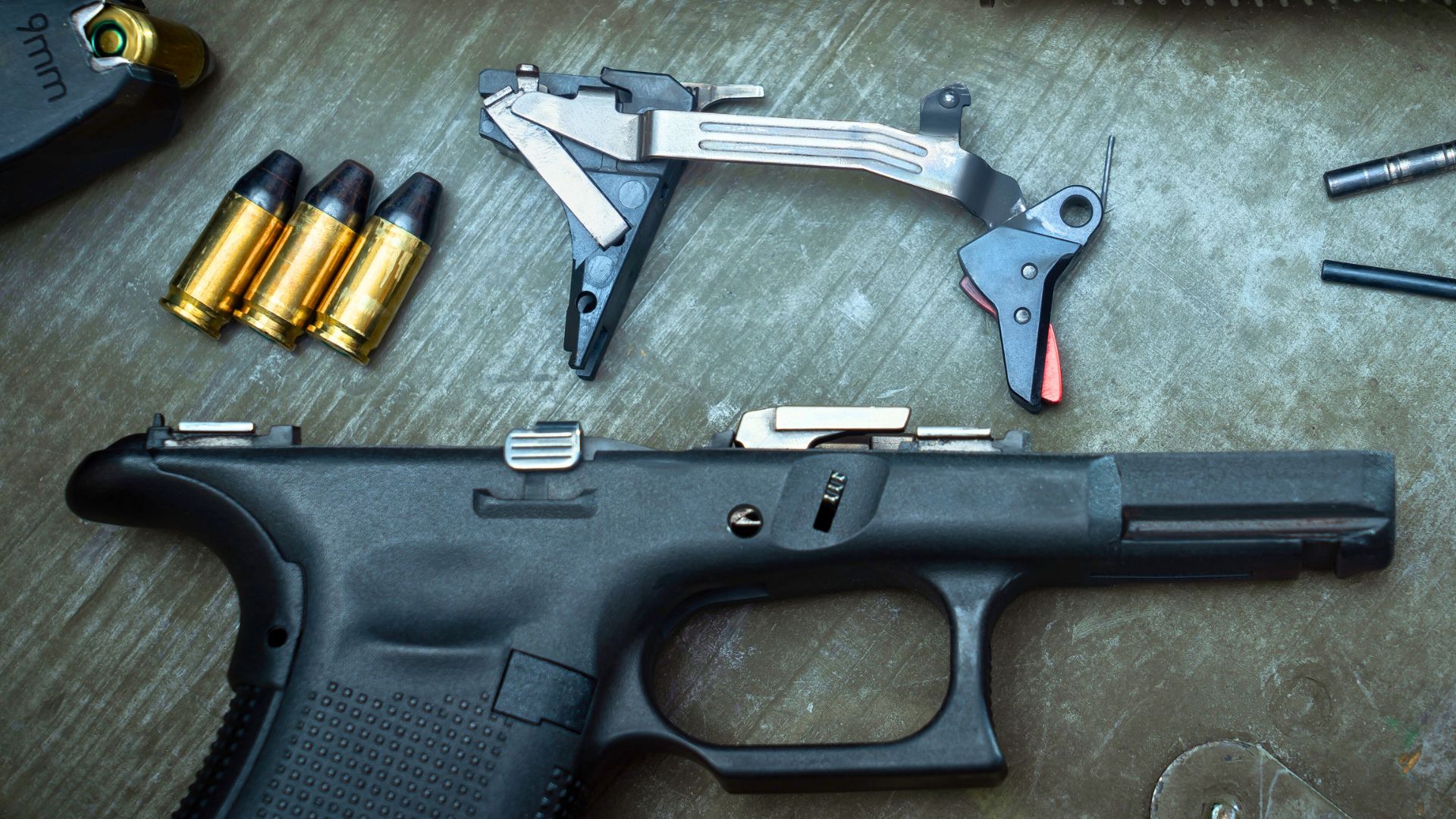
Photo credit: Dmitri T/Shutterstock.com
Reliable guns rarely “mysteriously” become unreliable. What usually happens is a shooter takes a system that was engineered to run with a specific balance of mass, spring rates, friction, and timing, then starts swapping parts one by one until the balance is gone. The frustrating part is that the gun often still looks great on paper and may even run fine for a couple hundred rounds. Then it gets hot and dirty, you switch ammo, you start shooting from awkward positions, or you carry it long enough that lint and grit become part of the ecosystem. That’s when the project begins: random stoppages, inconsistent ejection, weird lockback behavior, and a growing pile of “maybe it’s this” theories.
A modern semi-auto is a timing machine, and a rifle is not immune either. Slide velocity or bolt speed, magazine presentation angle, extractor tension, sear geometry, and lubrication all interact. When you change one component, you often change two or three behaviors downstream. The parts swaps that cause the most drama are the ones that change timing and friction but get sold as “drop-in performance.” The reason they’re so tempting is that they’re easy to buy, easy to install, and they promise a shortcut around practice or good setup discipline. In reality, they often turn a gun that used to be boring into a gun that needs constant attention.
Reduced-power springs that create “it runs… except when it doesn’t” malfunctions
The most common project-starter is messing with spring rates in a carry pistol or defensive rifle because the trigger “feels better” or the slide “feels smoother.” Reduced-power striker springs, hammer springs, or firing pin springs can absolutely change trigger feel, but they also reduce ignition energy. The mechanism is simple: the primer needs a certain amount of impact energy to dent and ignite consistently, and when you reduce that energy you narrow your reliability margin. You might not notice it with one brand of range ammo in warm weather, then suddenly you get light primer strikes with harder primers, cold-soaked ammo, or a slightly dirty firing pin channel. Now you’re chasing ghosts, because the malfunction isn’t constant—it’s conditional.
Recoil spring swaps do the same thing on the cycling side. People “tune” recoil springs to make the gun feel flatter or to accommodate a comp, but slide velocity is what drives extraction, ejection, and feeding timing. Too heavy and you can get sluggish cycling, failures to return to battery, and short-strokes with lower-powered practice ammo. Too light and the slide can slam harder, outrun magazine presentation, and induce nose-dives or feedway stoppages, especially as mags get dirty and springs weaken. The gun becomes a project because the answer changes with ammo, temperature, and fouling, and you’ve turned a wide operating window into a narrow one.
Aftermarket triggers and connectors that change geometry, timing, and safety margins
Triggers are the most emotionally purchased part in the gun world. People chase a cleaner break and a shorter reset because it feels like instant skill, and sometimes it is an improvement—on a range gun with disciplined testing. On a defensive pistol, the risk is that trigger parts alter sear engagement, striker/firing pin safety timing, and reset behavior in ways that are hard to see without understanding the geometry. When engagement surfaces get reduced or angles change, you can end up with inconsistent break, failure to reset under speed, or a trigger that feels great until the gun is dirty and the friction stack changes. The shooter experiences this as “it doubled once” or “it didn’t reset once,” and now the gun is no longer boring.
Even when nothing unsafe happens, the functional project starts because the gun’s reliability was built around a certain amount of margin. A lighter trigger return spring can reduce reset authority, especially when you’re shooting with cold hands or a compromised grip and you’re not letting the trigger go fully forward under stress. A connector change can alter how the trigger bar drags across surfaces, and that changes friction and timing. Stack that with a slightly gritty striker channel, a little dried lube, and normal carry lint, and you can get sporadic sluggishness that only appears in the exact moments you can’t reproduce on a clean bench. The gun doesn’t need a miracle part at that point; it needs the factory geometry back and a shooter who tests changes like they matter.
Extractor, ejector, and “reliability kits” that mask the real cause of failures
When a pistol starts throwing brass at your face, short-stroking, or leaving cases in the chamber, the internet answer is often “replace the extractor” or “drop in a reliability kit.” That’s how projects multiply. Extraction and ejection problems are rarely caused by one part alone. They’re caused by the interaction of extractor tension, case rim engagement, chamber cleanliness, slide velocity, and even ammunition pressure curves. If you swap an extractor because ejection looks odd, but the real cause is a dirty chamber that’s gripping brass, you’ve changed a part without fixing the root problem. Now you might get different symptoms, not fewer symptoms, and you’ll convince yourself you’re “close” while the gun remains unpredictable.
The same thing happens with ejectors and recoil systems. Ejection pattern changes when slide speed changes, and slide speed changes when recoil spring rate changes, ammo changes, or friction changes. If you install a heavier extractor spring or a different ejector because the brass pattern bothers you, you might be forcing the system to behave one way with one load while creating stoppages with another. In rifles, especially AR-pattern guns, “fixing” ejection by swapping buffers, springs, and gas components without diagnosing over-gassing, under-gassing, or carrier speed can create a setup that runs only when perfectly clean and lubricated. The real reliability work is boring: confirm gas and buffer balance, keep the chamber clean, use good mags, and don’t treat ejection pattern as the only diagnostic truth.
Magazine “upgrades” that create feeding problems you didn’t have
Magazines are the most common cause of semi-auto issues, and they’re also the most ignored. That’s why magazine-related parts swaps create projects fast. Aftermarket baseplates, extended followers, spring kits, and “plus” extensions can change spring pressure, follower tilt, and feed lip dynamics enough to induce nose-dives or bolt-over-base failures. The maddening part is that the gun may run fine for the first few range trips, then start choking after the mags have been dropped, stepped on, carried in grit, or stored loaded long enough for springs to weaken. Now the shooter blames the gun because the symptoms appear as failures to feed, when the real problem is presentation angle and spring authority.
On rifles, especially ARs, people get seduced by cheap mags or bargain “enhanced” followers and then wonder why the gun runs fine with one brand and not another. Feeding is a timing event between bolt speed and the next round rising into position. If the magazine is slow, the bolt outruns it. If the mag spring is weak, the last rounds can nose-dive. If the feed lips are out of spec, the round releases too early or too late, changing the entry angle into the chamber. None of that is glamorous, but it’s exactly how a reliable rifle becomes a project that only runs with “my special magazines,” which is a fancy way of saying you’ve made the system pickier than it needs to be.
“Match” barrels, tight chambers, and drop-in accuracy parts that punish field conditions
Barrel swaps are another classic path into project land, especially when someone wants more accuracy without understanding what they’re trading away. A tighter chamber and tighter lockup can shoot great groups when everything is clean, the ammo is consistent, and the gun is run in controlled conditions. In a defensive pistol or a hunting rifle that sees dust, cold, and variable ammo, tighter can mean less forgiving. In pistols, a tighter chamber can increase the chance of failures to return to battery when the gun gets fouled or when ammo has slight dimensional variation. In rifles, tight chambers can raise pressure with some loads and can get sticky with brass that’s on the long side, especially when the chamber is dirty or the gun is cold-soaked and tolerances shift.
“Accuracy upgrades” also tend to come with fitting assumptions people ignore. A true match setup often wants proper fitting and verification, not blind drop-in optimism. When a barrel doesn’t lock up consistently, you can get point-of-impact shifts and inconsistent cycling. When headspace or chamber dimensions aren’t what the gun expects, you can get extraction issues that look like “the extractor is weak” but are really “the case is stuck because the chamber is tight and dirty.” These are the kinds of problems that don’t show up on a sunny 50-round range day. They show up in hunting season when it’s wet, your rifle rode in a truck all week, and you’re asking for one clean shot from a cold barrel with zero drama.
Muzzle devices, comps, and gas changes that turn rifles into tuning exercises
On rifles, especially ARs, the fastest way to create a project is to change muzzle devices and gas-related parts without understanding the full system. A muzzle brake or suppressor changes backpressure. Backpressure changes carrier speed. Carrier speed changes extraction and ejection timing and how hard the system is beating on itself. People then start swapping buffers, springs, adjustable gas blocks, and bolts trying to “tune” a gun that was already fine, and they end up with a rifle that runs only in one configuration with one ammo type. In cold weather, lubrication thickens and springs behave slightly differently, and now the tune that worked in July isn’t as reliable in November. The rifle becomes a project because it requires constant revalidation.
Even outside the AR world, adding a brake or suppressor can reveal poor fundamentals in setup and maintenance. If the muzzle device loosens, your point of impact can shift and your groups open up, and you’ll blame the barrel or the ammo when the culprit is mechanical. If a suppressor mount adds variables in repeatability, you’ll chase zero instead of confirming it and living within a consistent routine. Suppressed semi-autos also get dirtier faster, which means what was “reliable enough” when you cleaned every 500 rounds might not be reliable when you push 800 in dusty conditions. None of this means muzzle devices are bad. It means they demand discipline and testing, and they punish casual part swapping more than most shooters expect.
The “reliability” mindset that keeps a gun from becoming a project
If you want to swap parts and not end up with a project, you have to treat changes like a mechanic treats a critical system: one variable at a time, with a clear reason, and with a test that actually matches how you use the gun. That means testing with the magazines you carry, the ammo you carry, and the conditions you’re likely to encounter—hot, a little dirty, from concealment if it’s a carry gun, and from field rests if it’s a hunting rifle. It also means being honest about what you’re solving. If your issue is poor hits under speed, the solution is often practice and a consistent grip, not a bag of springs. If your issue is ejection pattern aesthetics, the solution is rarely an extractor swap; it’s ensuring the gun is clean, lubricated appropriately, and running the correct mags and ammo.
The simplest rule I’ve learned is this: if a gun is already reliable, don’t change parts that affect timing, ignition, or feeding unless you have a specific problem you can reproduce and measure. Keep wear items fresh—mag springs, recoil springs, and critical small parts when round counts justify it—but resist the urge to “improve” a system that’s already doing its job. The moment you start stacking parts for feel, aesthetics, or internet validation, you’re not building a better gun. You’re building a project, and the bill always comes due at the worst possible time.
Like The Avid Outdoorsman’s content? Subscribe to our newsletter so you never miss an article.
Here’s more from us: