Photo credit: Hmaag – CC BY-SA 3.0/Wiki Commons
From blackpowder buffalo rounds to sleek modern service cartridges, a handful of American ammo types have done more than punch paper or drop game. They have steered battlefield tactics, defined eras of hunting, and shaped how you think about guns in everyday culture. The following survey traces fifteen of those cartridges, showing how each one earned its place in war stories, deer camps, and the broader debate over firearms in the United States.
.22 Long Rifle: the tiny workhorse that trained a nation
If you grew up around guns in the United States, there is a good chance your first trigger pull involved a .22 Long Rifle. The cartridge is light on recoil, cheap to shoot, and accurate enough for serious marksmanship training, which is why it has become the default starting point for new shooters and a constant companion for experienced ones. It has also been a quiet backbone of small‑game hunting, dispatching squirrels, rabbits, and varmints without the noise and recoil of larger rounds.
That ubiquity is not anecdotal. The .22 Long Rifle cartridge is described as the most extensively produced and popular rimfire in the United States, with a production history that stretches across more than a century of civilian and military use. It has serviced the demands of hunters, target shooters, and even training programs for the armed forces, which have long relied on low‑cost rimfire practice to build fundamentals before moving recruits to centerfire service ammo. When you look at how many Americans learned sight alignment, trigger control, and safe gun handling behind a .22, it becomes clear that this humble round has shaped gun culture as much as any big‑bore icon.
.30‑30 Winchester: smokeless powder and the rise of the deer rifle
The .30‑30 Winchester is where modern American deer hunting really begins for you. Introduced in the late nineteenth century, it brought smokeless powder performance to the average hunter and paired it with handy lever‑action rifles that could be carried in a saddle scabbard or across a hardwood ridge. For generations, a short, blued carbine in this chambering was the default answer when families asked what to buy for whitetail season.
Reporting on classic hunting cartridges notes that the .30‑30 Winchester and its companion .25‑35 were America’s first smokeless‑powder sporting cartridges, a leap that changed both ballistics and expectations. Modern comparisons still treat the .30‑30 as a benchmark, with lever‑gun focused analyses putting it alongside the 45‑70 in discussions of traditional woods rifles and noting that, inside typical deer ranges, both rounds perform well. That combination of historical firsts and enduring practicality explains why the .30‑30 remains lodged in corners of gun safes and in the cultural memory of rural America.
.45‑70 Government: from trapdoor rifles to modern big‑game legend
Few cartridges bridge the blackpowder era and modern hunting quite like the .45‑70 Government. Originally developed for military use in single‑shot rifles, it fired a heavy bullet at modest velocity, relying on mass rather than speed. Over time, as you see it today, the same basic case has been loaded to very different pressures, turning a once‑military round into a favorite for close‑range big‑game work and a symbol of Old West firepower.
Historical accounts describe the original nomenclature as “. 45‑70‑405,” with the numbers 45, 70, 405, and 40 tied to bullet diameter and blackpowder charge, and they emphasize how that combination powered early service rifles and later lever‑action “guide guns.” Modern overviews of top hunting cartridges list the 45‑70 Government as having been Introduced in the trapdoor Springfield and named for its 70 G and 70-grain blackpowder charge, while modern comparisons of 45‑70 vs 30‑30 highlight how both are Known as trademark choices for lever guns. When you shoulder a modern 45‑70, you are carrying a direct descendant of a nineteenth‑century service round that now anchors some of the heaviest hunting in North America.
.44‑40: the cartridge that tied rifle and revolver together
Long before modular carbines and pistol‑caliber carbines became fashionable, the .44‑40 solved a frontier logistics problem for you. By chambering both rifles and revolvers in the same cartridge, it let cowboys, lawmen, and outlaws carry one type of ammo for every long gun and sidearm they owned. That simplicity, combined with adequate power for the time, made it a defining round of the American frontier.
Historical discussions of Old West guns point out that the 1873 Winchester, probably the main rifle used in the West, most often used the . 44‑40 centerfire cartridge, and that this same round could be chambered in revolvers. Separate coverage of cowboy‑action shooting notes that the . 45 Colt was the most effective for use against the lawless, while the . 44‑40 was seen as the best hunting cartridge, again citing the numbers 45, 44, and 40 as shorthand for bullet and case dimensions. When you hear the phrase “how the West was won,” the .44‑40 is one of the cartridges that actually earned that reputation in both rifle and pistol.
.45 Colt and the single‑action mystique
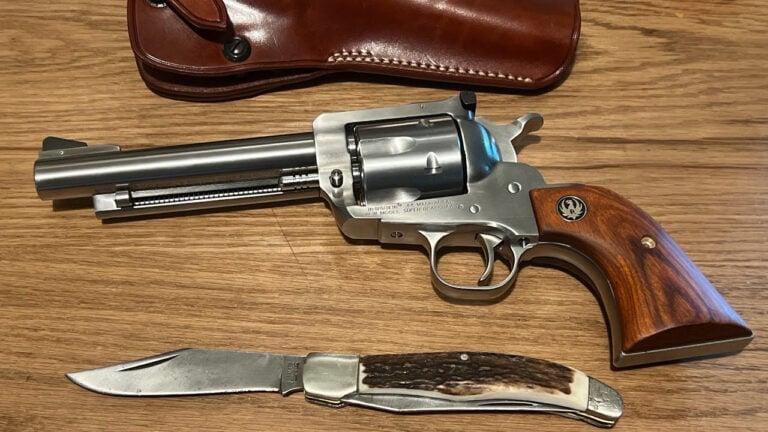
Where the .44‑40 unified rifle and handgun, the .45 Colt defined what you picture when you think of a frontier revolver. Chambered in iconic single‑action designs, it offered substantial stopping power in a belt holster and became closely associated with lawmen, outlaws, and the mythology that grew up around them. For you as a modern shooter, it is less about ballistics and more about the feel of a heavy, slow bullet leaving a classic wheelgun.
Accounts of Old West sidearms describe how the . 45 Colt was the most effective for use against the lawless, while the . 44‑40 was favored for hunting, underscoring how the .45 Colt became the defensive standard of its day. Modern retrospectives on American firearms heritage highlight Revolvers Used by Famous Lawmen and Outlaws of the Old West, Housed at the NRA National Sporting Arms Museum, including .45 SAA models that cemented the cartridge’s legend. When you load .45 Colt today, you are participating in a tradition that blends practical sidearm use with a powerful cultural story about authority, rebellion, and the early American West.
.30‑06 Springfield: the all‑around American rifle round
If you had to pick one cartridge that straddles American war stories and hunting tales, the .30‑06 Springfield would be a leading candidate. Developed as a military round and later embraced by hunters, it offers a balance of power, trajectory, and recoil that lets you pursue everything from deer to elk while still recalling its service heritage. Its case design also became the parent for a family of other influential cartridges.
Guides to hunting rifle bullets describe the . 30‑06 Springfield as a classic choice for large game, with bullet weights ranging from 150 to 220 g grains to cover different distances and species. Broader histories of hunting ammo group it among The Popular Calibers in Hunting Ammo, noting that There are numerous calibers that hunters frequently use, each boasting unique capabilities, and the .30‑06 remains a touchstone in that list. When you see it on a shelf today, you are looking at a cartridge that helped arm American soldiers in the twentieth century and still anchors countless deer camps every fall.
.30‑40 Krag and the first smokeless U.S. service round
Before the .30‑06 took center stage, the .30‑40 Krag marked the United States military’s first real step into smokeless powder service ammunition. For you as a student of gun history, it represents a transitional moment when tactics, rifle design, and logistics all had to adapt to higher velocities and flatter trajectories. Although it had a relatively short frontline career, its influence on later designs was significant.
Analyses of old‑time hunting cartridges point out that In the parlance of the day, early rounds like the . 45‑70‑405 were still rooted in blackpowder, while the .30‑30 and later .30‑40 Krag began to shift expectations. Broader surveys of iconic rifle calibers that have shaped history, Whether for hunting, sport, or defense, place these early smokeless rounds in a lineage that leads directly to the .30‑06 and modern 7.62x51mm. When you handle a Krag rifle or its ammunition, you are seeing the first American attempt to harness smokeless performance in a standard issue cartridge.
7.62x51mm / .308: from NATO standard to hunting staple
The 7.62x51mm, known in the civilian market as the .308 Winchester, is one of the clearest examples of a military cartridge that migrated into your hunting and target rifles. Adopted as a shorter, more efficient successor to the .30‑06 in service roles, it offered similar performance in a more compact package that worked well in modern actions. Civilian shooters quickly recognized that those same traits made it ideal for everything from deer hunting to precision competition.
Lists of the most common calibers in the United States include 7.62x51mm among the top cartridges, noting that its robust construction and 2 MOA red dot compatibility make it suitable for a variety of shooting applications. Broader discussions of iconic rifle calibers that have shaped history, Whether for hunting, sport, or defense, also highlight the .308’s dual identity as both a NATO standard and a go‑to round in bolt‑action and semi‑automatic sporting rifles. When you zero a .308 today, you are benefiting from decades of development driven first by Military needs and then by civilian demand.
5.56 NATO and .223 Remington: the small‑caliber revolution
Where earlier service cartridges relied on heavy bullets, the 5.56 NATO and its civilian cousin, the .223 Remington, represent a shift toward lighter, faster projectiles. For you as a shooter, that means flatter trajectories, reduced recoil, and the ability to carry more rounds for the same weight, all of which have influenced both battlefield doctrine and civilian training. These cartridges are now inseparable from the image of the modern American rifle.
Explainers on what ammunition the Military uses describe how the ammo that the US Military uses is referred to as ball ammo, more commonly called Ball, and they identify the 5.56 as the most common round used by the military for nearly 60 years. Contemporary guides to the most common calibers in the United States list .223 / 5.56 among the top five, alongside 7.62x51mm and other staples, underscoring how a cartridge born from service requirements has become a default choice for home defense, competition, and varmint hunting. When you load a 30‑round magazine of 5.56, you are participating in a small‑caliber revolution that reshaped both warfighting and civilian rifle culture.
9mm Luger: the dominant handgun cartridge
In the realm of handguns, no cartridge has more influence on your daily carry choices than the 9mm Luger. Its balance of recoil, capacity, and terminal performance has made it the default option for law enforcement agencies, military sidearms, and civilian concealed carriers. That dominance has also driven an enormous ecosystem of pistols, training programs, and defensive loads tailored to this single caliber.
Market overviews of common ammunition types state plainly that the 9mm is the most popular, and therefore the most common, ammunition in the United States, and they note that While it is not a runaway in every metric, it still holds a convincing lead. Historical pieces on iconic American weapons add context by highlighting how earlier service pistols like the Colt M1911 in .45 ACP once set the standard, Serving as the standard sidearm from 1911 to 1985, before many institutions shifted to 9mm platforms. When you choose a compact 9mm today, you are aligning with the prevailing trend in both official and civilian handgun use.
.45 ACP and the Colt M1911 legacy
Even as 9mm dominates current carry trends, .45 ACP retains a powerful hold on American gun culture, largely because of its association with the Colt M1911. For you, the appeal is as much emotional as technical: a heavy, slow bullet with a reputation for “stopping power,” launched from a steel single‑action pistol that served through two world wars and beyond. That combination of cartridge and platform has become a symbol of American sidearm design.
Historical surveys of U.S. military weapons emphasize that the Colt M1911, chambered in .45 ACP, is legendary for its stopping power and reliability, Serving as the standard sidearm from 1911 to 1985. Exhibits of Revolvers Used by Famous Lawmen and Outlaws of the Old West, Housed at the NRA National Sporting Arms Museum, help trace a broader lineage of .45‑caliber handguns that shaped both law enforcement and civilian carry long before polymer 9mm pistols took over. When you load .45 ACP into a modern or vintage 1911, you are engaging with more than a century of sidearm history that still influences debates about caliber choice today.
.30‑30 and 45‑70 in modern lever‑gun culture
Although semi‑automatic rifles dominate headlines, lever‑action culture remains a distinct and influential corner of American gun life, and it is anchored by the .30‑30 and 45‑70. For you as a hunter or enthusiast, these cartridges represent a blend of nostalgia and practicality: fast follow‑up shots from a slim rifle, paired with ballistics that still work in thick woods and brush. Their continued popularity shows how older designs can coexist with newer platforms.
Comparative pieces on 45‑70 vs 30‑30, labeled as a Caliber Comparison, stress that As we have mentioned, the 45 and 70 rounds, along with the .30‑30, are Known as trademark choices for lever guns, and that inside typical hunting distances both bullets perform well. Broader histories of classic hunting ammo note that The Popular Calibers in Hunting Ammo include these traditional rounds, and that There are numerous calibers that hunters frequently use, both lighter and heavier bullets, depending on game and terrain. When you cycle a lever gun in either chambering, you are not just indulging in nostalgia, you are using tools that still meet real‑world needs in the field.
6.5‑caliber upstarts and the long‑range trend
In recent years, you have probably heard more about 6.5‑millimeter cartridges, especially in the context of long‑range shooting. These rounds promise high ballistic efficiency, manageable recoil, and impressive downrange performance, which has made them favorites among precision hunters and target shooters. Their rise reflects a broader shift toward data‑driven marksmanship and extended‑range capability.
Case studies of deer cartridges note that it has been around since the 1890s in European cartridges, but Americans never really took to 6.5’s at first, and that the . 264 Wincheste was an early attempt that struggled for mainstream acceptance. Modern discussions of long‑range rifles explain that Long‑range hunting has been popular since the days of the great buffalo hunts of the American West, but recent rifle manufacturing and optics have pushed effective distances far beyond what was typical over the past century or so. When you consider a 6.5‑caliber rifle today, you are tapping into a trend that finally brought European efficiency into the American mainstream of precision shooting.
.30‑30, .25‑35, and the first smokeless sporting era
Looking back at the dawn of smokeless sporting cartridges helps you understand how quickly expectations changed for hunters like you. The .30‑30 and .25‑35 did not just offer cleaner burning powder, they delivered flatter trajectories and more consistent performance, which in turn encouraged longer shots and more specialized rifle designs. That shift laid the groundwork for the modern idea of a “deer rifle” as a distinct category.
Reports on old‑time hunting cartridges state that the . 30‑30 Winchester and its companion . 25‑35 were America’s first smokeless‑powder sporting cartridges, introduced at a time when blackpowder rounds still dominated. Those same sources emphasize the metric 35 as part of the .25‑35 designation, underscoring how bullet diameter and case capacity were being optimized for new powders. When you compare these early smokeless rounds to both older .45‑70 loads and newer high‑velocity cartridges, you can see how each generation of ammo reshaped what hunters expected from their rifles.
.45‑70 and the mythology of the American West
Beyond ballistics, some cartridges carry a mythic weight, and the .45‑70 is one of them. For you, it evokes images of buffalo hunters, cavalry troopers, and rugged guides carrying short, hard‑recoiling carbines in bear country. That mythology has been reinforced by film, literature, and modern marketing that leans heavily on frontier imagery.
Historical retrospectives on iconic American firearms note that The Winchester Model 1894 hit the scene too late to see the height of the American Wild West, but that rifles in big‑bore chamberings kept Winches relevant in the public imagination. Lists of top hunting cartridges highlight the 45‑70 Government, Introduced in the trapdoor Springfield and named for its 70-grain blackpowder charge, as capable of handling the biggest bears and even Cape buffalo. When you chamber a 45‑70 round today, you are not just preparing for heavy game, you are also stepping into a story that links the cartridge to the American West in a way few others can match.
Programmable and next‑generation ammunition
While most of the cartridges that shaped American gun culture are more than a century old, the future of ammo is moving in a very different direction. For you as an observer of defense trends, programmable and smart munitions signal a shift from simple brass and lead to integrated systems that can be tailored in flight or on impact. These technologies are less about hunting or everyday carry and more about how the United States and its allies will fight in complex environments.
Industry research on the programmable ammunition market notes that the changing nature of global warfare has led various defense ammunition manufacturing companies within the North Amer region to invest in rounds that can be set to airburst, delay, or perform other specialized functions. These developments are framed as a response to requirements from defense forces that need ammo which supports urban operations, armored threats, and networked targeting. While you are unlikely to see such rounds in civilian hands, their emergence shows how far the concept of a “cartridge” has evolved from the simple .22 Long Rifle or .30‑30 that once defined American shooting.
How these 15 cartridges still shape your choices today
When you stand at a gun counter or scroll through an online catalog, the influence of these fifteen cartridges is everywhere. The .22 Long Rifle still trains new shooters, the .30‑30 and 45‑70 keep lever‑gun traditions alive, and the .30‑06 Springfield and 7.62x51mm anchor big‑game and precision roles. On the handgun side, 9mm dominates daily carry while .45 ACP and .45 Colt maintain a loyal following rooted in history and feel rather than pure numbers.
Contemporary guides to The Popular Calibers in Hunting Ammo emphasize that There are numerous calibers that hunters frequently use, each boasting unique capabilities, yet many of them trace their lineage directly to the rounds discussed here. Lists of the most common calibers in the United States, along with analyses of what the Military uses and how long‑range trends have evolved, show that your current options are the product of more than a century of experimentation, conflict, and cultural storytelling. Whether you are choosing a first .22, a classic deer rifle, or a modern defensive pistol, you are operating in a landscape shaped by these iconic American ammo types and the roles they played in war, hunting, and everyday gun culture.
Like The Avid Outdoorsman’s content? Be sure to follow us.
Here’s more from us: