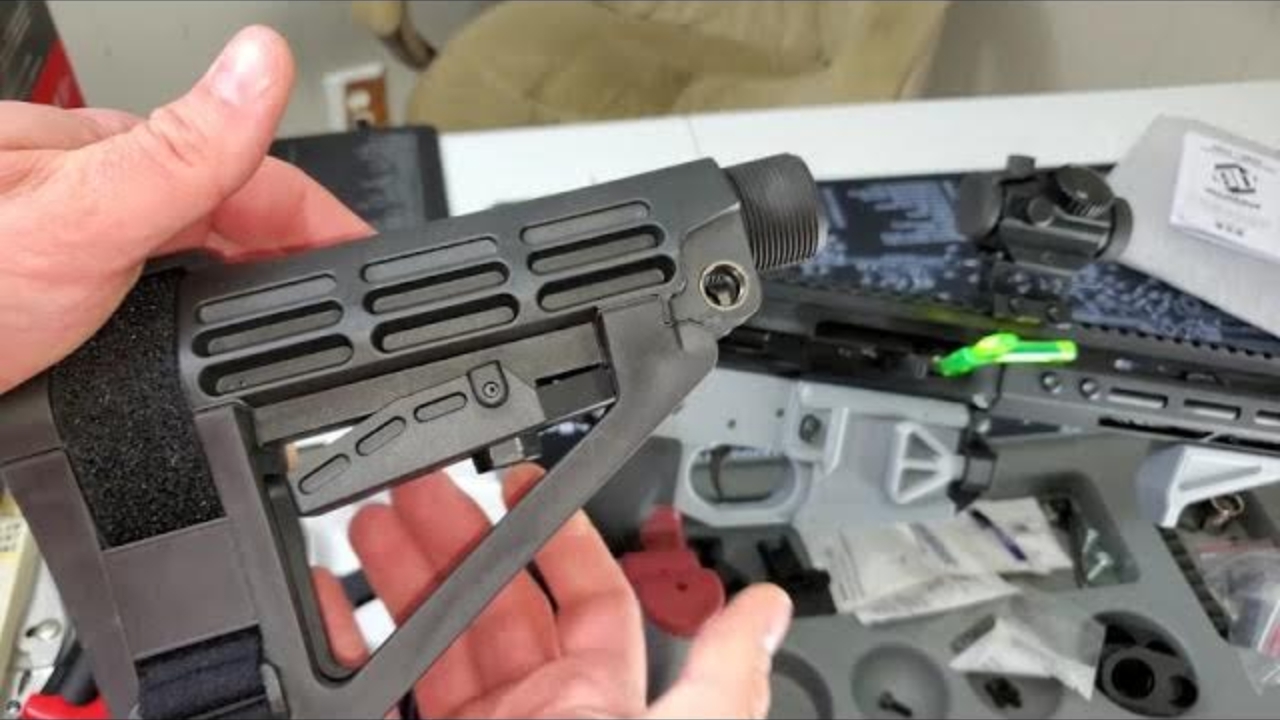
Photo credit: Kenne Bears Arms/YouTube
Pistol braces have been through a full political and legal spin cycle, and you are the one left trying to sort out what is actually allowed as 2026 approaches. The federal rule that once threatened to turn millions of braced pistols into contraband has been wiped off the books, yet the mix of court decisions, state laws, and shifting guidance still leaves you with more questions than clear answers. If you own an AR pistol, sell firearms, or are just considering a braced setup, you now have to navigate a landscape where the headline says “legal again” but the fine print still matters.
How pistol braces became a legal flashpoint in the first place
To understand why pistol braces remain confusing, you have to start with what they are supposed to do. A brace is designed to strap to your forearm so you can stabilize a heavy handgun, especially something like an AR-pattern pistol, using Velcro or similar attachments instead of a traditional shoulder stock. As of 2025, federal guidance again treats these devices as lawful accessories when they are used as intended, which is why you see references to Federal Legality Restored in discussions of modern brace designs.
The controversy grew because braces blurred the line between pistols and short barreled rifles, categories that carry very different obligations under the National Firearms Act. A braced AR pistol can look and feel close to a compact rifle, and regulators worried that some owners were using braces as improvised stocks to bypass NFA registration. That tension between the original intent of stabilizing a pistol and the perceived misuse as a stock is what pushed pistol braces from a niche assistive device into the center of a national fight over how far the government can go in reclassifying firearms by regulation instead of legislation.
The ATF’s 2023 rule and why it collapsed in court
Your lingering uncertainty about pistol braces traces directly back to the ATF’s Final Rule 2021R-08F, which tried to redefine when a braced pistol would be treated as a short barreled rifle. In January 2023, the ATF published that final rule in the Federal Register and announced that many braced pistols would now be considered NFA firearms unless owners removed the brace, replaced the barrel, or registered the gun. The agency’s scoring system and multi factor test left even experienced dealers guessing which configurations would suddenly be treated as contraband.
Litigation followed almost immediately, and by 2025 the legal tide had turned against the agency. Multiple federal courts concluded that the ATF had overstepped its authority, and by the time you reached the latest updates, the short answer was that, as of 2025, the ATF pistol brace rule from 2023 had been vacated. That meant the sweeping reclassification of braced pistols as NFA items was no longer in effect, even though the memory of that rule still shapes how cautious many owners and Federal Firearms Licensees are today.
What “legal again” really means at the federal level
When you hear that pistol braces are “legal again,” it is tempting to think you can bolt any brace onto any AR pistol and forget about it. The reality is more nuanced. As of 2025, federal guidance confirms that pistol braces are legal at the national level, and that the ATF’s attempt to treat most braced pistols as short barreled rifles has been set aside. That is why resources aimed at gun owners now state plainly that Are Pistol Braces Legal can be answered “yes” in the current federal status, provided your configuration still qualifies as a pistol.
The catch is that the National Firearms Act did not disappear, and neither did the definitions that separate pistols from rifles and shotguns. Short barreled rifles, short barreled shotguns, and suppressors remain NFA items that require registration and a 200 dollar tax stamp, and the ATF has already shown it is willing to argue that certain brace equipped builds cross that line. Compliance guidance for dealers still emphasizes that NFA items and pistol brace compliance created serious challenges when the rule was active, and that the underlying NFA framework still applies to any firearm that actually meets the definition of an SBR under federal regulations, as highlighted in discussions of NFA Items and Pistol Brace Compliance.
How court victories reshaped the landscape but not the confusion
From your perspective, the most important shift came when federal courts stopped treating the ATF’s brace rule as valid law. A key turning point was Mock v. Garland, where a federal court concluded that the agency’s reclassification of braced pistols as NFA items could not stand. That decision, along with similar rulings, meant that braced pistols covered by the litigation were not classified as NFA items, and it set the stage for broader relief that now informs the guidance that Mock v. Garland is often cited for.
The legal pressure culminated in the federal government dropping its appeal in the main pistol brace ban case, a move that gun rights advocates described as a final victory. Reporting on that decision notes that the Biden originated federal pistol brace ban is finally dead and that the attempt to treat millions of brace equipped pistols as if they were registered under the National Firearms Act is gone for good, a point underscored in coverage of Biden administration litigation choices. Yet even with the rule vacated, the years of shifting guidance left a residue of doubt, and many owners still worry that a future administration or agency interpretation could try to revive similar restrictions in a different form.
Why your AR pistol setup still demands careful choices
Even in a friendlier federal environment, your specific AR pistol build matters. Pistol braces revolutionized the AR platform by making it easier to control compact firearms that would otherwise be unwieldy, especially for shooters who need extra support. Guides aimed at owners emphasize that you should understand the history and evolution of these devices, and that you should verify that any configuration you choose is legal in your state before you buy or assemble parts, a point that is central to resources titled Pistol Braces and what you need to know for your AR pistol.
From a practical standpoint, that means paying attention to barrel length, overall length, and how the brace interfaces with the buffer tube or rear of the firearm. The same AR pistol can move from clearly legal to questionable depending on whether you add certain accessories, change the barrel, or alter the way the brace is attached. Because the ATF previously tried to use a multi factor test that looked at features like weight, optics, and how the gun was marketed, many owners now err on the side of conservative builds that stay well within traditional pistol territory rather than pushing the edge of what might be argued as a short barreled rifle in a future enforcement action.
What “the rule is dead” means for FFLs and record keeping
If you hold a Federal Firearms License, the end of the brace rule did not erase the compliance headaches you have already lived through. For nearly two years, you had to track shifting guidance on whether certain braced pistols should be logged as pistols, rifles, or NFA items, and whether customers needed to file Form 1 applications or remove braces before transfers. Compliance resources now stress that, as of 2025, the ATF pistol brace rule from 2023 has been vacated in federal courts, and that FFLs should adjust their policies accordingly while still documenting how they classify firearms, a point summarized in guidance that opens with The Short Answer for licensees.
At the same time, broader regulatory changes around frames, receivers, and other NFA items have pushed dealers to invest in better compliance tools. Overviews of new gun laws in 2025 highlight that, at a glance, federal developments have focused on clarifying definitions and speeding up compliance decisions, which affects how you log and transfer all regulated items, not just braced pistols. That is why many shops now lean on software and updated procedures that reflect New Gun Laws and what FFLs need to know, so that if the ATF revisits braces or similar accessories, you are not starting from scratch on your record keeping systems.
State lines: why 2026 will not look the same everywhere
Even with the federal brace rule gone, your legal exposure can change the moment you cross a state border. Some states have long treated certain AR pistol configurations with suspicion, and new laws are tightening control over the parts and accessories you can buy without extra steps. In California, for example, beginning January 1, 2026, that will change significantly for AR 15 owners, because accessories such as pistol grips, adjustable stocks, and flash hiders will face new restrictions and shipping requirements that include an adult signature on delivery, as detailed in guidance that opens with Beginning January and explains how those accessory rules will work.
For you, that means a braced AR pistol that is perfectly lawful in one state could be difficult or impossible to configure the same way in another, even if the brace itself is not banned outright. Shipping restrictions, feature based definitions of “assault weapons,” and local interpretations of what counts as a pistol versus a rifle all interact with your choice to run a brace. As 2026 approaches, the smartest move is to treat your home state’s statutes and attorney general opinions as the floor, not the ceiling, and to assume that any travel with a braced pistol requires checking both destination and transit state laws rather than relying on the federal status alone.
Why some owners still hesitate to reinstall braces
Despite the legal victories, many gun owners have not rushed to put braces back on every AR pistol in the safe. Part of that hesitation comes from the memory of how quickly the regulatory environment flipped in 2023, when the ATF used its authority to reclassify millions of firearms by rulemaking instead of waiting for Congress. Commentators who walked through the full saga now describe how, after years of legal battles, the ATF pistol brace rule is finally dead and the attempt to treat a braced pistol as a short barreled rifle is gone for good, a narrative captured in retrospectives that state the Pistol Brace Rule is finally dead and explain how we got here.
Yet you may reasonably wonder whether a future administration could try again with a slightly different theory or a more carefully drafted rule. That concern is why some owners have shifted toward registered SBRs, pinned and welded barrels that clear 16 inches, or traditional pistols without braces, even though current guidance says braces are lawful. The legal fight may be over for now, but the experience taught you that regulatory risk is not theoretical, and that building in a margin of safety can be worth more than squeezing every ounce of compactness out of a firearm that might end up in the crosshairs of the next rulemaking cycle.
How to think about pistol braces heading into 2026
Looking ahead, the most useful mindset is to treat pistol braces as a tool that sits at the intersection of performance, accessibility, and legal complexity. If you choose a braced AR pistol, you are doing so in a world where the challenged rule has been vacated and the ATF’s criteria are not being enforced, which is why updated buyer guides now emphasize that, with the rule gone, braced pistols are again treated as pistols at the federal level, as reflected in summaries that explain Are Pistol Braces Legal Again in a 2025 update. That gives you room to prioritize ergonomics and control, especially if you are building a compact defensive firearm or a range gun that needs to stay maneuverable.
At the same time, you should keep one eye on the broader regulatory environment, including how the ATF approaches other accessories and how states like California tighten rules on AR 15 parts. The fact that the ATF pistol brace rule was vacated in July 2025, with coverage noting that the controversial 2023 regulation targeting pistol stabilizing braces under the National Firearms Act was struck down, shows that aggressive rulemaking can be rolled back, as described in updates that state The ATF Pistol Brace Rule Vacated. But it also shows how quickly your equipment choices can become the subject of national litigation. Heading into 2026, the straightest answer you can give yourself is that pistol braces are federally legal, but they are not simple, and treating them with the same seriousness you would any NFA adjacent accessory is the best way to stay ahead of the next round of changes.
Like The Avid Outdoorsman’s content? Be sure to follow us.
Here’s more from us: