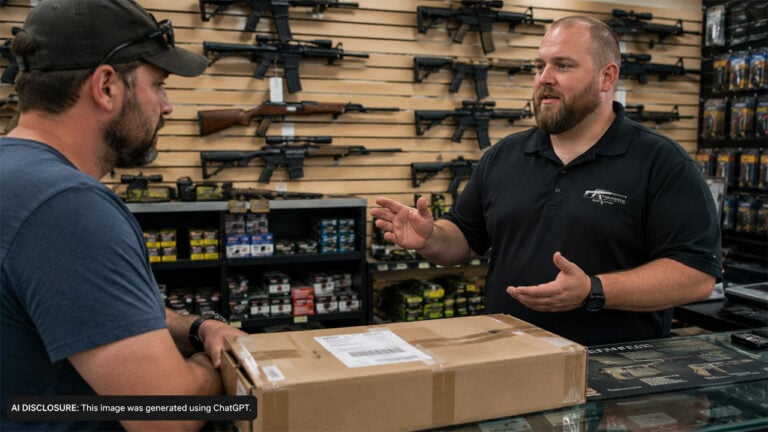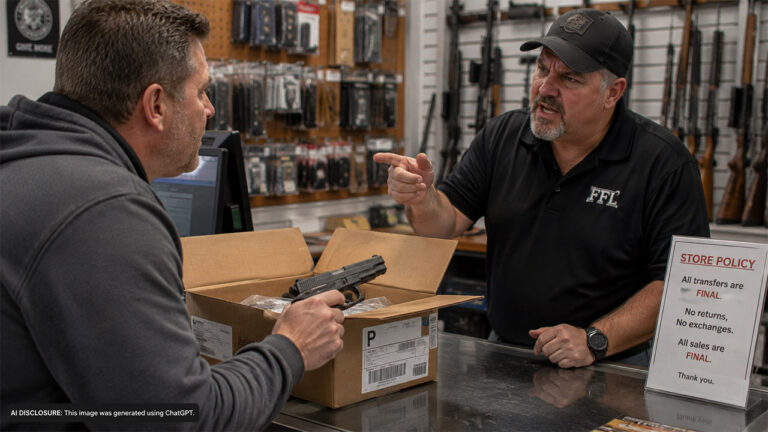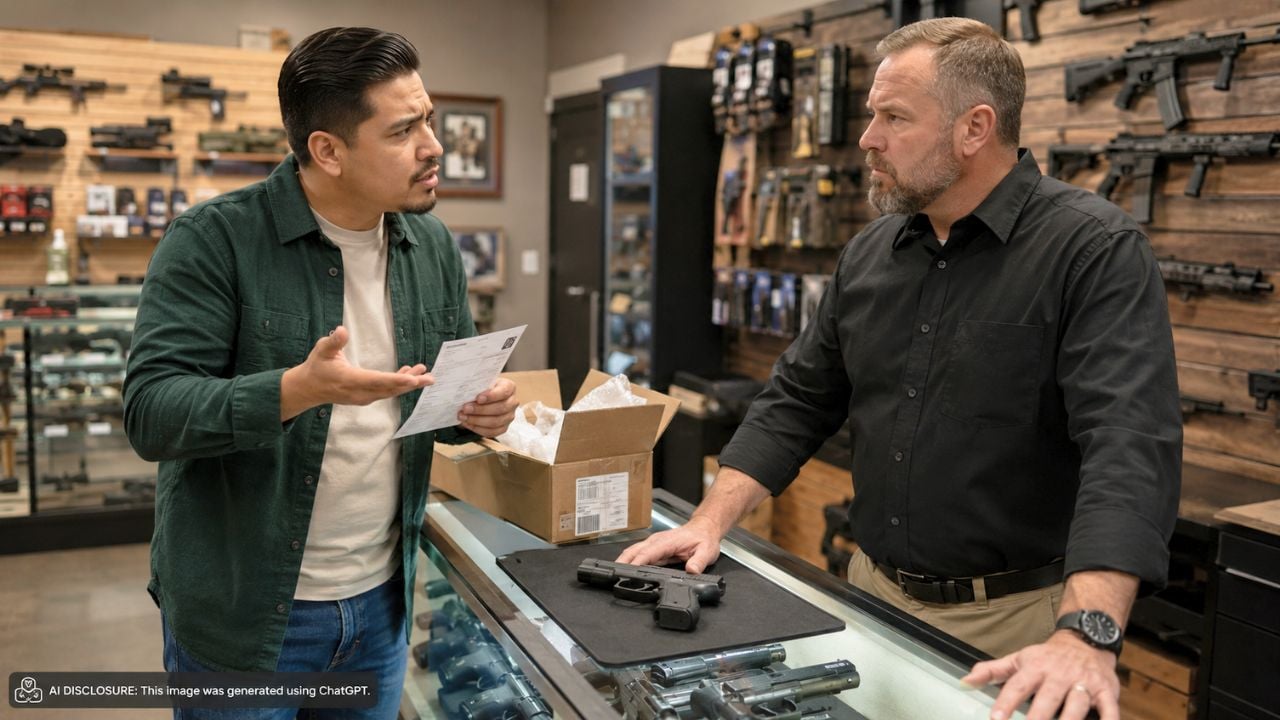
Photo credit: AI-generated image created using ChatGPT. Illustrative only
Most folks who order a firearm online expect two things when they walk into their local shop: the gun they paid for, and a clean, professional transfer. In one Utah buyer’s case, what should’ve been a quick paperwork stop turned into a mess after the dealer handed over the wrong version of the firearm, then tried to make the customer eat the price difference—and topped it off with a threat to report the gun as stolen.
A simple online order turned into a color mix-up
According to the original post, the buyer ordered a firearm earlier in the week and selected the least expensive option for that particular model—specifically, a certain stock color. By Thursday, the firearm had arrived at the local FFL, and the buyer came in to complete the transfer.
He went through the normal process—ATF Form 4473 and the usual steps—while noting he’d already paid online. Like plenty of people who treat a transfer as a quick in-and-out errand, he didn’t inspect every detail at the counter and left the gun in the box.
The call that changed everything
The tone shifted when the dealer called later and admitted he’d made a mistake. The firearm transferred to the buyer had the “wrong colour stock” compared to what was originally ordered, and the dealer wanted to correct it after the fact.
The buyer said he’d be willing to bring it back, but also mentioned he’d already put “a few rounds through it.” That’s a pretty normal first-week reality—folks buy a gun and go verify function, sights, and basic reliability. The dealer’s response was that he couldn’t take it back because it had been fired, and that the buyer would need to pay the $80 difference between the two color variants.
The paperwork didn’t match the dealer’s new story
Here’s where it gets important for anyone who buys guns online: the invoice the buyer received listed the firearm he actually walked out with—not the one he originally intended to receive. More than that, it had the matching serial number for that firearm, and it was marked “paid” in the dealer’s handwriting.
In the real world, that invoice matters. It’s the kind of document you want saved in a folder at home and backed up digitally—especially if you ever have to prove lawful ownership or straighten out an error that wasn’t yours.
The dealer escalated to theft accusations and a stolen-gun threat
The buyer said he was close to working something out until an email arrived that changed the entire posture of the situation. Instead of treating it like a shop mistake and a customer-service problem, the dealer accused the buyer of theft and blamed him for not verifying the colors before leaving.
Then came the hard line: pay the difference, or the dealer would report the firearm stolen. In the dealer’s words, “the next step here is to report this gun as stolen,” adding that a stolen firearm is “a big deal.” For most gun owners—especially in a state where plenty of us hunt, travel, and cross paths with law enforcement now and then—that kind of threat hits like a punch to the gut.
Why gun owners were focused on documentation and not arguing in circles
The buyer’s questions were the same ones most of us would have. Does he legally owe the dealer money when the dealer made the mistake? Can a dealer threaten police involvement to squeeze payment? And if the dealer does call it in, could the buyer be arrested even with proof the gun was transferred to him and paid for?
In an update, the buyer said he contacted local law enforcement as well as ATF. He reported being told that if he has documentation of purchase—especially with matching serial numbers—he should be fine. He also said they recommended calling so the details were on record since it involved a firearm. That’s practical advice, and it’s a reminder that when a situation involves a serial-numbered item and threats get thrown around, you want to get out in front of it with calm, professional documentation.
What this teaches anyone doing online-to-FFL transfers
No one wants to turn a gun purchase into a paperwork project, but this story highlights a few habits that can save you a pile of stress. First, open the box at the counter. Check the model, the serial number, and yes, even the stock color or finish if that’s what you paid for. It’s not about mistrusting the dealer; it’s about catching honest mistakes when they’re easiest to fix.
Second, keep your docs. The buyer here had an invoice listing the exact gun he received, with the serial number and “paid” noted. That’s the kind of proof that matters when somebody later tries to rewrite history.
Third, don’t get dragged into emotional phone calls when the other side is throwing around criminal accusations. The buyer responded by putting things on a more formal track—he said he emailed the dealer back and told him that if the dealer wanted to pursue it further, communication would go through an attorney. After that, he reported he hadn’t heard anything back.
Most outdoorsmen I know aren’t looking for fights—especially not over a stock color. But when a shop error turns into threats about “stolen firearms,” it’s time to slow down, save every email and invoice, and handle it like an adult with something to lose. If you’re standing at the gun counter this weekend, take the extra 60 seconds to verify what’s in the box. It’s cheap insurance, and it can keep a minor mix-up from turning into a major headache.
Like The Avid Outdoorsman’s content? Be sure to follow us.
Here’s more from us: