Photo credit: AI-generated image created using ChatGPT. Illustrative only
If you’ve spent any time living out past the subdivisions, you already know the kind of traffic you want on your place: invited. The rest—lost delivery drivers, sightseers, and “just checking something”—can go from annoying to dangerous in a hurry.
That’s the corner a Florida farmer said he found himself in, when multiple real estate agents started using his clearly marked private driveway as a convenient route to show a piece of property that doesn’t even have road access. The landowner laid it out in the original post, including a hand-drawn map of how the landlocked parcel sits boxed in by a subdivision, a wildlife refuge, and his farm.
A landlocked listing turned into a “shortcut” across a working farm
The for-sale tract was described as a “big plot of land” that had been ignored for decades—dense forest, no maintained road, and apparently no obvious way to get a buyer to it without a hike. On paper, access was through a narrow gap between the farm and a nearby subdivision, where “a road should be,” but where the woods have taken over after 40 years of nobody caring for it.
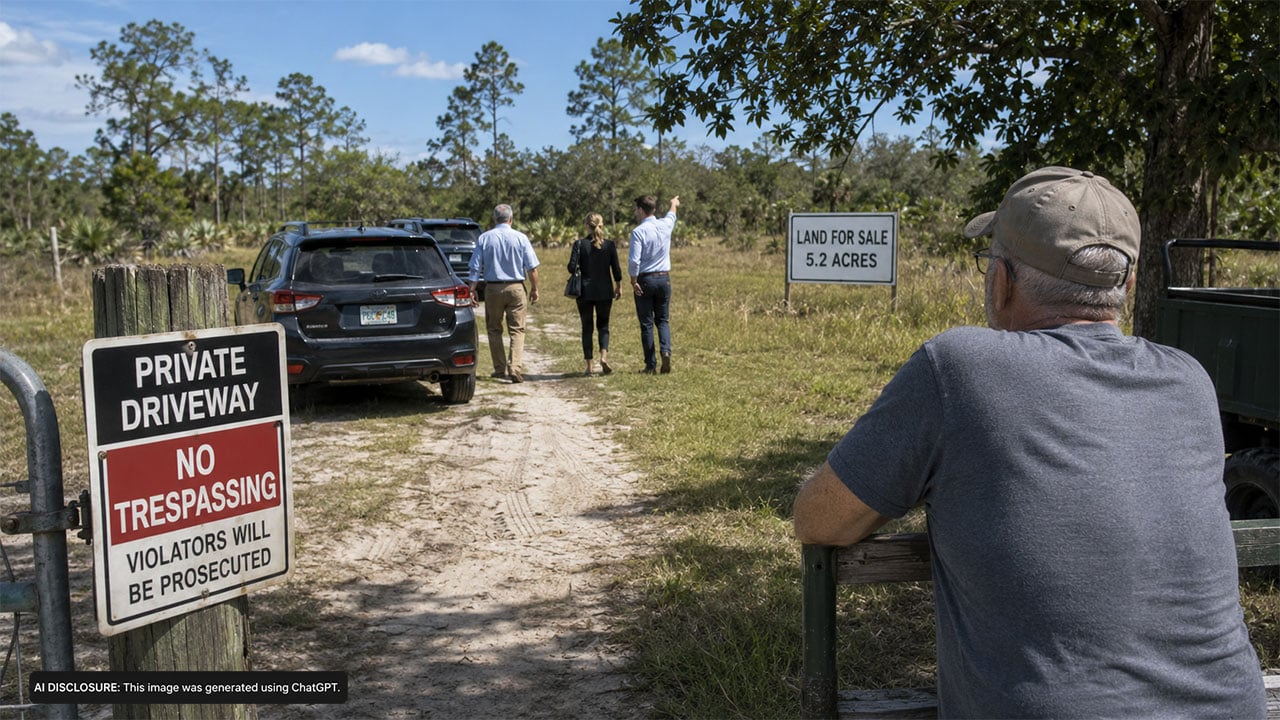
In practice, the farmer said the realtors simply started driving up his long private driveway—one that dead-ends at his house—then parking on his lawn and walking roughly 300 feet across his land to reach the property they were selling. That’s not someone stepping over a corner by mistake. That’s using a driveway like it’s a public lane and treating a farm like it’s open space.
The landowner tried being reasonable—then it kept happening
He didn’t start off looking for a fight. He explained the situation the first time and even offered a compromise: if they really needed to access the area, call ahead so he’d know what was going on. That worked once. Then, he said, they went right back to “randomly driving up” again with clients.
Anybody who’s lived on rural ground knows why that matters. A long driveway that ends at your house isn’t a “maybe.” It’s your living room stretched out through the pines. When strangers roll all the way in, you’re instantly into a personal safety issue—kids, dogs, livestock, equipment moving, even somebody walking out to a stand or a barn not expecting company.
When he got stern, the agents claimed they were allowed to trespass
After the polite approach failed, the farmer said he contacted both the realty company and specific agents and told them flat-out: this is private property, and they’re trespassing. If they wanted to show the land, they could use the gap where the listing already indicated access and walk through the woods instead of cutting across his farm.
That’s when the story took a sharper turn. He said the agents insisted it was legal for them to do what they were doing. One even tossed out a line that if he wanted it to stop, maybe he should buy the land himself.
Whether that was swagger, ignorance, or someone trying to bully a landowner, it’s the kind of statement that gets folks heated—because it flips the burden onto the person whose land is being used without permission.
The address change made it feel even more deliberate
The farmer also noticed something that would put any property owner on alert: the for-sale parcel’s address appeared to be listed as “3874 N [his street name],” right next to his own “3872” address. To him, that made it look like his private driveway was the intended access point, even though he said the MLS listing had the “road” location as the address.
If you’ve ever dealt with boundary disputes or easement arguments, you know why that matters. Once an access route starts looking “official” on paper—through an address, a listing description, or casual repeated use—people begin acting like they’ve got a right to it. And the longer that goes on, the more headaches it can create for the landowner trying to shut it down cleanly.
He didn’t claim he’d granted any easement. He didn’t describe any signed agreement. What he described was repeated, uninvited entry and a growing sense that his place was being treated like the most convenient route for someone else’s sale.
A gate went up, and the phone started ringing
With the unannounced visits continuing, the farmer said he installed a gate at the end of his road. That’s a common, practical move in the country: you can’t argue with a closed gate as easily as you can argue with a “private drive” sign somebody chooses to ignore.
But the gate didn’t end the problem—it changed it. He said it increased the number of calls he started getting. That makes sense, too. Once you block the easy path, the folks who were comfortable treating your driveway like a public access point now have to ask, and some of them don’t like being told “no.”
He also said he called several law offices locally and wasn’t getting a clear answer from anyone with experience in this kind of situation, which is another reality of rural life: the issue is common, but the exact details can be very specific to deeds, easements, and how the parcels were created.
What outdoorsmen keyed in on: access, documentation, and not letting it turn ugly
Even without a final legal outcome in the source material, the situation highlights a handful of things rural landowners tend to focus on when unwanted traffic shows up—especially when it’s strangers bringing other strangers onto the property.
First is access. A “landlocked” parcel doesn’t magically gain a right-of-way because it’s for sale, and a real estate agent’s confidence isn’t the same thing as an easement recorded at the courthouse. The farmer’s instinct to head to the county clerk’s office and “confirm everything” is the right kind of move—know exactly what your deed says, where the lines are, and whether any access rights exist on paper.
Second is documentation. A marked private driveway, a gate, and consistent messaging matter. If different agents are coming from different offices, a calm written notice to the brokerage(s) that the driveway and fields are private—and that buyers/agents are not permitted to enter—can reduce the “we didn’t know” excuses. Keeping a record of dates, vehicles, and communications is also just common sense if the situation escalates.
Third is keeping the temperature down. A farm and a dead-end driveway are about the worst place to have misunderstandings between armed homeowners and unexpected visitors. Most rural folks carry on their own land, and plenty of buyers walking unknown ground may be armed too. The goal is to stop the trespass, not create a confrontation. A gate, clear signs, and handling it through official channels beats a driveway argument every time.
In his own update, the farmer said he planned to verify the property situation with the county clerk and then stop by the realty office. That’s the kind of steady, daylight approach that usually plays best: get the facts, then deal with the business side in writing and in person, before it becomes a pattern that’s harder to unwind.
At the end of the day, most landowners don’t care if somebody sells a parcel next door. They care when strangers start treating a private drive like a showing route and a working farm like a public footpath. Shut it down early, document what’s happening, and keep it as professional as you can—because once random vehicles are rolling up to your house, it’s not just about property lines anymore.
Like The Avid Outdoorsman’s content? Be sure to follow us.
Here’s more from us: