Photo credit: All About Survival/YouTube
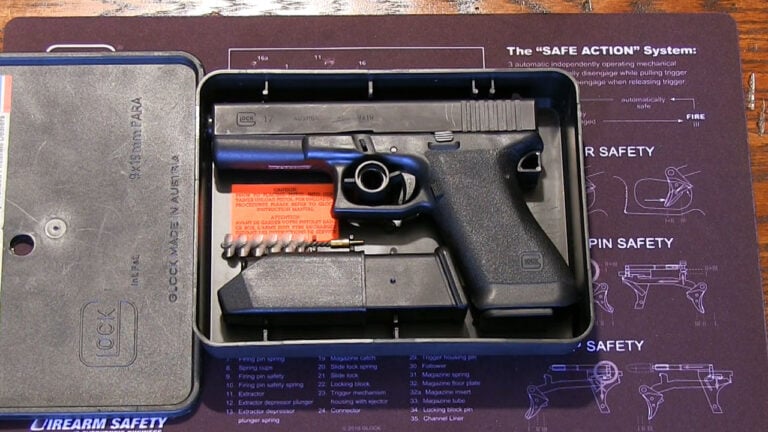
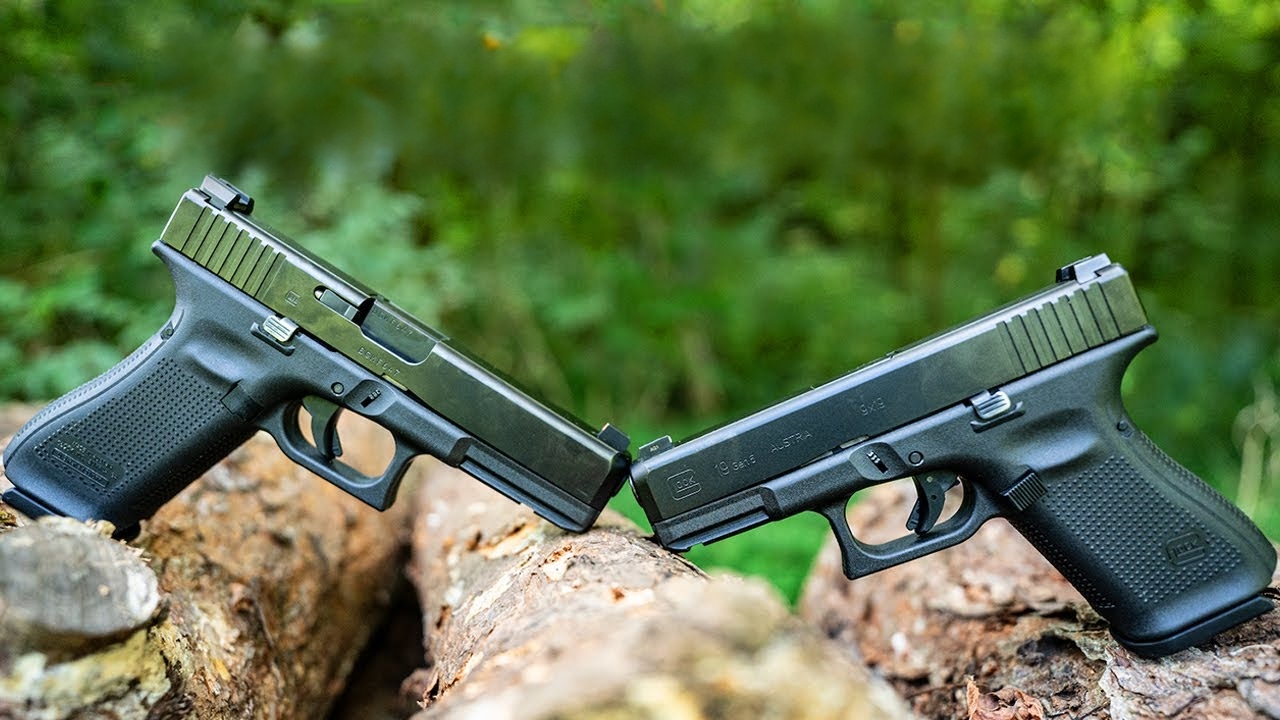
The “Glock 19 vs. Glock 17” debate is usually framed like a pure shooting comparison—sight radius, recoil feel, and two extra rounds in the magazine. Naval Special Warfare choices don’t live in that simple lane, because a pistol is rarely the primary tool in the kit, and the decision tends to revolve around what carries easier, integrates better with mission gear, and stays consistent across training and deployment loads. In the U.S. Navy’s Mk-series naming, the Glock 19 shows up as the Mk 27 family, and multiple defense/industry sources describe the Mk 27/Glock 19 as a general sidearm for Naval Special Warfare and broader SOCOM use, especially as a compact, close-assault pistol concept.
That framing matters because “why pick a 19 over a 17” isn’t really about which one shoots tighter groups from a bench. It’s about what gives you the best blend of capability while still being the least annoying thing on your body when you’re moving, climbing, swimming, wearing armor, or carrying a rifle as the main fighting tool. Compact pistols aren’t a compromise when the pistol is a secondary, but still critical, system—and that’s the lane the Glock 19 sits in better than a full-size frame for a lot of real-world use cases.
The pistol is usually the backup, and that changes what “best” means
A full-size pistol like the Glock 17 can be easier to shoot well for many people because it offers a longer grip and a longer sight radius, and it can feel steadier when you’re driving the gun hard. In a typical military context, though, the sidearm often lives as a secondary tool while a carbine does the heavy lifting, and the sidearm needs to carry comfortably and predictably without stealing space from everything else you must carry. The Glock 19 keeps the same core manual of arms and magazine family logic as the larger models but packages it in a shorter slide and grip that tends to be less intrusive with body armor, comms, and other mission-essential gear, which is one reason compact “do-most-things” pistols are so common in professional use.
This is also where the “two rounds” argument gets overplayed in civilian conversations. A Glock 17’s standard magazine capacity advantage is real, but it’s not free—overall bulk and carry footprint matter every hour you’re wearing the gun. If you’re building a system that needs to sit on the belt, in a drop rig, or on a vest without constantly colliding with other gear, a slightly smaller package can reduce friction and fatigue enough that the pistol is more likely to be worn consistently and accessed cleanly. That’s not glamorous, but it’s the kind of reasoning that shows up in serious procurement and unit-level preference discussions.
Size and weight are “small” until you’re carrying everything
The Glock 19’s advantage is not that it’s tiny—it’s that it’s compact enough to be less of a burden while still being large enough to run like a duty gun. That matters when the pistol isn’t the only thing on the belt and you’re stacking medical, comms, water, ammo, tools, and sometimes mission-specific equipment on top of that. Even small reductions in size can affect how the gun rides in relation to armor plates and how quickly it can be drawn from certain holster positions, especially when you’re moving through awkward body positions instead of standing upright on a clean range line. Sources that discuss the Glock 19’s use in Naval Special Warfare routinely point to its compact footprint and carry practicality as a central part of the appeal.
There’s also a knock-on effect people miss: compact guns tend to integrate more smoothly with a wider range of holster setups. When you’re dealing with different clothing layers, armor setups, and equipment loads, the pistol that carries “well enough” in more scenarios often wins over the pistol that shoots marginally better in a narrow slice of scenarios. That doesn’t mean the Glock 17 is wrong; it means the Glock 19’s middle-ground sizing creates fewer problems across more configurations, and professional users tend to favor reliability and predictability of the whole system over theoretical performance edges.
The Mk 27 angle: standardization, training, and ecosystem
The Mk 27 designation gets mentioned in multiple writeups that link the Glock 19 platform to Naval Special Warfare use, and those discussions often emphasize that standardization of manual of arms, parts, and magazines can simplify training and logistics across units and roles. That kind of standardization matters because pistol time in training is finite, and the more “same” the system feels across different guns and configurations, the easier it is to maintain consistent competency across a force. A Glock 19-based system can also support different configurations—suppressor-ready setups, night sights, and other duty-driven configurations—without changing the fundamentals of how the pistol runs in the hands.
It’s also worth separating “unit adoption” talk from internet certainty. Different elements within larger commands can have different allowances, different mission sets, and different equipment pipelines, and public reporting on special operations small arms is often incomplete by nature. The useful takeaway for readers isn’t “this is the one true pistol,” it’s the logic behind why a compact, high-reliability 9mm with a deep parts ecosystem keeps showing up in professional contexts where the pistol has to work but can’t be the center of the universe.
Why the Glock 17’s advantages don’t always matter in that role
The Glock 17’s longer grip can help with control and can offer slightly easier reload indexing for some hands, and the longer slide can be marginally more forgiving with sighting and recoil impulse. Those are real upsides, and they’re why many agencies and shooters still prefer full-size pistols. But the difference is smaller than people think when you’re talking about modern 9mm duty ammo, modern training, and a user base that already shoots frequently. When the gap in shootability is “some,” and the gap in carry intrusion is “every day,” professional users often pick the option that reduces constant friction, because constant friction is what causes workarounds and inconsistent carry habits.
There’s also the reality that if a pistol is truly a backup to a rifle, “best” becomes “best balance.” You want it big enough to shoot fast and accurately under stress, but compact enough that it never becomes the thing you’re adjusting, snagging, or cursing when you’re trying to do something else. The Glock 19 sits in that balance point for a lot of people: it’s not the easiest Glock to shoot or the easiest Glock to conceal, but it does both well enough that you can build a whole system around it and stop thinking about it.
What civilian buyers should take from it without over-copying it
The mistake civilians make is assuming that “SEALs use it” means “it’s best for me,” when the more useful lesson is the selection criteria. If you carry regularly, a compact pistol that you will actually wear consistently often beats a full-size pistol that’s more comfortable on the range but gets left at home more often. If you mostly shoot at the range or want a dedicated home-defense handgun, a full-size pistol can make a lot of sense because you’re not paying the carry penalty every hour. If you want one pistol to do most things—carry, range, occasional training, and general defensive use—the Glock 19-size class is popular because it splits the difference in a way that’s hard to argue with.
The other takeaway is that “feature creep” is a trap. Many reliability issues—especially in Glocks—show up after people start chasing modifications, swapping springs, messing with trigger geometry, and layering on parts that were never vetted together. Professional use tends to favor changes that support durability and consistency rather than changes that create a tighter feel for one narrow performance metric. If you want your pistol to behave like a professional tool, you prioritize boring reliability and proven configurations over anything that makes the gun feel “cooler” in the hand.
Like The Avid Outdoorsman’s content? Subscribe to our newsletter so you never miss an article.
Here’s more from us: