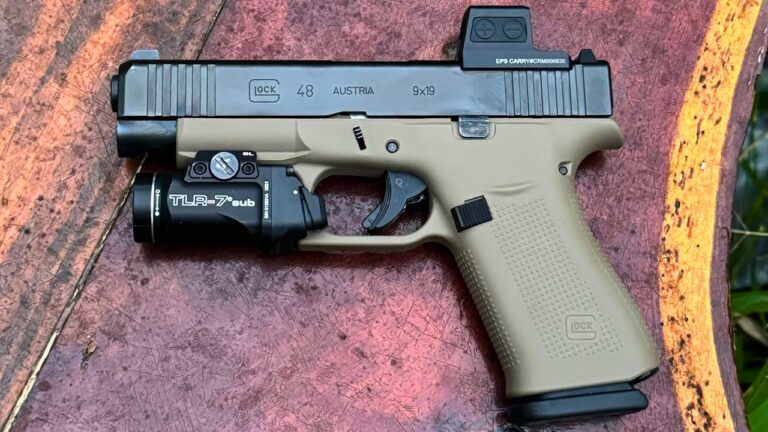
Photo credit: Elliott Delp/YouTube
Used AR pistols are piling up in display cases and back rooms across the country, a visible sign of how quickly the firearms market can turn. What looked like a must‑have configuration during the pandemic surge is now being traded in, parted out, or quietly discounted as owners and dealers adjust to a very different legal and economic landscape.
The flood of consigned and secondhand AR pistols is not driven by a single cause, but by a convergence of shifting ATF rules, a cooling gun market, and changing tastes among both veteran shooters and first‑time buyers. I will walk through how those forces intersect, and why the same accessory that once made these guns so attractive is now helping push them onto the used rack.
The pistol brace whiplash that reshaped the AR pistol market
The modern AR pistol boom was built around one accessory, the stabilizing brace that let shooters shoulder a compact firearm without registering it as a short‑barreled rifle. That foundation cracked when the ATF tried to reclassify braced pistols as rifles subject to the National Firearms Act, then cracked again when courts vacated the rule and left owners trying to interpret what “legal again” really means. As of the current guidance, the ATF rule from 2023 has been described in one legal summary as vacated in federal courts, with “The Short Answer” that the regulation is not in effect and that Federal Firearms Licensees, or FFLs, are being told to treat braced pistols under the pre‑rule framework while they monitor what the ATF does next, a position laid out in detail for dealers in a compliance advisory that explicitly references “As of” and the ATF’s shifting stance on braces for (FFLs) in the retail channel The Short Answer.
For ordinary owners, that kind of regulatory whiplash has real consequences, because the same AR pistol that felt like a clever way to avoid NFA paperwork suddenly looked like a potential felony, then like a gray‑area gun that might be reclassified again. Many shooters responded by stripping braces, converting pistols to rifles, or simply deciding they were tired of being a test case and selling the guns outright. The result is a wave of used AR pistols hitting counters at the same time, not because the platform stopped working, but because the legal uncertainty around the ATF and pistol braces has eroded the confidence that once drove brisk sales.
How the ATF’s brace rule died, and why owners are still spooked
Even though the brace rule is now effectively dead, the path to that outcome helps explain why so many owners are unloading their guns instead of celebrating. After years of litigation, one detailed legal history notes that the ATF Pistol Brace Rule was “Finally Dead” only after courts permanently vacated the attempt to treat most braced pistols as short‑barreled rifles, and that the interpretation tying a brace to an NFA rifle is “gone for good” according to that account of how we got here Finally Dead. Another legal update aimed at dealers explains that “At a Glance: As of” the current court rulings, pistol braces are again treated as lawful accessories under federal law, and it walks through how the ATF’s final rule in the Federal Register was undercut by multiple injunctions and then vacated, leaving FFLs to navigate a patchwork of past guidance and new court orders while they advise customers At a Glance.
On the consumer side, advocacy‑oriented updates have framed the outcome in celebratory terms, with one manufacturer declaring “Victory for Freedom” and stating that “The Pistol Brace Rule Is DEAD” after nearly two years of legal battles, court rulings, and grassroots pressure, and emphasizing that the rule is “permanently vacated” for owners who kept their braced pistols or registered them during the amnesty window The Pistol Brace Rule Is DEAD. Yet the same saga also includes the Department of Justice’s decision to drop an appeal in a key brace ban case, where reporting on that litigation notes that “Post Final Rule” the government tried to argue that stabilizing braces were always unlawful, a claim that gun‑rights plaintiffs and judges rejected as they defended owners like Benjamin Owen and others whose guns were equipped with specialized braces Post Final Rule. When a federal agency spends years insisting that a common accessory turns a pistol into contraband, then loses in court, it is not surprising that some owners decide the safest move is to cash out of that category entirely.
What pistol braces actually are, and why they mattered so much
To understand why used AR pistols are stacking up, it helps to revisit what a brace is and why it became central to the platform’s appeal. A technical guide aimed at new owners defines a pistol brace as a device that attaches to the rear of a firearm and straps to the shooter’s forearm, originally marketed as a way to help disabled shooters control recoil, and notes that the accessory blurred the line between pistols and rifles long before the ATF tried to clamp down on it What Are Pistol Braces. That same guide emphasizes that “Federal Legality Restored” after courts vacated the restrictive rule nationwide, which means that, on paper, a braced AR pistol is once again treated as a pistol under federal law, even if state rules vary. For several years before the crackdown, that legal status made braced AR pistols a sweet spot for buyers who wanted rifle‑like performance in a compact package without the tax stamp, fingerprints, and wait times that come with an NFA short‑barreled rifle.
Retail‑focused explainers have leaned into that pitch, with one overview titled “Pistol Braces: What You Need to Know for Your AR Pistol in” the current environment, and a section called “The History and Evolution of Pistol Braces” that walks through how the accessory moved from niche aid to mainstream add‑on as AR pistols became a staple of gun store walls Pistol Braces. Another buyer’s guide framed the appeal even more bluntly, under the heading “Are Pistol Braces Legal Again” with a 2025 “Update” that answers “Why choose a braced AR pistol?” by stressing that “Compact size meets real‑world usability” for home defense, vehicle carry, and range use, as long as “it’s legal in your state” and the owner keeps up with federal changes Are Pistol Braces Legal Again. That combination of compactness and perceived legal safety is exactly what is now in question for many buyers, which helps explain why so many of those guns are being traded in rather than accessorized further.
A cooling gun market is crushing resale values
The legal drama around braces is colliding with a broader slump in the firearms market, and that macro trend is punishing owners who try to sell AR pistols into a buyer’s market. One analysis of background check data notes that “Gun Sales Have Steadily Declined Since” the pandemic peak, quoting industry voices who say that “What we saw in 2020 and 2021 were not sustainable from a market standpoint” and that demand has fallen back toward pre‑pandemic levels as the acute fear and uncertainty of that period faded Gun Sales Have Steadily Declined Since. A separate financial review of manufacturers’ earnings reports concludes that the gun industry “remains on a downward trajectory” in the first half of 2025, with declining profits that reflect an industry‑wide slide, particularly in the AR and tactical segments that boomed during the pandemic and then softened after President Donald Trump took office earlier this year, changing the political calculus that often drives panic buying remains on a downward trajectory.
On the ground, that slowdown translates into racks of unsold new inventory and aggressive discounting that undercuts what used guns can fetch. A video breakdown of “12 GUNs That CRASHED in Value from 2024 to 2025” singles out several AR‑pattern firearms as examples of guns that were “riding high” during the surge but then dropped sharply in resale price as demand cooled and supply caught up, a pattern that many shop owners say now applies to braced pistols as well 12 GUNs That CRASHED. Another commentary on “Gun Models Gun Shops Can’t Sell” describes a “massive correction” hitting parts of the Ameri gun market, with hosts explaining that some tactical SKUs are sitting unsold for months and forcing dealers to take painful losses when they finally move them Ameri. When new AR pistols are being marked down, used ones have to be priced even lower to move, which encourages owners who are on the fence to sell now before values slide further, adding to the glut.
From panic buying to “critical mass” of ARs
The pandemic era did not just boost sales, it saturated the market with AR‑pattern firearms in a way that is now reshaping supply and demand. In the same analysis that tracks the post‑2020 decline, sociologist Jonathan Metzl, who directs Vanderbilt University’s Center for Medicine, Health, and Society, is quoted explaining that the earlier spike was driven by “heightened fear and uncertainty” that made people feel they needed to arm themselves, and that as those emotions eased, the market naturally cooled from the extraordinary levels it reached during the pandemic Jonathan Metzl. That surge included a huge number of AR pistols, which were marketed as compact defensive tools and range toys for new owners who might not have considered a rifle before, and which now represent a large pool of guns that can be traded in when those owners reassess their needs.
Within gun culture, some enthusiasts are starting to talk about a “critical mass” of firearms in circulation, and what that means for pricing. In one widely shared discussion thread, a commenter argues that “Otherwise, stuff only gets cheaper when people do not want them anymore or production abilities advance,” and points to improvements in CNC machining and other manufacturing efficiencies that have driven down the cost of producing AR‑pattern receivers and components, while also warning that the market could be entering another “peace dividend” period where surplus supply weighs on prices Otherwise. When you combine that structural oversupply with a specific category like braced AR pistols that has just gone through a legal scare, it is easy to see why used examples are stacking up and why sellers are finding that the guns they bought at peak panic are now worth far less.
New buyers, different tastes, and the AR pistol mismatch
At the same time that older owners are offloading AR pistols, the profile of new gun buyers is changing in ways that do not always favor that platform. A recent look at background check trends notes that “Women and other minority groups” are increasingly interested in gun ownership, and that instructors and retailers are adapting their offerings to meet that need with more emphasis on concealed carry pistols, training, and approachable entry‑level options rather than only pushing traditional AR‑15 style rifles and pistols Women and. Many of those first‑time buyers are less interested in a braced AR pistol with a 10.5‑inch barrel and more interested in a compact 9 mm handgun they can carry or store discreetly, which means that when a used AR pistol hits the shelf, it is competing for attention with products that better match the priorities of the fastest‑growing customer segments.
That mismatch shows up in how retailers merchandise their stores. Range owners and shop managers say that classes on basic handgun safety, concealed carry licensing, and home defense with shotguns or carbines are filling up with students who want simple, low‑maintenance tools rather than niche configurations that might require them to follow ATF rulemakings. When those customers walk past a rack of used AR pistols, the guns can look intimidating, politically fraught, or simply unnecessary compared with a straightforward pistol and a holster. As the center of gravity in the market shifts toward these new demographics, the AR pistol, once a symbol of cutting‑edge practicality, risks becoming a relic of a very specific moment in American gun culture.
Industry whiplash: from production ramp‑up to clearance racks
The supply side of the equation is just as important, because manufacturers spent years ramping up production of braces and AR pistols, and they are now living with the consequences. A historical overview of the accessory’s rise notes that “The firearms industry has bounced back, with manufacturers ramping up production of AR pistol braces and retailers restocking shelves” after earlier regulatory scares, only to see the ATF’s later crackdown and court battles leave many gun owners wondering “what’s next” for the category and whether it is safe to invest in more braced builds The firearms industry has bounced back. That boom‑and‑bust cycle left warehouses full of components and finished guns that had to be sold somewhere, and the used market is one of the pressure valves through which that excess inventory is now being released.
Dealers caught in the middle are making hard choices. Some are bundling braces with stripped lowers or rifle‑length uppers to encourage buyers to build compliant rifles instead of pistols, while others are offering steep trade‑in bonuses to move AR pistols off their books and into the secondhand channel where pricing can be more flexible. The result is a feedback loop: as more used AR pistols appear at attractive prices, new buyers who might have considered a fresh build opt for a discounted used gun instead, which in turn forces manufacturers and distributors to cut prices further or slow production. That dynamic is not unique to AR pistols, but the legal uncertainty around braces has made this particular segment especially volatile.
Why some owners are cutting their losses now
For individual gun owners, the decision to sell a braced AR pistol often comes down to risk tolerance and opportunity cost. Even with the rule vacated, some worry that a future administration or a new ATF leadership could try again, and they do not want to be holding a safe full of legally ambiguous firearms if that happens. Legal explainers that walk through the ATF’s history with braces, including the “In January” 2023 final rule in the Federal Register that tried to reclassify millions of guns overnight, have left a lasting impression on those who watched the saga unfold and now see the current reprieve as potentially temporary rather than permanent In January. For them, selling into a soft market at a loss is preferable to living with the anxiety that their favorite range toy could again become a regulatory target.
Others are simply reallocating their budgets. Shooters who bought multiple AR pistols during the surge are now trading one or two toward higher‑end optics, suppressors for registered rifles, or training classes that they feel offer more practical value. Retailers report that some customers walk in with a braced pistol and walk out with a full‑size carbine or a quality handgun, treating the used gun as a down payment on a platform they trust to remain stable in the eyes of regulators. In that sense, the crowded used racks are not just a sign of panic or regret, but of a maturing market in which owners are making more deliberate choices about what they keep and what they let go.
What the brace saga reveals about the future of AR pistols
The story of why gun shops are suddenly awash in used AR pistols is ultimately a story about how law, economics, and culture intersect in the firearms world. The ATF’s attempt to redefine millions of braced pistols as NFA rifles, the subsequent court decisions that vacated that rule, and the Department of Justice’s retreat from key appeals have all left a residue of mistrust that will not disappear just because the current legal status is favorable. At the same time, the broader market correction, documented in financial updates that show declining earnings and in sales data that confirm a steady drop from the pandemic peak, has exposed how fragile the resale value of trend‑driven guns can be when demand normalizes and supply remains high The gun industry remains.
Looking ahead, I expect AR pistols to remain part of the landscape, but in a more modest role. Enthusiasts who value compactness and are comfortable tracking regulatory changes will keep them, especially now that “Federal Legality Restored” is the operative phrase in many legal guides, while more cautious owners will continue to trade them in for platforms that feel less exposed to the next rulemaking cycle Federal Legality Restored. For dealers, the challenge will be to manage that inventory without getting burned by further price drops, and to help a new generation of buyers, including the growing number of women and minority gun owners, navigate a market where yesterday’s hot configuration can quickly become today’s clearance item.
Like The Avid Outdoorsman’s content? Subscribe to our newsletter so you never miss an article.
Here’s more from us: