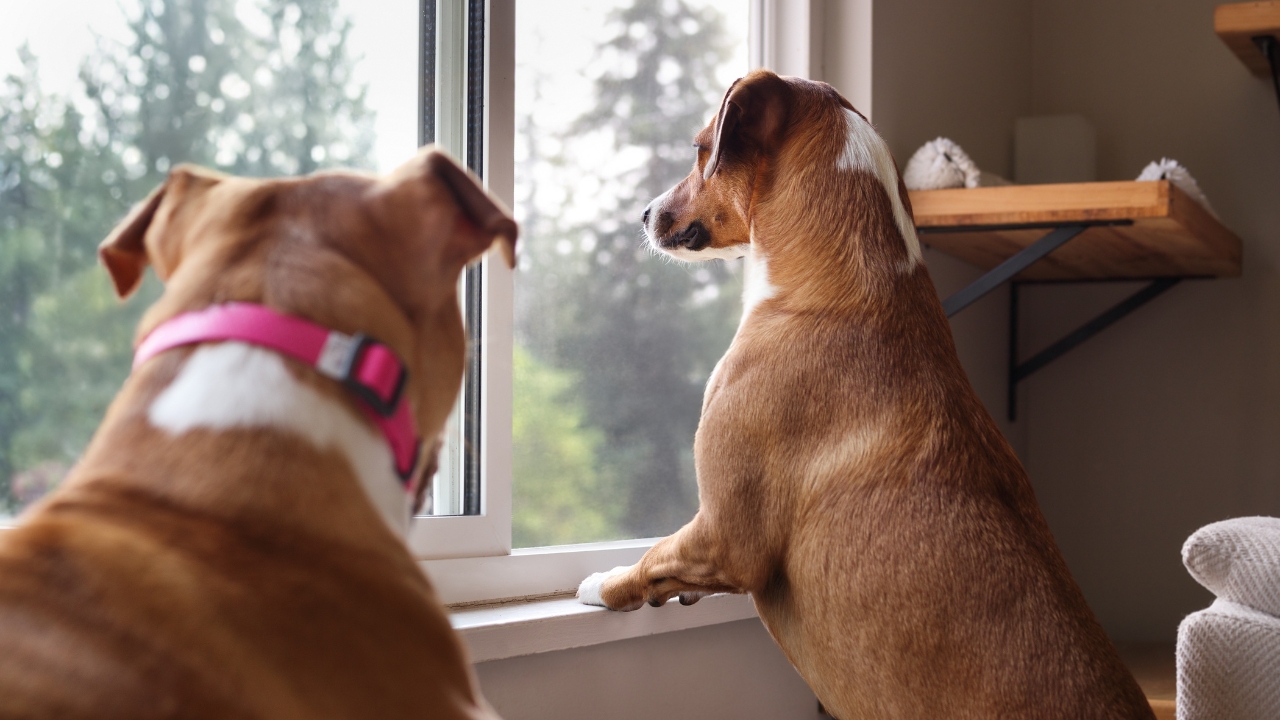
Photo credit: sophiecat/Shutterstock.com
When your dog keeps going back to the same doorway, corner, window, hallway, or patch of the yard, it usually is not random. Most of the time, your dog is picking up on something you are missing — a sound, a smell, a tiny movement, or some change in the environment that matters more to a dog than it does to you. Dogs are much more sensitive than people to certain sounds, and they rely heavily on scent to make sense of the world, so a repeated “check” often has a real trigger even when you cannot find one.
A lot depends on how your dog looks while doing it. A calm dog that checks the same spot and then moves on is different from a dog that seems tense, keeps returning to it, or cannot settle afterward. VCA notes that fearful or anxious dogs may pace, freeze, fidget, hide, or stay hyperaware, while Blue Cross says stress in dogs can be triggered by loud noises, new places, and changes in routine.
One very common reason is sound. Your dog may be hearing something in the wall, outside the house, under the floor, near a vent, or beyond the fence line that never fully registers for you. That is why repeated checking often happens around windows, doors, ceilings, and one stretch of wall. From your point of view, the dog is watching “nothing.” From the dog’s point of view, it is checking a place where something keeps showing up on its radar.
Stress and anxiety can make this habit stronger too. If your dog has become more vigilant in general, the same spot may turn into a kind of checkpoint. AKC says anxiety in dogs can show up as hypervigilance, restlessness, and an inability to settle, and VCA says fearful dogs often freeze or keep scanning for what worries them. In that case, the repeated checking is less curiosity and more your dog trying to keep tabs on a place it has decided might matter.
Sometimes the habit has more to do with your dog than the spot itself. Attention-seeking can also become repetitive behavior when it gets a response. If your dog checks the same area, then looks back at you and gets reassurance, petting, or engagement, AKC notes that behaviors that capture your attention can become reinforced and repeat. That does not mean your dog is faking it. It means the behavior may have started for one reason and kept going because it now reliably gets a reaction.
There is also the possibility that a medical or age-related change is making your dog act differently. VCA says behavior problems can be caused or worsened by pain, sensory decline, neurologic disease, or discomfort. So if your dog is checking the same spot over and over and also seems confused, restless, harder to redirect, or unlike itself in other ways, it is worth taking more seriously.
The main thing to watch is the pattern. If your dog is relaxed, easily distracted, and otherwise normal, it is usually just being a dog with better senses than yours. If the behavior is new, obsessive, tense, or comes with pacing, panting, confusion, or other changes, then it is probably telling you something more important than “I like that corner.”
Like The Avid Outdoorsman’s content? Subscribe to our newsletter so you never miss an article.
Here’s more from us: