Photo credit: The Avid Outdoorsman
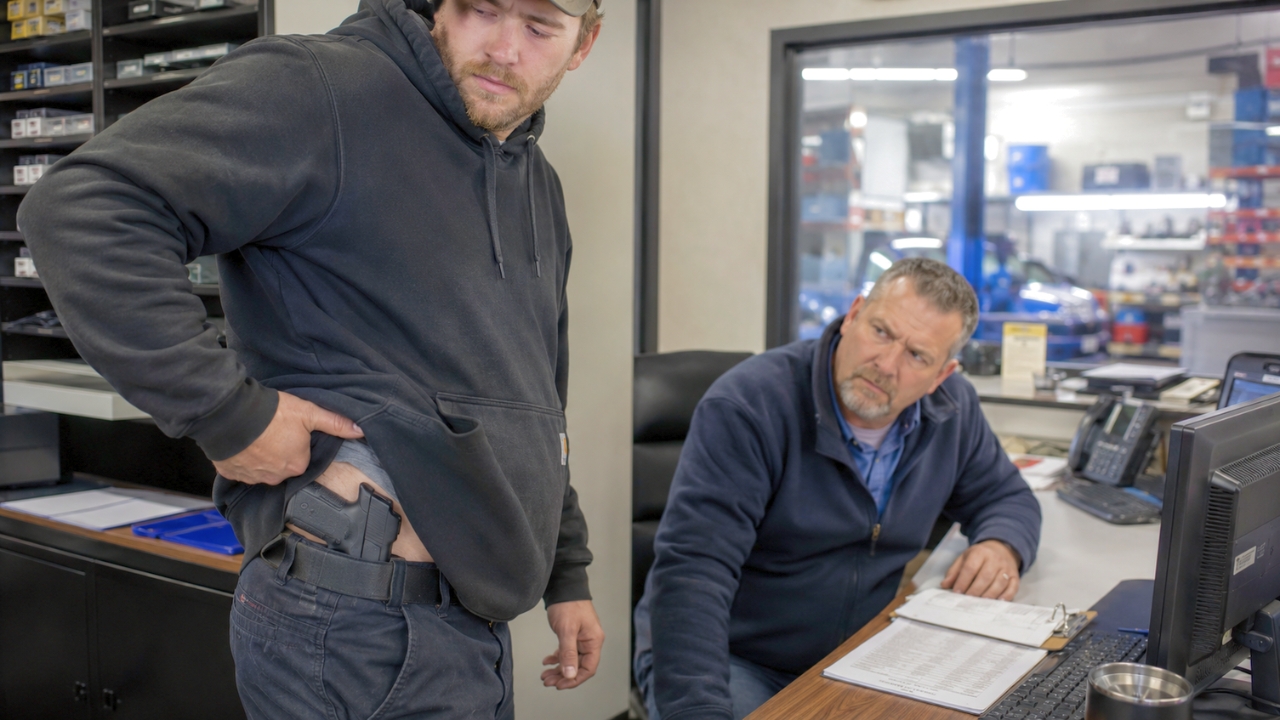
The worker knew he had probably messed up the second he felt the hoodie catch.
That is how these moments usually happen. It is not some big dramatic reveal. It is not someone yelling, “Gun!” across the office. It is one tiny piece of clothing moving wrong, one split second where the shirt or hoodie does something you did not expect, and suddenly your concealed carry setup is not nearly as concealed as it was supposed to be.
In a Reddit post, the gun owner said he was carrying at work when his hoodie snagged on his firearm. He seemed to realize almost immediately that the movement may have exposed the gun, or at least made it obvious enough for someone nearby to notice.
And someone nearby did notice.
The service manager.
That is what made the whole thing feel worse. This was not a random person in a gas station who would forget his face in five minutes. This was someone at work. Someone with authority. Someone who could keep watching, ask questions, report it, or quietly decide the employee had become a problem.
The worker said the service manager kept staring at his waistband after the snag. That kind of stare is its own little nightmare for a concealed carrier. Nobody has said anything yet, but you can feel the suspicion building. You know he saw something, or at least thinks he did. Now every movement feels obvious. Every adjustment feels risky. Every second feels like you are waiting for the conversation you do not want to have.
That is one of the most uncomfortable parts of carrying at work. Once you think someone noticed, you cannot really unring that bell.
You can tug the hoodie back down. You can act normal. You can keep working. But your brain is already running ahead. Did he know what it was? Did he see the grip? Did he just see fabric catch? Is he going to tell the boss? Is there a policy? Did I just get myself fired over one snag?
The worker’s title said he “probably messed up,” and that is the right wording. A moment like that leaves you in the gray area. Nothing may come from it. The manager may have noticed but decided not to say anything. He may not have known exactly what he saw. He may have stared because the movement looked odd, not because he clocked the gun. Or he may have known immediately and just chosen to wait.
That uncertainty can eat at you.
The bigger issue is that workplace carry leaves very little room for clothing problems. A hoodie is comfortable and usually helpful for concealment, but it can also snag, ride up, bunch, or hang on the grip. Any cover garment can. A setup that looks fine while standing still at home has to survive real work movement: reaching, bending, leaning over a counter, grabbing tools, getting into vehicles, lifting boxes, turning sideways in narrow spaces, and dealing with coworkers close by.
At work, people are watching more than you think.
They may not be looking for a gun, but they notice weird movement. A shirt stuck on something. A hoodie hanging oddly. A hand quickly pulling fabric down. A stiff posture after a snag. Those tiny signals can make someone glance twice, and sometimes twice is enough.
That seems to be what scared the worker most. The gun may not have fallen. It may not have been fully exposed. Nobody screamed or called HR right there. But the service manager’s attention shifted to his waistband, and that was enough to make the worker feel like he had blown his concealment.
And if the job had a no-firearms policy, that could become serious fast.
That is the part people sometimes forget. Carrying at work is not only about whether you can hide the gun from customers. It is about whether you can hide it from coworkers, managers, cameras, awkward movement, company uniforms, and the random moments where clothing betrays you. If a policy says no firearms, one hoodie snag can turn into a disciplinary meeting.
Even if there is no written policy, the discovery can still change everything. A manager who never thought about it before may suddenly decide he cares. A coworker may complain. The company may create a policy because the issue landed in front of them. The employee may go from “quietly carrying” to “the guy everyone knows carries.”
That is not where a concealed carrier wants to be.
The worker did not describe any immediate firing or confrontation, at least from the way the post was framed. But that almost makes it more tense. He was left waiting, replaying the moment, trying to decide if the stare meant anything.
Anyone who has carried concealed knows that feeling. You check your shirt. You replay your movements. You wonder if you should change holsters, change clothing, stop carrying at work, or just pray nobody brings it up.
The lesson is not complicated, but it is annoying: concealment has to work while moving, not just while posing.
A hoodie can help hide a gun, but if it catches on the grip at the wrong time in front of the wrong person, it can also be the thing that gives you away.
Commenters mostly treated the post like a warning about workplace carry and clothing choice.
Several people said the worker needed to assume the service manager may have noticed. Not panic, not confess, not start explaining, but assume the setup had failed enough to deserve a hard look. If the hoodie snagged once, it could snag again, and next time the person watching might say something.
Others said not to bring it up unless management did. Their reasoning was simple: if the manager was unsure, volunteering information could turn suspicion into confirmation. Acting normal and fixing the carry setup quietly was better than walking into an office and creating a problem.
A lot of commenters focused on the gear. They said the holster, ride height, cant, belt, and cover garment all matter. If a hoodie is catching on the gun, the setup may need to be adjusted. A lower profile holster, different carry position, longer garment, or more careful movement could help.
Some people were blunt about the workplace risk. If the company bans firearms, the worker is gambling with his job every day he carries there. If he gets caught, “my hoodie snagged” probably will not matter much. The employer will care that the gun was there.
Others were more sympathetic and said almost every carrier has had a printing scare, shirt ride-up, or clothing snag at some point. The important part is learning from it before it turns into a full exposure, a complaint, or a termination.
The practical advice was simple: fix the setup, stop touching or adjusting it in obvious ways, and remember that at work, one person noticing can be enough to change everything.