Image Credit: FotograFFF/Shutterstock.com
Some guns show up, do their job, and fade into history. But every now and then, a firearm rolls out that makes people stop and say, “Wait, what is that thing?” These are the guns that didn’t just work—they pushed the limits. Whether it was the design, the firepower, or just being weirdly early to a trend, these firearms were seriously ahead of their time.
1. Mauser C96

The Mauser C96 looked like it came from a sci-fi prop department, not a 19th-century workshop. With its broom-handle grip and integral magazine, it didn’t exactly blend in with the bolt-actions of the era.
It was one of the first commercially successful semi-auto pistols, and it even had a shoulder stock that doubled as a holster. That’s the kind of thing you’d expect in modern modular systems, not 1896.
2. FG 42

The FG 42 was supposed to be a paratrooper’s dream—lightweight, fully automatic, and chambered in a full-power rifle round. It was weirdly ambitious, even by WWII standards.
Germany didn’t make many of them, but the ideas it played with—like inline design and side-feeding mags—influenced later battle rifles. It was trying to be the future before the world was ready.
3. Gatling Gun

Before the term “machine gun” was even a thing, the Gatling gun was already chewing through ammo at wild rates. Hand-cranked, sure—but it was pumping out rounds way faster than anything else around it.
It came out in the 1860s. That’s Civil War era. Nobody else had anything close. The idea of spinning barrels would come back big time a hundred years later.
4. FN FAL

The FN FAL came out at a time when most armies were still figuring out how to modernize. This thing showed up already looking like the next step. Slim profile, solid ergonomics, and adaptable to different roles.
It became known as the “right arm of the free world,” but it wasn’t just widespread—it was forward-thinking. A 20-round mag and semi-auto capability in a full-size battle rifle? That was a big deal back then.
5. AR-10

Before the AR-15 took off, the AR-10 was already setting the stage. It had the same basic layout—straight-line recoil system, composite furniture, and a lightweight feel for a .308 rifle.
Most folks skipped right to the AR-15 in their minds, but the AR-10 was the real trailblazer. It just didn’t get its time in the spotlight until years later.
6. Puckle Gun

This one’s almost too old to believe. The Puckle Gun came out in the early 1700s. It was a flintlock machine gun before anybody knew what that meant.
It had a rotating cylinder and was meant to be mounted on a tripod. It didn’t exactly take off, but the concept of rapid-fire from a crew-served weapon? That was way ahead of the curve.
7. Steyr AUG

The AUG looked like it came from the future when it showed up in the late ’70s. Bullpup layout, integrated optic, modular parts—things that are just now becoming the norm in a lot of rifles.
It wasn’t just about looks. It handled well and packed full-sized rifle power into a compact package. Militaries around the world are still using it today for good reason.
8. Heckler & Koch G11

The G11 was so weird it still doesn’t feel real. It used caseless ammo, had almost no recoil thanks to a delayed firing system, and looked more like a laser blaster than a rifle.
It never saw full adoption, but it pushed boundaries in every direction. Even now, engineers are still trying to figure out what it nailed—and what it broke.
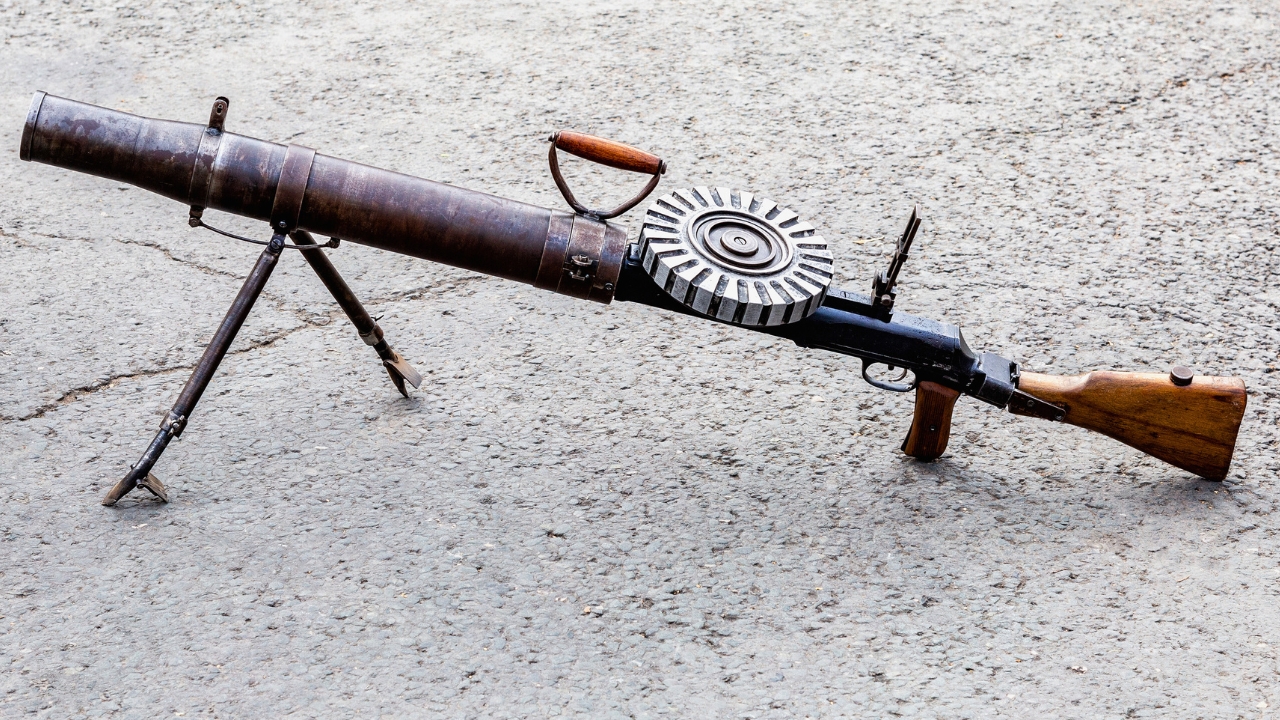
9. Lewis Gun

The Lewis Gun was air-cooled and magazine-fed at a time when most machine guns were water-cooled beasts. Its top-mounted pan magazine and barrel shroud gave it a unique look, but it wasn’t just for show.
It was light enough to be carried and fired by one man, which made it a favorite in WWI and beyond. Not bad for something designed in 1911.
10. Tavor X95

Israel’s Tavor X95 showed up with a plan—keep things short and maneuverable without giving up accuracy or power. The bullpup design helped with that, and it came with modern rails and controls that actually made sense.
It’s still new enough to feel “current,” but the layout and features put it miles ahead of other rifles in its class when it first rolled out.
*This article was developed with AI-powered tools and has been carefully reviewed by our editors.