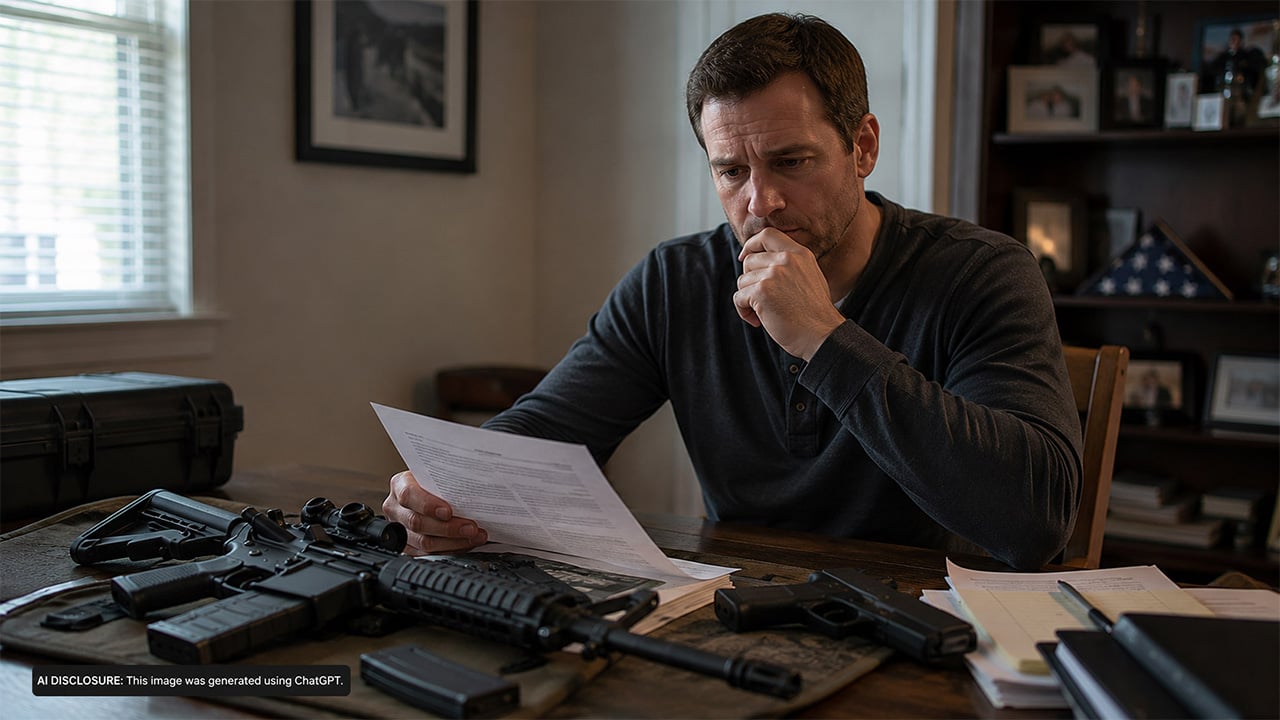
Photo credit: AI-generated image created using ChatGPT. Illustrative only
Divorce paperwork has a way of turning everyday stuff into line items, and sometimes those line items get oddly specific. One father, still waiting on a judge to sign everything and make it official, said his marital dissolution agreement included a request from his ex for “an AR15, .45 and ammo.” That’s it—no brands, no serial numbers, no “the one from the safe on the left.”
In the original post, he explained the catch: he owns several AR-15s, several .45s, and plenty of ammo. With no details in the agreement about which guns or how much ammunition, he’s left wondering whether he can hand over any AR-15 and any .45 he owns—and what “ammo” even means when nobody put a number on it.
When a settlement asks for “an AR-15,” that can mean a lot of rifles
If you’ve been around gun folks for more than five minutes, you know “AR-15” isn’t one single thing. It’s a platform. A person can have a basic, no-frills carbine set up for coyotes and predators, a heavier rig for bench work, and a lightweight build for walking fence lines—three rifles that all technically satisfy the words “an AR15.”
That’s what makes vague settlement language feel like stepping into mud. The agreement doesn’t just decide who gets what; it decides what you’re giving up. And if the firearm request doesn’t specify a particular make/model or otherwise identify the exact gun, it leaves the owner trying to interpret a document that was supposed to settle things cleanly.
“.45” is even messier—caliber isn’t a model
The same problem gets worse with “.45.” That could be a .45 ACP 1911, a polymer .45 carry gun, or even a .45 Colt revolver depending on what someone owns and how they talk about it. Most outdoorsmen I know say “my .45” and mean a specific pistol, but the paperwork doesn’t always speak the same language as the gun cabinet.
In this situation, the father said he owns several of each. Without a description that nails down which one—stainless vs. blued, optics-ready vs. iron sights, compact vs. full-size—he’s essentially being told to transfer “a category,” not a clearly identified firearm. That’s a recipe for disagreement later, especially if the ex believes she had a particular gun in mind.
Ammo requests are where things can really spiral
Asking for “ammo” sounds simple until you’re the one loading cases into a box. Is it one magazine’s worth? A single box? A full ammo can? The post makes it clear there was no amount specified, and that’s where a lot of guys get nervous—because ammunition is easy to store, easy to value differently, and easy to argue about.
Ammo also isn’t one-size-fits-all. An AR-15 might be fed 5.56 NATO or .223 Remington, and a “.45” might take .45 ACP or something else entirely depending on the handgun. Even if you assume the most common pairings, the question still stands: how much is enough to say you complied with the agreement and didn’t short the other party?
The gun-owner reality: you can’t treat this like swapping a set of wrenches
Firearms aren’t like household goods where you can toss any toaster in a tote and call it good. Depending on where a person lives, there may be legal steps around transferring firearms, and those steps can differ based on the type of firearm and who is receiving it. Even when it’s between two people who used to be married, it may not be as simple as “here you go.”
There’s also the practical side that gun owners understand: once a firearm leaves your possession, it’s gone. If you hand over a better rifle or a more valuable .45 than the agreement truly intended, there’s no easy “undo” button. On the flip side, if you hand over the cheapest options you own, you might satisfy your own reading of the agreement and still end up right back in conflict because the other side expected something different.
The question underneath the question: compliance, not cleverness
The most telling part of the father’s post wasn’t anger or name-calling—it was him searching for a straight answer. He asked whether he can give “any of the firearms she asked for” and “how much of the ammo” he should provide. That’s a compliance question. He’s looking for a way to do what the paperwork says without donating more than it actually requires.
But it’s also the kind of situation where being “technically right” can still cost you. Vague terms invite disputes, and disputes invite more legal bills and more time. If the agreement is still pending a judge’s signature, that window matters, because unclear language is easiest to fix before everything is finalized. Once it’s stamped and signed, every argument tends to get harder, not easier.
What outdoorsmen can learn from this before they ever see a courthouse
Whether you’re married, divorced, or just trying to keep your life squared away, this is a good reminder that guns should be treated like other serious assets. Lists beat memories. Specific descriptions beat nicknames. And “one AR-15” is not the same thing as “the black 16-inch AR with the red dot and sling.”
If you ever find yourself putting firearms into any kind of formal agreement, the cleanest path usually looks like this: identify the exact firearm, define the ammo amount in plain numbers, and make sure the transfer is handled in a way that doesn’t create new problems. That’s not about being difficult—it’s about keeping the paperwork from becoming a new kind of argument that follows you long after the divorce is final.
Like The Avid Outdoorsman’s content? Be sure to follow us.
Here’s more from us: