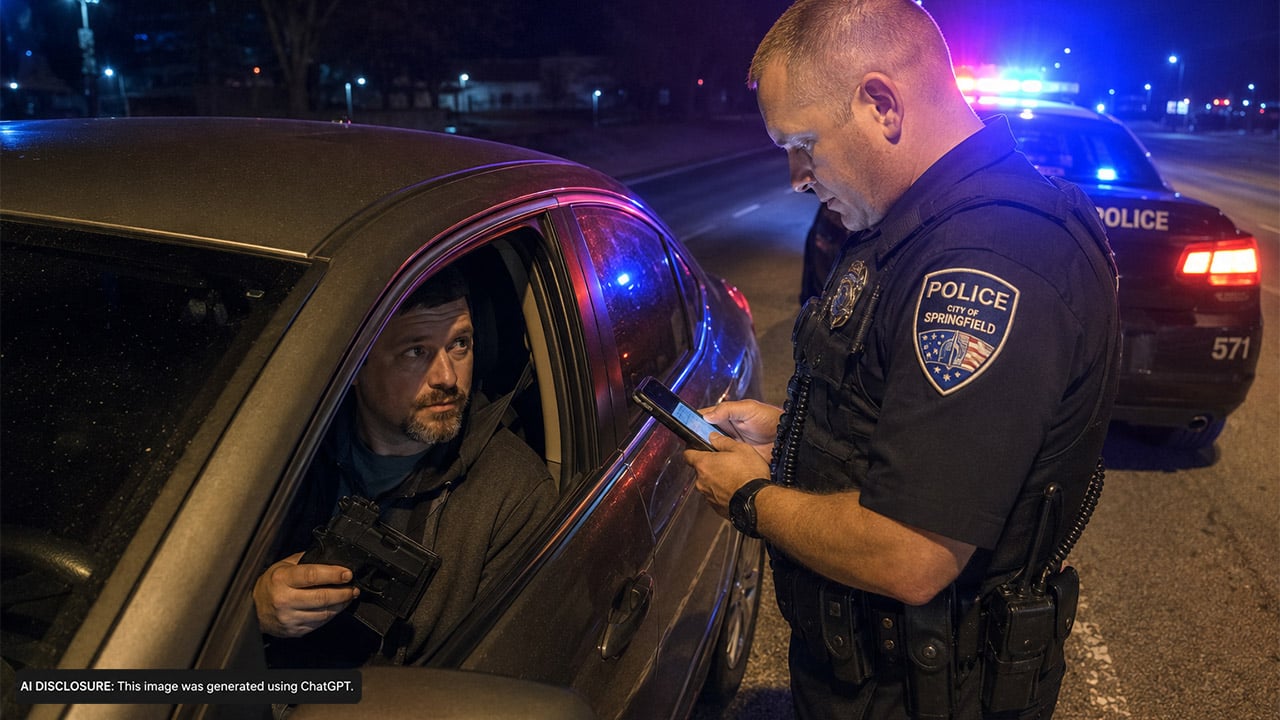
Photo credit: AI-generated image created using ChatGPT. Illustrative only
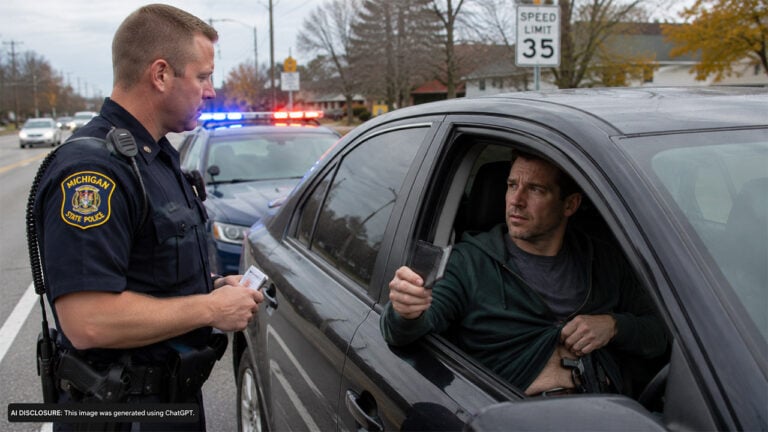
A lot of us have been there: you’re headed home after dark, minding your business, and suddenly you’ve got blue lights in the mirror for something you didn’t even know was wrong. In the original post, one concealed carrier described a nighttime traffic stop that turned into a hands-on gun check, a serial number run, and an officer deciding how the gun would be returned.
The driver wasn’t trying to make a scene. He was trying to do what most permit holders do—be calm, be clear, and keep everybody safe. But once he disclosed he was armed, the stop shifted fast, and it left him wondering where “officer safety” ends and where rights start getting thin.
The stop started with a minor equipment issue
The driver said he was on a multi-lane road at night when he pulled up to a stoplight. He noticed an empty lane next to him, signaled, and moved over to be first in line. A patrol car had moved in behind him, then ended up behind him again after the light.
After a few blocks, the officer lit him up and initiated a stop. The stated reason: both license plate lights were out. The driver suspected the officer thought the lane change looked suspicious and used the tag lights as an excuse, but either way, the encounter was now a routine traffic stop—at least at the beginning.
Retrieving a wallet turned into the “weapons” question
When the officer approached, he asked for license and registration. The driver told him his wallet was in his back pocket and asked if he could retrieve it. That’s a pretty common move from gun owners who are trying to keep hands visible and avoid surprises.
According to the driver, that seemed to make the officer more wary, not less. The officer then asked if he was carrying any weapons. The driver replied that he had a concealed carry permit and was carrying that night, even though his state doesn’t require notification unless asked.
Disclosing the carry gun changed the tone fast
Once the driver confirmed he was armed, the officer asked where the weapon was. The driver told him it was in his right hip pocket, and he identified it as a Kel-Tec P32.
At that point, the officer told him he would require the gun to be surrendered for the duration of the stop. He directed the driver to step out, put his hands on the roof, and then frisked him. The officer removed the pistol, dropped the magazine, and cleared the chamber. The driver noted it wasn’t chambered anyway, but the bigger point was that the officer had taken full control of the firearm.
The serial number check was the moment that raised eyebrows
After disarming him, the officer had the driver sit on the hood of the patrol car while he checked to make sure the gun wasn’t stolen. That’s the part that stuck with the driver—because from his perspective, there wasn’t probable cause that the gun was stolen. It was simply present, lawfully carried, and disclosed when asked.
Hunters and concealed carriers tend to understand the difference between a quick “let’s keep this safe for a minute” disarm and turning the stop into an investigation about the firearm itself. The driver’s question was straightforward: can an officer run a gun’s serial number through a database just because the gun exists during a traffic stop?
Even when you’re doing everything right, it’s a strange feeling to watch your personal property—especially a legally carried sidearm—treated like potential evidence. And in the real world, you can be “right” and still be stuck on the shoulder of the road while it plays out.
The officer decided how the gun would be returned
The stop didn’t end with the officer simply handing the pistol back and letting the driver go on his way. The driver said the officer told him he wasn’t comfortable handing it back loaded.
Then came another escalation: the officer told him—didn’t ask—that he was going to open the trunk, place the gun on the floor, and the driver could retrieve it after the officer pulled away. The driver briefly considered stating, “I don’t consent to any searches,” but worried that would lead to more detention time and possibly a full search anyway.
The driver said his trunk had nothing but two camping chairs. Still, it bothered him on principle, and he pointed out a practical concern many of us share: if the trunk had contained other legally purchased firearms, he suspected the officer would have run those serial numbers too.
What this looks like from an outdoorsman’s perspective
If you’ve spent time hunting public land, traveling to camp, or rolling through small towns on the way to the lease, you’ve probably learned that “simple” interactions with law enforcement can get complicated the moment a firearm enters the picture—even when the firearm is legal, holstered, and disclosed.
There are a few practical lessons buried in this kind of stop. First, it’s worth checking your own vehicle equipment more often than most of us do—tag lights, brake lights, and turn signals. A burned-out bulb is an easy reason to get stopped, and even if the stop stays polite, it’s still a risk you didn’t need on your way home.
Second, the driver did a couple things that are generally smart: he asked before reaching for his wallet, and he answered the weapon question directly. Where things get tricky is when an officer moves from “keeping hands safe” to “taking possession, investigating, and deciding what happens next,” including accessing parts of your vehicle you didn’t open yourself.
And third, there’s the “time and place” reality. On the roadside at night, most folks aren’t going to argue constitutional law with a uniformed officer who already has their gun. People want to go home. That’s not surrendering your rights; it’s recognizing that the shoulder of the highway is a bad courtroom.
In the end, the driver’s final question—“Should I have done anything differently?”—is the one most lawful carriers ask after a stop like this. The best answer is usually the unsexy one: keep your equipment squared away, keep your hands visible, communicate clearly, and if you believe something crossed a line, handle it later through proper channels instead of trying to win the debate while you’re still standing next to your door at night.
Like The Avid Outdoorsman’s content? Be sure to follow us.
Here’s more from us: