Photo credit: AI-generated image created using ChatGPT. Illustrative only
A bad motorcycle wreck can turn your whole life into paperwork in a hurry. One minute you’re just trying to get home safe, and the next you’re on a stretcher watching strangers make decisions for you—about your body, your property, and in this case, your carry gun.
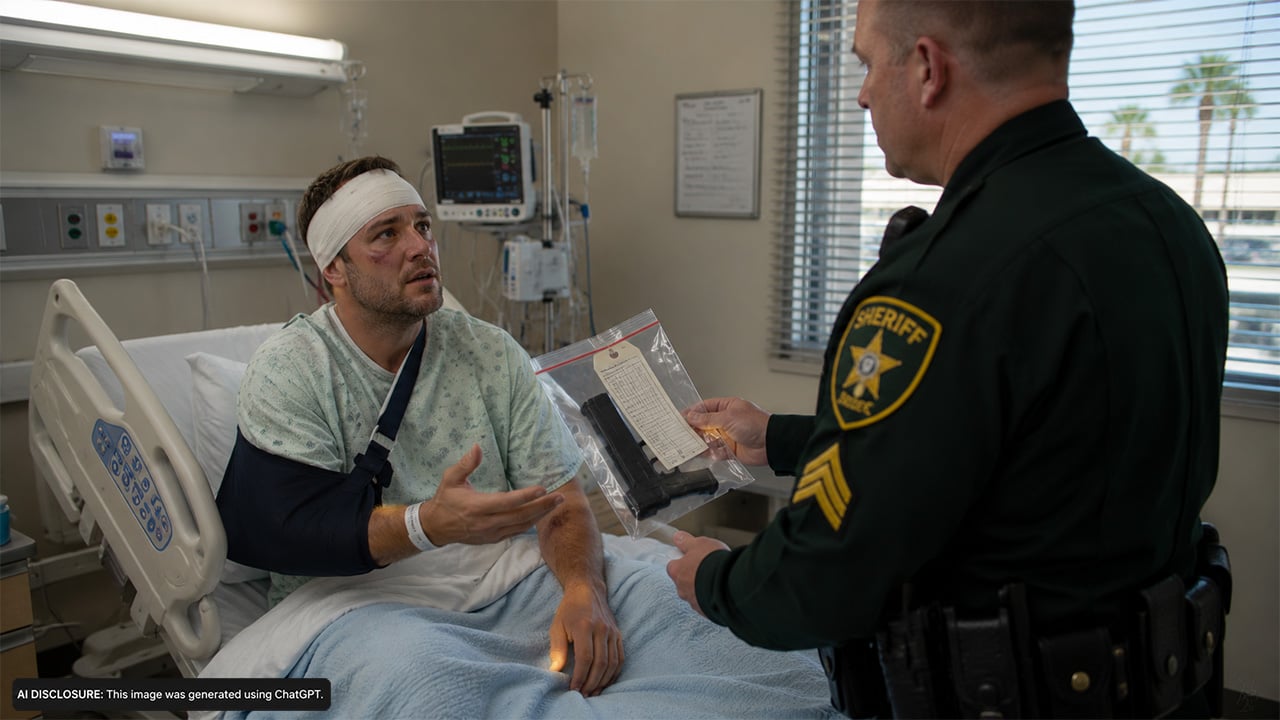
That’s the bind a 24-year-old Florida concealed carrier described in the original post: a deputy took his handgun for “safekeeping” at the crash scene while he was incapacitated. Three months later, he said he still couldn’t get it released.
The crash, the tourniquet moment, and a gun that vanished into “evidence”
According to the account, the rider was hit in a left-turning vehicle situation while he was on his motorcycle. He was carrying appendix in a sidecar-style holster, and the impact left him with a severe leg injury that made him unable to secure the firearm himself.
He wrote that the first sheriff’s deputy on scene rendered first aid and noticed the gun. The deputy reportedly told him calmly he was going to remove the holster and firearm and keep it safe. In shock and pain, the rider agreed—something he later called an “oversight.” That agreement, made in a moment where he didn’t have much choice, set the table for everything that followed.
From hospital discharge to a “background check” that didn’t make sense
The rider said he was transported to a trauma center and was in surgery within 30 minutes of arriving. The hospital, he wrote, ended up with only his spare magazine (with the rounds still inside) for safekeeping—while the pistol went with law enforcement.
During surgery, he said his father met the deputy. His father was told he could pick the firearm up at the station. Instead, the next day his dad came back with a piece of paper with “evidence” and a phone number written on it—meaning the gun wasn’t being treated like lost property or a simple safekeeping hold. It was in the evidence system.
About three weeks later, once discharged, he called the number and was told they needed his personal information to run a background check (name, date of birth, Social Security number). He reluctantly provided it, expecting an approval or disapproval within five business days.
That process raised his eyebrows for two reasons: he said there was no criminal case, and he wasn’t at fault for the crash. And from a gun-counter perspective—he works at a gun store/range—he’s used to background checks coming back quickly, especially for someone who already holds a Florida Concealed Weapons License.
“The case has to be closed”—even though he says there was no case
After 9–10 days with no call, he followed up and was told something different: the firearm could not be released from evidence until the “case” was closed. That’s where frustration turned into a stalemate.
From his perspective, there wasn’t a case to close. He described no arrest, no charges, and no continued law enforcement involvement after the night of the wreck. The gun was taken because he was incapacitated—not because it was tied to a crime.
He said he continued calling over the next month and got the same answer with little explanation: “it is what it is, nothing we can do.” Anyone who’s ever tried to get a tag office to fix a typo knows the feeling—except this isn’t a license plate. It’s a defensive tool with real dollar value and real personal value.
Trying to reach the deputy who took it, and getting nowhere
Eventually, he asked to speak directly with the deputy who removed the firearm at the scene. He said he was given the deputy’s name and district number, called the department, and was told the deputy was busy. He left a message and was told to expect a call back within a few days.
He wrote that no call ever came. By that point, he was considering getting his lawyer involved. He also mentioned there is a pending personal injury claim being handled between his lawyer and the other driver/insurance, but he didn’t believe that had anything to do with the gun sitting in evidence.
From the outside looking in, this is the part that would have most folks grinding their teeth. You’re not asking for special treatment—you’re just asking to retrieve lawfully owned property that was taken under the banner of “keeping it safe.” And the only answers you’re getting are procedural brush-offs.
Why the details of the firearm mattered to him
This wasn’t a beat-up pocket pistol he wouldn’t miss. He described the handgun as a Glock 19 Gen 5 MOS that he had effectively turned into a Glock 45 by trading frames with his father—something he said is legal in Florida. The end result is a pistol with two different serial numbers: one on the frame and one on the slide.
He also listed a Radian Ramjet + Afterburner barrel/comp setup, an RMR on the slide, a SureFire X300, and a custom backplate engraved with the Flag of Blackbeard. Regardless of what you run, anybody who carries understands the point: the gun you set up, vet, and trust isn’t just “a firearm.” It’s your firearm, tuned to you, and it isn’t cheap to replace.
Those details also hint at another practical worry—mix-ups. When a gun goes into an evidence room with nonstandard configurations, aftermarket parts, and a story that doesn’t fit a neat checkbox, it becomes even more important that whoever is holding it documents it correctly and returns the right item in the right condition.
What gun owners tended to focus on: documentation, property receipts, and the “evidence” trap
The rider’s story highlights a hard lesson for anyone who carries in the real world: even when law enforcement does the right thing in the moment—securing a firearm at a chaotic scene—the follow-through can get swallowed by bureaucracy. Once something is logged as “evidence,” it often stops being treated like simple property, even when there’s no criminal charge behind it.
He didn’t mention receiving a formal property receipt at the scene, just the “evidence” note and phone number his father was given later. That’s a detail that matters, because the more paperwork you have tied to a serial number, the harder it is for a system to stall you out with vague answers. It also matters that he attempted the polite route: calling, waiting, calling again, and trying to reach the deputy directly.
He also flagged a reality most outdoorsmen recognize: when you’re injured, you’re not thinking about chain-of-custody forms. You’re thinking about staying conscious and keeping your leg attached. But once the emergency passes, you’re left to deal with the administrative side of a decision you made under duress.
In the end, his situation is a reminder that “we’ll keep it safe” can turn into “we can’t release it” faster than it should—especially when the item is a firearm and the agency defaults to the evidence process. If you carry regularly—whether it’s to the feed store, the boat ramp, or down a dark highway—this is one more reason to keep your serial numbers documented, keep your purchase records handy, and know that sometimes the hard part isn’t the accident. It’s what happens after the ambulance leaves.
Like The Avid Outdoorsman’s content? Be sure to follow us.
Here’s more from us: